
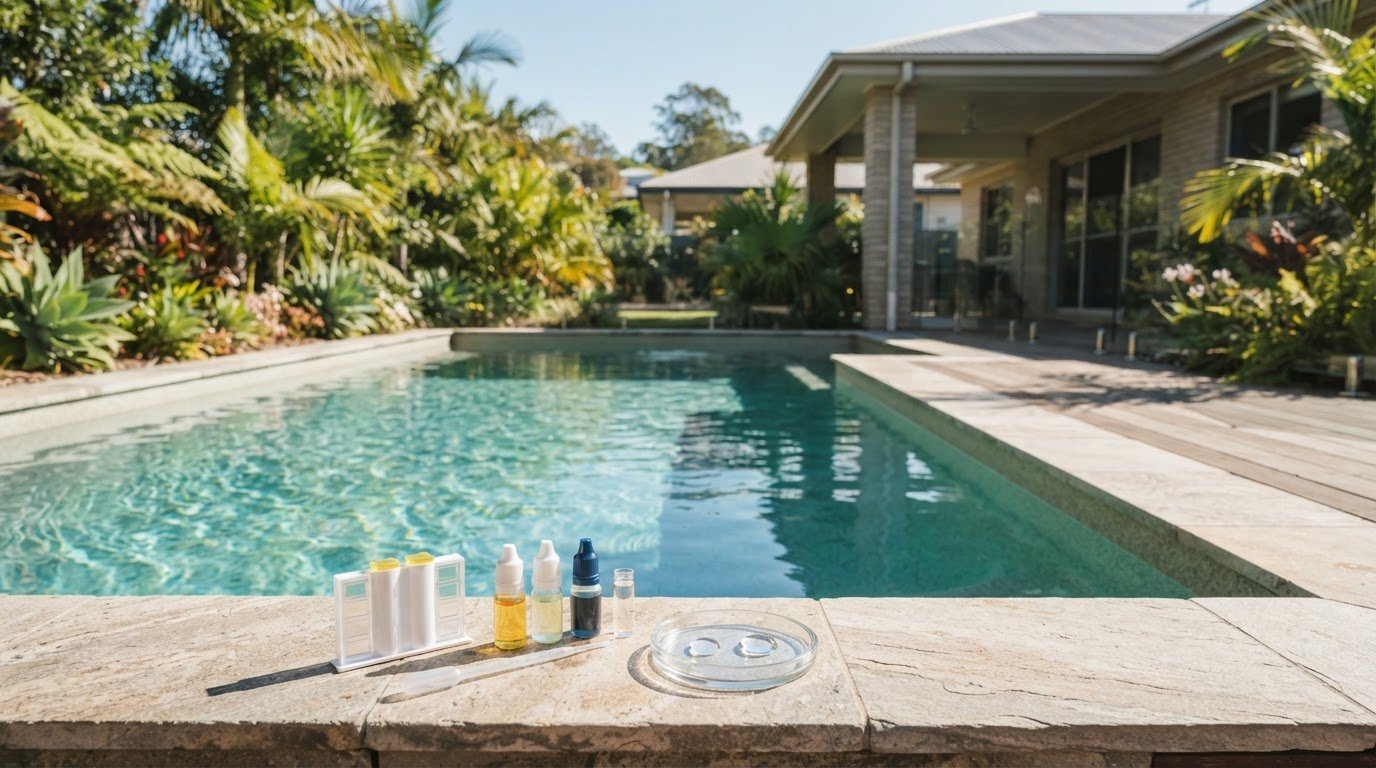
What if the reading that helps keep your pool’s pH steady isn’t the pH reading at all? Water alkalinity is easy to confuse with pH, but the two measure different things. Knowing the difference makes it easier to interpret a test result and decide what to check next.
If your pool water seems hard to keep balanced, you’re not alone. Total alkalinity acts as a buffer, helping resist sudden pH changes. For most pools, the recommended total alkalinity range is 80-120 parts per million (ppm), while the recommended pH range is 7.2-7.6. A result outside these ranges is a cue to test carefully and make measured adjustments, not to guess or add a large amount of chemical.
This guide explains what total alkalinity measures, how it affects pH, and what high or low readings can mean for water comfort, clarity and pool equipment. You’ll also learn why it’s generally best to balance alkalinity before adjusting pH, then retest to check the result. If readings remain difficult to control, Pool Blitz provides expert water balancing for Brisbane pools.
Key Takeaways
- Total alkalinity and pH measure different aspects of pool water, and both readings matter.
- Use alkalinity results to understand possible chemistry effects. Treat symptoms such as pH swings or scale as clues, not proof of the cause.
- Take a representative sample, record the result, make measured adjustments and retest before making another change.
- Consider rain, water replacement, pool use and chemical additions when readings change, especially after significant weather or water changes in Brisbane.
- If balancing remains difficult, expert water balancing can help bring more consistency to pool care.
What Is Water Alkalinity in a Pool, and Why Does It Matter?
Total alkalinity measures a pool’s capacity to resist rapid changes in pH. It measures buffering, not pH itself. Put simply, total alkalinity is the water’s reserve against sudden shifts in acidity, helping pH stay steadier as conditions change.
In pool water, bicarbonate is the main contributor to this buffering capacity. The broader scientific definition of alkalinity is the capacity of water to resist acidification. For pool care, this explains why an alkalinity reading is useful: it shows how strongly the water can resist changes, not its current pH.
How Is Total Alkalinity Different from pH?
pH tells you how acidic or alkaline the water is when you test it. Total alkalinity tells you how much buffering capacity is available to resist a change in pH. The readings are related, but they measure different things, so one can’t replace the other.
For example, adding an acidic pool chemical can lower pH and may also affect total alkalinity. How much each reading changes depends on the water and the product used, so they won’t necessarily move in step. Chlorine is different again: it sanitises pool water, but it isn’t another name for pH or alkalinity.
Why Does Pool Water Need a Stable Alkalinity Level?
Suitable buffering generally makes pH more predictable as pool conditions change, which can make routine water care easier. If buffering is too low, pH may be more prone to swings. If it’s too high, pH can be harder to adjust. Neither reading explains every change on its own, so test both for a clearer picture.
Balanced water also supports a more comfortable swim and helps protect pool surfaces and equipment. In premium landscape and pool design, specialists such as Kultgarden emphasise the importance of thoughtful construction and water systems to safeguard installations over time. Poor overall balance may contribute to irritation or corrosion, while scaling can occur when several water conditions combine. These signs don’t prove alkalinity is the cause: sanitiser levels, pH, hardness and other factors can also play a part. Compare the readings before deciding what needs attention.
How Water Alkalinity Buffers pH and Interacts with Pool Chemistry
Total alkalinity influences how readily pool pH changes, but it doesn’t hold pH fixed. In many pools, bicarbonate ions make up most of the buffering system. They can take up or release hydrogen ions as conditions shift, moderating the effect on pH. Think of alkalinity as a shock absorber: it softens some of the bumps but can’t prevent every movement.
Alkalinity helps moderate changes in pool pH by giving the water a buffer against sudden shifts. This matters during routine care because repeated pH corrections can make water chemistry harder to manage. If pH keeps moving, several careful adjustments and retests may be needed. Alkalinity is part of the explanation, but it’s not the only factor that affects pH.
What Does Bicarbonate Do in Pool Water?
Bicarbonate is a major contributor to total alkalinity in many pools. It acts as a chemical reserve that can respond when acids or bases enter the water, reducing the size of some pH swings. The buffer has limits: rain, chemical additions and other changes can still move pH, particularly when the pool’s overall balance is out of range.
Alkalinity shouldn’t be mistaken for cleanliness or sanitising strength. A pool can have a suitable alkalinity result and still need attention to pH or chlorine. Test and interpret each reading separately rather than assuming one result means the others are also right.
Does Pool Alkalinity Affect Chlorine Performance?
Alkalinity affects chlorine management indirectly, through its influence on pH stability. pH itself affects how effectively chlorine sanitises: as pH rises, chlorine’s sanitising action can become less effective. When pH is steadier, it’s easier to make informed chlorine adjustments and maintain consistent care. Alkalinity doesn’t tell you how much chlorine is present, so chlorine needs its own test.
Think of the readings as related but separate checks. Test total alkalinity to assess buffering, pH to check the water’s current acidity or alkalinity, and chlorine to assess sanitiser level. If one is out of range, don’t assume the others need the same adjustment.
For more on managing sanitiser in local conditions, read our guide to pool chlorine levels in Brisbane heat. If readings remain difficult to interpret or keep stable, expert pool water balancing can help you work through the chemistry with measured adjustments.
Low vs High Water Alkalinity: How to Read the Signs
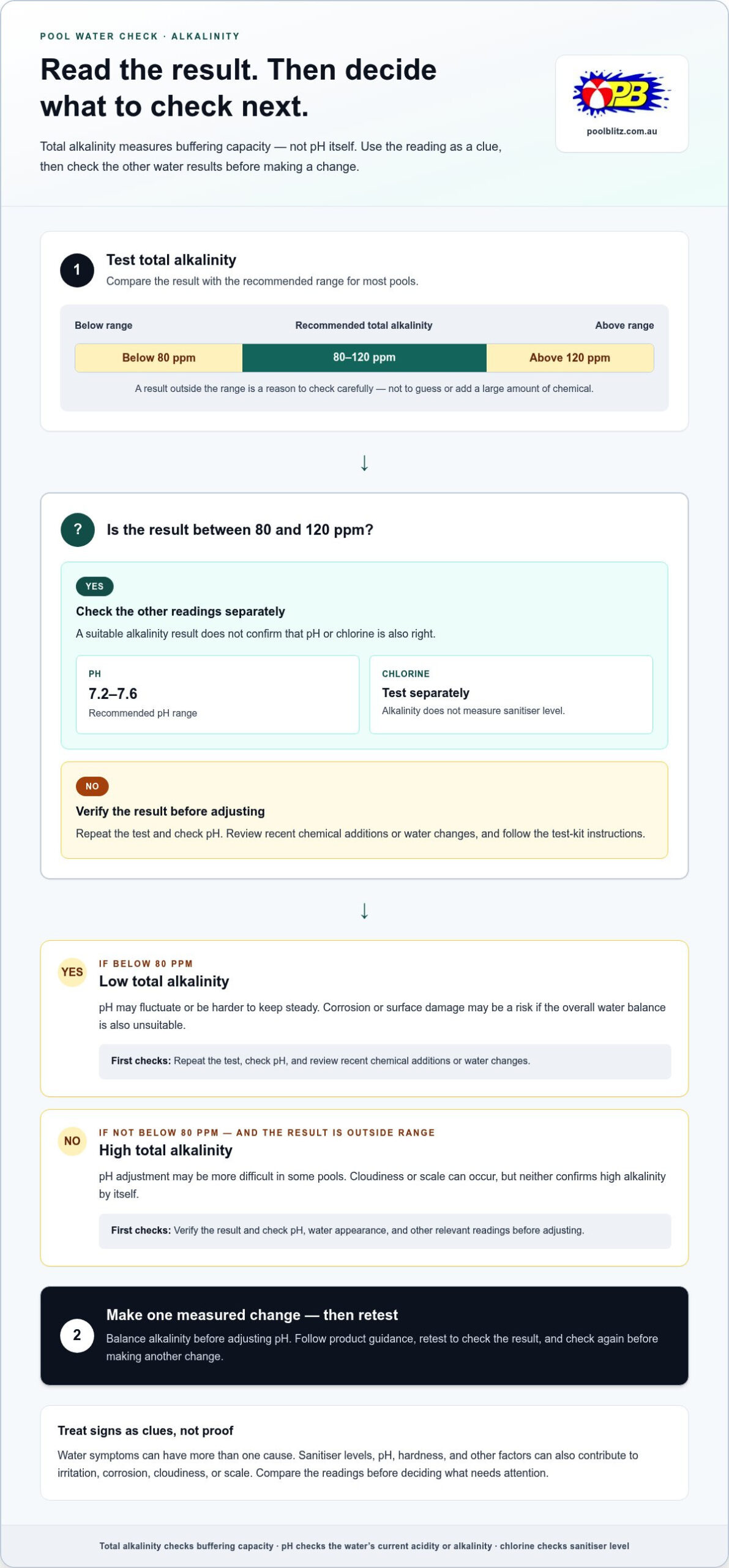
A test result is a useful starting point, not a diagnosis on its own. A common recommended total alkalinity range for pools is 80-120 parts per million (ppm). Use your test-kit instructions and the guidance for the chemicals you use to decide whether a result needs adjustment.
Low and high readings can affect how manageable pH is, but visible signs are only clues. Use the comparison below to decide what to check next, rather than treating a symptom as proof of a particular chemistry problem.
| Reading | Possible chemistry effects or clues | First checks |
|---|---|---|
| Low total alkalinity | pH may fluctuate or be harder to keep steady. Corrosion or surface damage may be a risk if the overall water balance is also unsuitable. | Repeat the test, check pH and review recent chemical additions or water changes. |
| High total alkalinity | pH adjustment may be more difficult in some pools. Cloudiness or scale can occur, but neither confirms high alkalinity by itself. | Verify the result and check pH, water appearance and other relevant readings before adjusting. |
What Can Happen When Pool Alkalinity Is Too Low?
With less buffering capacity, pH can be more susceptible to movement and may seem to swing after chemical additions or other changes. If the water is also poorly balanced, corrosion or surface concerns may arise, though low alkalinity alone doesn’t guarantee damage. For pool installations and custom concrete structures, specialists such as Santarossa Group emphasise that protecting finishes from etching begins with consistent water balance. Before adding a chemical, take a fresh sample and confirm the reading according to your kit’s instructions.
What Can Happen When Pool Alkalinity Is Too High?
High alkalinity can make pH harder to adjust in some pools. Cloudy water or scale may also prompt a closer look, but these signs can have other causes. Check the result alongside pH and the pool’s appearance, and consider whether recent top-ups or chemical additions could have affected the readings.
Fluctuating pH, cloudiness and scale are clues, not definitive diagnoses. Results are more useful when you collect and handle the sample as directed, then compare readings with relevant product guidance. If a result seems unexpected, repeat the test before making a change. A measured response is safer than trying to correct the water based on appearance alone.
How to Test and Adjust Pool Water Alkalinity Safely
A reliable adjustment starts with a reliable test. Pool water alkalinity results are most useful when you collect the sample correctly, follow your kit’s method and make one measured change at a time.
- Collect a representative sample. Follow the kit’s instructions for where and how to take the sample. Avoid testing water immediately beside a return jet or just after adding chemicals, unless the instructions say otherwise.
- Test and record. Check total alkalinity and note the result, date, and any recent chemical additions or water changes. Follow the kit’s timing and reading instructions carefully.
- Choose a measured adjustment. Use the product label to determine whether the chemical is appropriate for your pool and how to apply it. Don’t estimate a dose without knowing pool volume, the current result and the product concentration.
- Retest before making another change. Allow the product to circulate for the period stated on its label, then test again as directed. This shows the effect of the first adjustment before you decide on the next step.
Never mix pool chemicals. Read and follow all label directions and safety precautions, and store and handle chemicals as directed. If instructions are unclear or readings remain confusing, pause rather than adding more product.
How Often Should You Test Pool Alkalinity?
Set a consistent routine that reflects how often the pool is used, local weather and the instructions for your test kit and pool products. Testing after heavy rain, a significant water top-up or a major chemical adjustment can also help you see whether readings have changed. Follow the kit’s guidance on when to test after treatment.
What Raises or Lowers Total Alkalinity?
Sodium bicarbonate is commonly used to raise total alkalinity. Acid products can lower alkalinity, but they also lower pH, so use them with care and accurate testing. Product strength and pool conditions vary, making a generic dose unsuitable for every pool. Follow the product label and retest before considering another adjustment.
If you’re unsure how to interpret results or the readings keep shifting, Pool Blitz provides professional pool maintenance and expert water balancing. Learn about expert pool water balancing.
Managing Water Alkalinity in Brisbane Pools with Consistent Water Balancing
Pool chemistry can shift over time, even when a pool has been balanced recently. Rain, water top-ups, swimmer activity and chemical additions may all affect readings, so an alkalinity result is a snapshot, not a permanent setting. In Brisbane, retesting after significant weather or a water change helps you see what has actually changed before deciding whether an adjustment is needed.
Reliable alkalinity management depends on testing, measured adjustment and retesting. This steady approach helps avoid reacting to a single symptom or adding chemicals based on an assumption. Keep a simple record of readings and notable changes, such as heavy rain or topping up, to spot patterns in your pool over time.
What Brisbane Pool Owners Should Watch After Rain or Water Changes
Heavy rain can add water to the pool and alter its chemistry, while topping up changes the balance according to the water being added. Neither event guarantees that alkalinity will be high or low. Test before adding chemicals, then interpret the result alongside pH and the product guidance you follow. For related local advice, read our Brisbane pool filtration and water-health guide.
Pool use and chemical additions can also influence readings. If results change unexpectedly, consider what has happened since the last test and repeat it according to your kit instructions before adjusting. This extra check can help distinguish a genuine change from a sampling or testing issue.
When Can Professional Water Balancing Help?
Careful testing and label-led adjustments are useful first steps, but some pools remain difficult to stabilise. If readings continue to fluctuate or you’re unsure how to interpret them together, professional support can bring a clearer, more consistent approach. Pool Blitz provides pool servicing and expert water balancing for Brisbane pool owners.
Ongoing support can help when you want a dependable routine rather than repeated guesswork. Explore Pool Blitz pool care.
Keep Your Pool Balance Steady with a Measured Approach
Understanding water alkalinity makes pool care easier to approach with confidence. Alkalinity buffers pH, but each reading tells you something different. Test them separately and don’t treat a symptom such as fluctuating pH or scale as a diagnosis.
When a result is out of range, confirm the test, follow the chemical label and make a careful adjustment before retesting. In Brisbane, rain, top-ups, pool use and chemical additions can all affect readings over time. Check after a notable change so you can respond to the water in front of you rather than guess.
If readings remain difficult to manage, Pool Blitz’s qualified team provides pool servicing and expert water balancing. Pool Blitz is an independent local Brisbane business serving the community for over three decades. Explore Pool Blitz pool care and take the next step towards clearer, more dependable water.
Frequently Asked Questions
Is water alkalinity the same as pH in a swimming pool?
No. pH measures how acidic or alkaline pool water is at the time of testing, while total alkalinity measures its capacity to resist rapid pH changes. The readings are related, but they aren’t interchangeable. An adjustment that affects pH may also affect alkalinity, though the readings won’t necessarily change by the same amount. Test both to understand the water’s current condition and its buffering capacity.
What happens if pool alkalinity is too low?
Low total alkalinity means the water has less buffering capacity, so pH may fluctuate more readily or be harder to manage. If the overall water balance is also unsuitable, corrosion or surface concerns may arise, but low alkalinity alone doesn’t prove damage is occurring. Confirm the result using your test kit’s instructions, then check pH and other relevant readings before making a measured adjustment.
What happens if pool alkalinity is too high?
High total alkalinity can make pH more difficult to adjust in some pools. Cloudiness or scale may also occur, but these signs can have other causes and aren’t proof of an alkalinity problem. Confirm the reading, check pH and consider recent chemical additions or water changes before responding. Follow your test-kit instructions and product guidance rather than adding chemicals based on appearance alone.
How do I raise total alkalinity in my pool?
Sodium bicarbonate is commonly used to raise total alkalinity. First, confirm the test result and compare it with your test-kit instructions and the chemical manufacturer’s recommended range. A commonly recommended pool range is 80-120 parts per million (ppm), but follow applicable product guidance for your pool. Use the label to determine the amount and application method, allow the product to circulate as directed, then retest before making another adjustment.
How do I lower pool alkalinity safely?
Acid products can lower total alkalinity, but they also lower pH, so careful testing and measured use are important. Confirm the reading and follow the product label for application and safety instructions. Don’t estimate a dose without considering pool volume, the current test result and the product’s concentration. Never mix pool chemicals. Allow the water to circulate as directed, then retest before deciding whether another adjustment is needed.
How often should I test water alkalinity?
Set a regular testing routine that suits your pool’s use, local weather and the instructions for your test kit and pool products. Test again after heavy rain, a substantial water top-up or a major chemical adjustment, since these changes may affect readings. Consistent records can help you notice patterns and respond to changes. If results seem unexpected, repeat the test according to the kit instructions before adjusting the water.
Can Brisbane rain affect my pool’s water alkalinity?
Yes, heavy rain can add water to a pool and alter its chemistry, including total alkalinity, but it doesn’t guarantee a particular change. After a significant downpour in Brisbane, test before adding chemicals rather than assuming the reading is too high or too low. Also consider whether the pool has been topped up or recently treated. Use a representative sample and follow your kit instructions to guide the next step.
No responses yet