
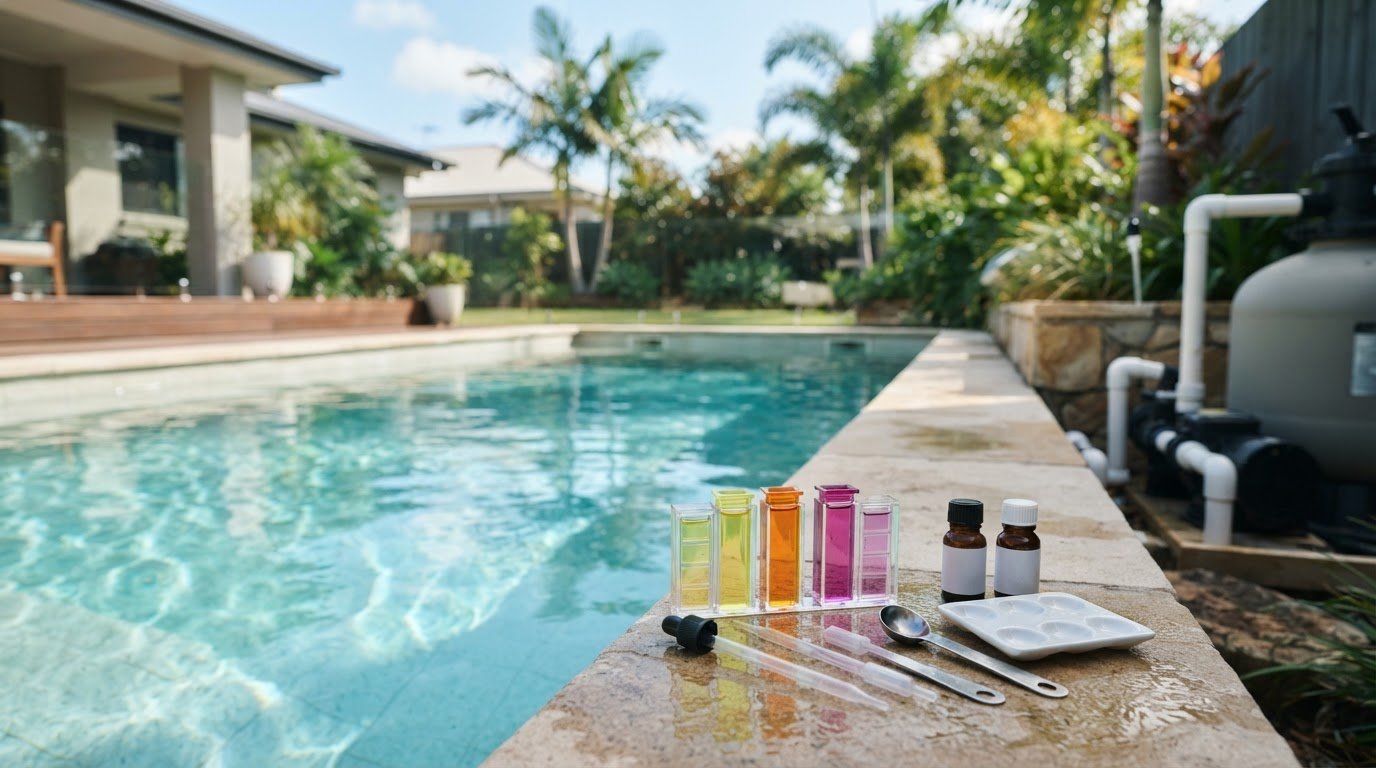
Dumping more chlorine into a cloudy pool rarely solves the problem. Sanitiser efficiency is governed by delicate water balance rather than sheer chemical volume, which is why understanding pool water chemistry is the true foundation of stress-free pool care. If you have spent weekends wrestling with sudden algae blooms, stinging eyes, or confusing test strips, you know how quickly backyard maintenance can feel like expensive guesswork. It is equally frustrating to worry that unbalanced water might be quietly etching your interior surface or corroding your expensive pump and filtration equipment.
Mastering your pool’s balance protects your investment and turns routine maintenance into a predictable, manageable rhythm. By understanding how each chemical parameter functions as part of an interconnected ecosystem, you can safeguard your family’s comfort, prevent unnecessary chemical waste, and keep your water crystal clear through the hottest Australian summers. This guide breaks down how each vital element interacts, giving you the practical knowledge to maintain healthy, sparkling water with total confidence.
Key Takeaways
- Truly understanding pool water chemistry means viewing sanitisers and mineral balance as an interconnected ecosystem that protects swimmer health and skin comfort.
- Maintaining ideal parameters for pH, total alkalinity, and calcium hardness safeguards your interior surfaces and filtration equipment from costly etching or scale build-up.
- Intense Australian sunlight and severe rain events rapidly degrade chlorine reserves, making stabiliser management essential for lasting water clarity.
- Testing water correctly at elbow depth and balancing total alkalinity before adjusting pH prevents chemical waste and stabilises your water profile.
- Persistent water clarity issues often indicate underlying equipment problems rather than simple chemical shortfalls, warranting prompt technical inspection.
The Core Fundamentals: What Pool Water Chemistry Actually Means
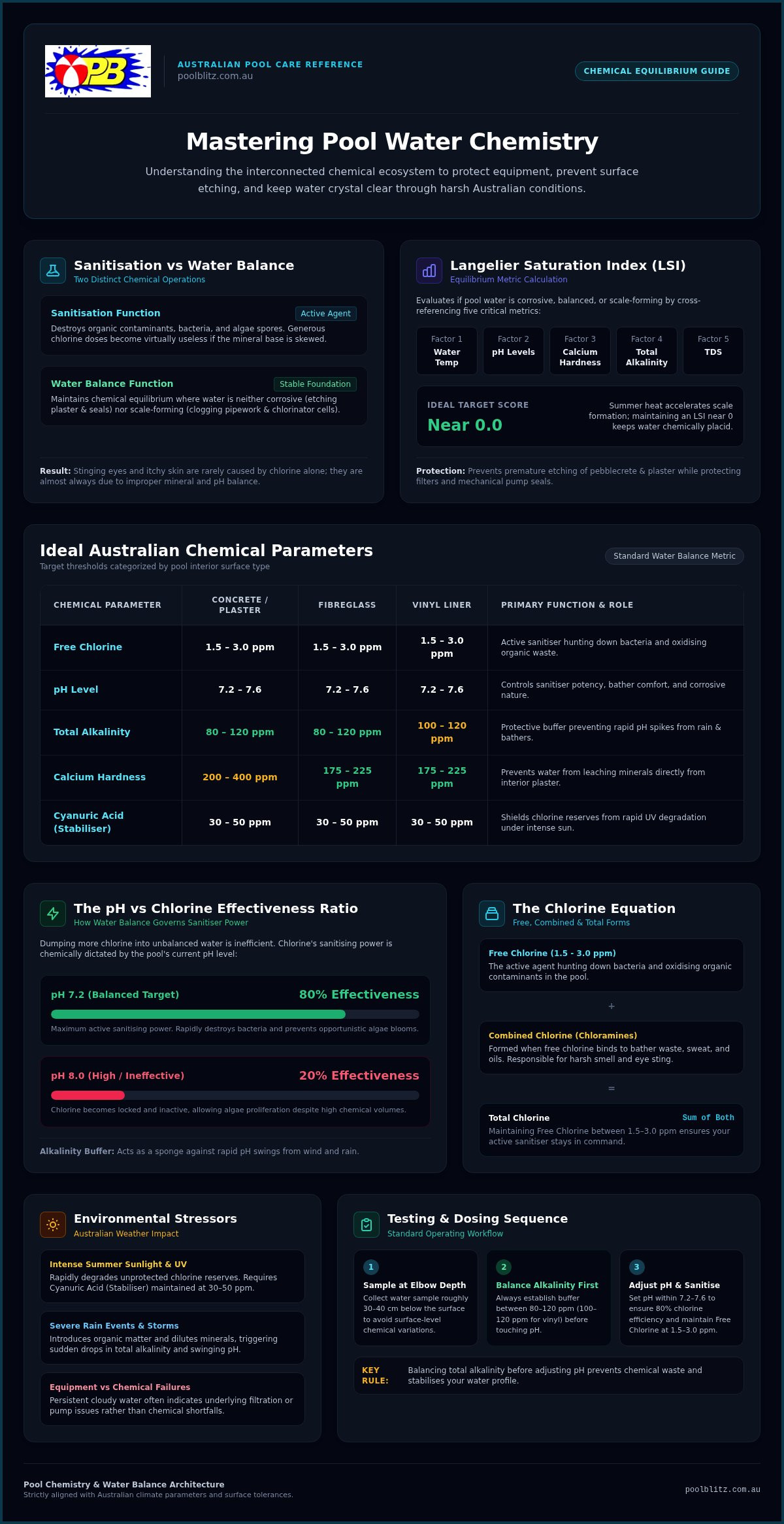
Water is a natural solvent that continually seeks chemical equilibrium. In a swimming pool, water balance is the equilibrium where water is neither corrosive nor scale-forming. When this balance is lost, water behaves aggressively. It will satisfy its chemical hunger by leeching minerals directly from your pool plaster, or it will deposit excess minerals onto surfaces as stubborn scale. True mastery begins with understanding pool water chemistry as an active mineral solution, rather than simply clear liquid filled with chlorine.
Unbalanced water exacts a heavy toll on your backyard investment. Acidic water strips heat exchangers, pits pebblecrete, and ruins mechanical pump seals. Conversely, over-saturated water coats chlorinator cells and internal pipework in chalky calcium crusts, choking flow rates and causing filtration systems to work twice as hard. Beyond protecting your equipment, proper water chemistry directly affects swimmer comfort. Red, stinging eyes and itchy, dry skin after a swim are rarely caused by too much chlorine alone; they are almost always the direct result of improper mineral and pH balance.
Sanitisation vs. Water Balance: The Crucial Distinction
Many pool owners confuse killing bacteria with balancing water, yet they represent two distinct chemical operations. Sanitising destroys organic contaminants, bacteria, and algae spores. Water balance creates the stable physical environment required for that sanitiser to do its job. The foundational principles of pool sanitation show that even generous chlorine doses become virtually useless if your mineral base and water parameters are skewed.
The Langelier Saturation Index (LSI) Made Simple
The Langelier Saturation Index (LSI) evaluates whether your water is corrosive, balanced, or scale-forming. This mathematical formula cross-references five distinct metrics:
- Water temperature (higher summer heat accelerates scale formation)
- pH levels
- Calcium hardness
- Total alkalinity
- Total dissolved solids (TDS)
A balanced LSI reading sits right near zero. Maintaining this precise threshold ensures your water remains chemically placid, protecting interior finishes from premature etching while preserving expensive chlorinators, filters, and pumps for years of trouble-free operation.
The Key Chemical Parameters and Their Ideal Australian Ranges
Achieving pristine water requires knowing your specific target numbers. Because our regional climate exposes pools to high temperatures and heavy sun, these values shift rapidly. Truly understanding pool water chemistry requires knowing how ideal thresholds interact across different interior surfaces.
| Chemical Parameter | Concrete / Plaster | Fibreglass | Vinyl Liner |
|---|---|---|---|
| Free Chlorine | 1.5 – 3.0 ppm | 1.5 – 3.0 ppm | 1.5 – 3.0 ppm |
| pH Level | 7.2 – 7.6 | 7.2 – 7.6 | 7.2 – 7.6 |
| Total Alkalinity | 80 – 120 ppm | 80 – 120 ppm | 100 – 120 ppm |
| Calcium Hardness | 200 – 400 ppm | 175 – 225 ppm | 175 – 225 ppm |
| Cyanuric Acid (Stabiliser) | 30 – 50 ppm | 30 – 50 ppm | 30 – 50 ppm |
Free Chlorine, Combined Chlorine, and Total Chlorine
Free chlorine is the active agent hunting down bacteria and oxidising organic contaminants. Once it binds to bather waste, sweat, and oils, it transforms into combined chlorine, commonly called chloramines. These spent compounds generate the harsh chemical smell and stinging eyes often mistakenly blamed on fresh chlorine. Total chlorine represents the sum of both forms; keeping free chlorine steadily between 1.5 and 3.0 ppm ensures your sanitiser remains in command.
PH and Total Alkalinity: The Essential Relationship
Your pool’s pH determines whether chlorine can actually sanitize. At a pH of 8.0, chlorine operates at roughly 20% effectiveness, inviting opportunistic algae blooms. Bring that pH down to 7.2, and sanitising effectiveness rebounds to 80%. Total alkalinity functions as a protective sponge, buffering your water against rapid pH spikes caused by wind, rain, and swimmers. Always balance alkalinity before adjusting pH to prevent volatile chemical swings.
Calcium Hardness and Cyanuric Acid (Stabiliser)
Calcium hardness protects the structural integrity of your pool interior. Hungry, low-calcium water leaches minerals straight out of concrete and tile grout, causing permanent pitting. Cyanuric acid acts as sunscreen for free chlorine. Under blazing UV rays, unstabilised chlorine can vanish within two hours; holding stabiliser between 30 and 50 ppm shields your sanitiser reserve. If balancing these complex ratios feels overwhelming, arranging an expert water balancing service removes the guesswork and preserves your valuable filtration assets.
Environmental Stressors: How Australian Weather Disrupts Pool Balance
Backyard swimming pools in Australia endure brutal environmental extremes. Blistering UV indexes, sudden monsoonal downpours, and sweltering humidity constantly strain sanitiser reserves. In subtropical regions, maintaining clear water requires adapting to external forces rather than simply following a fixed calendar schedule. A firm grasp of understanding pool water chemistry means learning to anticipate how local climate swings degrade your water profile before problems show up on the surface.
Managing Intense UV Exposure and Summer Evaporation
Solar radiation strips unstabilised chlorine with extraordinary speed. On a cloudless 35°C afternoon, solar radiation can wipe out unbuffered free chlorine reserves in less than two hours. Simultaneously, rapid evaporation removes pure water while leaving behind heavy minerals, steadily driving up calcium hardness and total dissolved solids (TDS). You must adjust your chlorinator output and daily pump runtimes to counter this thermal load. Review our Ultimate Brisbane Pool Filtration & Health Guide to properly balance summer filtration runtimes against intense seasonal heat demands.
The Aftermath of Heavy Storms and Rainwater Inundation
Subtropical summer storms dump vast volumes of acidic rainwater into your pool in minutes. This deluge rapidly dilutes chemical levels, dragging down total alkalinity and pH while washing away cyanuric acid. Strong storm winds compound the trouble by blowing in lawn debris, garden fertiliser overspray, and microscopic organic material.
To recover your water after a severe rain event, follow this recovery order:
- Empty skimmer and pump baskets immediately to restore proper system suction.
- Test and restore total alkalinity to re-establish your protective pH buffer.
- Adjust pH to the optimal 7.2 to 7.6 zone.
- Apply a high-strength shock treatment to tackle introduced biological wash.
Bather Load, Cosmetic Oils, and Organic Phosphates
A busy weekend pool party rapidly depletes your chemical buffer. Sweat, body oils, and thick sunscreens immediately latch onto free chlorine, creating irritating chloramines and forming unsightly scum lines along the waterline tiles. Worse, decaying leaves blown from nearby gum trees and garden soil leach dense phosphates directly into the water. Phosphates serve as direct fuel for stubborn green algae blooms. Regular surface skimming, robotic vacuuming, and periodic phosphate removers starve algae of their primary food source, preserving your free chlorine for genuine sanitisation.
The Step-by-Step Testing and Dosing Sequence for Homeowners
Accurate testing depends entirely on proper sampling technique and fresh testing supplies. Dipping a test vial into surface water or sampling right beside a return jet skews your results with unmixed rainwater or concentrated sanitiser. Always plunge an inverted vial down to elbow depth, roughly 30 centimetres beneath the surface, well away from return returns and skimmer boxes. Precise testing forms the practical foundation of understanding pool water chemistry. Crucially, total alkalinity must always be balanced before adjusting pH.
Selecting the Right Testing Equipment
Test strips provide quick spot-checks, but liquid reagent kits using DPD tablets deliver the precision needed to protect your mechanical systems. Strips degrade rapidly in humid subtropical conditions and often struggle with nuanced calcium hardness or stabiliser readings. Keep test kits stored inside a cool, dry cupboard rather than the pool shed, as intense heat spoils chemical reagents and leads to false readings.
The Correct Dosing Hierarchy: What to Add First
Adding chemicals without a structured plan invites mineral precipitation and cloudy water. Always follow this methodical dosing sequence:
- Total Alkalinity: Test and adjust your alkalinity first using sodium bicarbonate to establish a reliable pH buffer.
- pH Level: Dose incrementally with hydrochloric acid to lower pH, or sodium carbonate to raise it, aiming for a stable 7.4.
- Calcium Hardness: Dissolve calcium chloride in a bucket of water before slowly pouring it over the deep end.
- Sanitiser and Stabiliser: Add your chlorine shock or top up cyanuric acid last, allowing the sanitiser to work in an already balanced environment.
Critical Chemical Safety and Application Guidelines
Handling pool chemicals safely demands strict discipline. Never mix raw chemicals together dry; combining different chlorine varieties or mixing acid with dry chlorine causes immediate, volatile reactions and toxic gas releases. Always add chemicals directly to water, never pour water onto concentrated chemicals. Broadcast diluted mixtures around the deep end perimeter with the filtration pump running continuously, allowing at least two to four hours of circulation between additions. If keeping track of this precise sequence feels challenging, you can book regular pool servicing to let qualified technicians handle your water balance safely and efficiently.
Troubleshooting Water Chemistry Pitfalls and When to Call an Expert
Persistent water quality problems often aren’t chemical shortfalls at all. When test strips show erratic results or water turns murky despite repeated chemical doses, the issue usually traces back to mechanical trouble. True mastery in understanding pool water chemistry involves recognising when the water is simply reflecting an underlying hardware failure rather than a lack of additives.
Diagnosing Cloudy Water, Algae Outbreaks, and Chlorine Lock
If your pool consistently tests zero for free chlorine despite pouring in bags of shock, you may be confronting chlorine lock. This condition occurs when cyanuric acid climbs beyond recommended thresholds, binding chlorine molecules so tightly that they cannot sanitise the pool. Adding more sanitiser will not fix it; the only reliable remedy is partially draining the pool and refilling it with fresh mains water. Hazy water can also stem from elevated pH or suspended mineral dust. If cloudy conditions persist despite balanced numbers, consult our Expert Pool Equipment Repairs Brisbane guide to diagnose hidden circulation restrictions or failing valve seals.
Equipment Faults Masquerading as Chemical Failures
A pool’s chemical balance relies entirely on mechanical circulation. A calcified salt chlorinator cell cannot convert saline water into active hypochlorous acid, no matter how many hours the pump runs each day. Similarly, calcified sand filters or torn cartridge pleats allow microscopic silt and dead algae to blow straight back into the pool. Addressing underlying mechanical issues is vital, and our Professional Pool Service Brisbane Guide highlights how routine mechanical checkups resolve recurring water hygiene issues.
The Value of Scheduled Professional Water Balancing
Backyard testing provides a great snapshot, but professional diagnostics track subtle mineral trends before they etch plaster or corrode expensive pump impellers. A complete understanding pool water chemistry includes knowing when experienced hands will save you time, stress, and wasted retail chemicals. Local technicians tailor filtration and sanitisation to Brisbane’s shifting humidity and storm cycles. Contact Pool Blitz to arrange casual water balancing or establish a regular servicing schedule, ensuring your pool stays safe, clear, and perfectly conditioned year-round.
Achieve Lasting Clarity and Trouble-Free Swimming
A sparkling pool should be a place of quiet relaxation, not an ongoing source of frustration. Truly understanding pool water chemistry transforms routine maintenance from stressful guesswork into reliable, predictable care. By keeping your total alkalinity buffered, respecting vital mineral parameters, and guarding sanitiser levels against harsh seasonal downpours, you safeguard expensive pumps, chlorinators, and interior finishes for the long haul.
When you want total peace of mind, experienced support makes all the difference. Backed by over three decades of dedicated pool care experience across Brisbane since 1994, the team at Pool Blitz provides specialist water balancing and equipment servicing tailored to Queensland’s subtropical climate. From caring for salt chlorinators and filtration systems to repairing robotic cleaners, our comprehensive care keeps your backyard oasis running smoothly. Book a professional water balancing service with Pool Blitz today and enjoy clean, comfortable swimming through every season.
Frequently Asked Questions
Why is my pool water cloudy even though the chlorine level reads high?
Cloudiness despite elevated chlorine usually points to inactive sanitiser or filtration issues. When your pH spikes above 7.8, free chlorine loses up to 80% of its oxidising strength, leaving fine debris unoxidised. Alternatively, dirty sand filters or torn cartridges allow tiny particles to bypass filtration. A thorough understanding pool water chemistry shows that sanitiser requires active mechanical filtration and strict pH control to keep water transparent.
What is the difference between total alkalinity and pH in swimming pools?
pH measures how acidic or basic your water is on a 0 to 14 scale, directly determining swimmer comfort and chlorine effectiveness. Total alkalinity measures the water’s capacity to neutralise acid, acting as a defensive buffer against rapid pH fluctuations. Think of alkalinity as an anchor; when it is set properly between 80 and 120 ppm, your pH remains stable instead of bouncing wildly after rain or heavy pool usage.
How does heavy rainfall affect my pool water chemistry in Australia?
Heavy rainfall rapidly dilutes sanitiser levels and washes away cyanuric acid, leaving your pool exposed to rapid UV burnoff. Brisbane storm systems also dump acidic water, pulling your pH and total alkalinity downwards. At the same time, garden run-off introduces soil spores, nitrogen, and organic phosphates. You should always empty your baskets, rebalance alkalinity, and shock the pool promptly following significant subtropical downpours to prevent green algae from establishing.
What causes chlorine lock and how can I fix it in my pool?
Chlorine lock happens when cyanuric acid climbs past safe thresholds, often from prolonged use of stabilised chlorine tablets. The excess stabiliser chemically traps free chlorine, preventing it from sanitising even when test readings show high levels. No balancing chemical can neutralise over-stabilisation. The only reliable remedy is to partially drain the pool and refill it with fresh tap water to dilute cyanuric acid back down into safe operating ranges.
Can unbalanced pool water actually damage my pool pump and filter?
Yes, unbalanced water can silently ruin expensive pool equipment. Corrosive water with low pH eats away at internal rubber seals, metallic heat exchangers, and pump impellers, leading to costly leaks and premature motor burnout. Conversely, scaling water with high calcium hardness coats chlorinator plates and pipe interiors in chalky crusts, restricting circulation. Maintaining precise mineral balance serves as vital long-term insurance for your pump, chlorinator cell, and filtration system.
How often should I test my pool water during the Australian summer?
During a hot Brisbane summer, test your free chlorine and pH at least twice weekly, or after heavy weekend swimming sessions. Intense heat and frequent afternoon storms disrupt sanitiser balance quickly. Total alkalinity, calcium hardness, and stabiliser levels should be tested fortnightly or following significant weather events. Applying a disciplined testing routine ensures you catch minor chemical drifts early, avoiding the substantial chemical volumes needed to recover a neglected pool.
Why do my eyes sting after swimming if the chlorine level is normal?
Stinging eyes are almost always caused by improper pH balance or the accumulation of chloramines, not free chlorine. Human tears sit naturally at a pH of 7.4. If your pool water drops into acidic ranges or climbs too high, eye irritation occurs immediately. Combined chloramines also accumulate when sanitiser binds to sweat and bather waste, producing that harsh stinging sensation. Truly understanding pool water chemistry ensures you maintain the correct pH and oxidise chloramines effectively.
No responses yet