
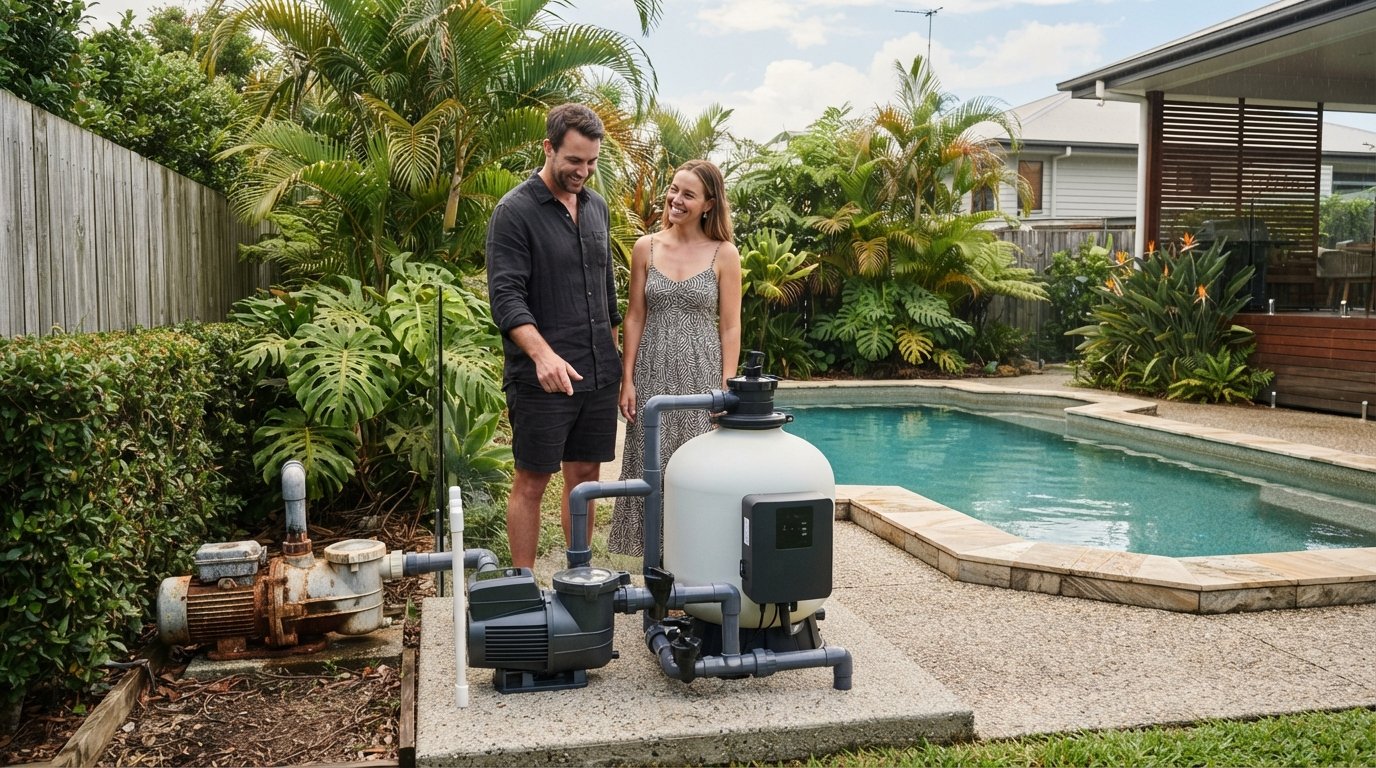
An obsolete single-speed pump can quietly account for nearly a fifth of your home’s total electricity consumption, driving up power bills while struggling against the brutal Queensland heat. If you’re weighing up whether to repair a screeching motor or reconfigure your entire filtration setup, sound Brisbane pool equipment upgrade advice is essential to avoid costly missteps.
It’s exhausting to endure noisy machinery that disturbs the neighbours, especially when heavy subtropical downpours leave your water cloudy and green by Sunday afternoon. You deserve an outdoor living space that offers genuine relaxation, not an endless cycle of chemical firefighting. In this 2026 guide, you’ll discover how to select modern, energy-efficient filtration systems tailored specifically to Brisbane’s sunny aspect and high bather loads, allowing you to slash running expenses and secure pristine water year-round.
We examine the practical criteria between repairing older units and upgrading to quiet, dependable equipment, ensuring you make an informed, confident investment for your backyard.
Key Takeaways
- Recognise early warning signs such as mechanical screeching and climbing power bills before your filtration pad suffers complete failure.
- Discover how variable-speed pumps and advanced glass filter media deliver superior water clarity while dramatically lowering everyday household running costs.
- Use our practical Brisbane pool equipment upgrade advice to weigh the 50 percent rule, helping you decide whether to repair an older unit or invest in a modern replacement.
- Master the sizing criteria needed to protect your water chemistry against intense Queensland UV radiation, high bather loads, and sudden summer storm deluges.
- Follow a clear pad-audit framework to ensure your pipework, sanitation, and electrical connections are optimised for whisper-quiet performance.
Signs Your Brisbane Pool Equipment Needs an Upgrade
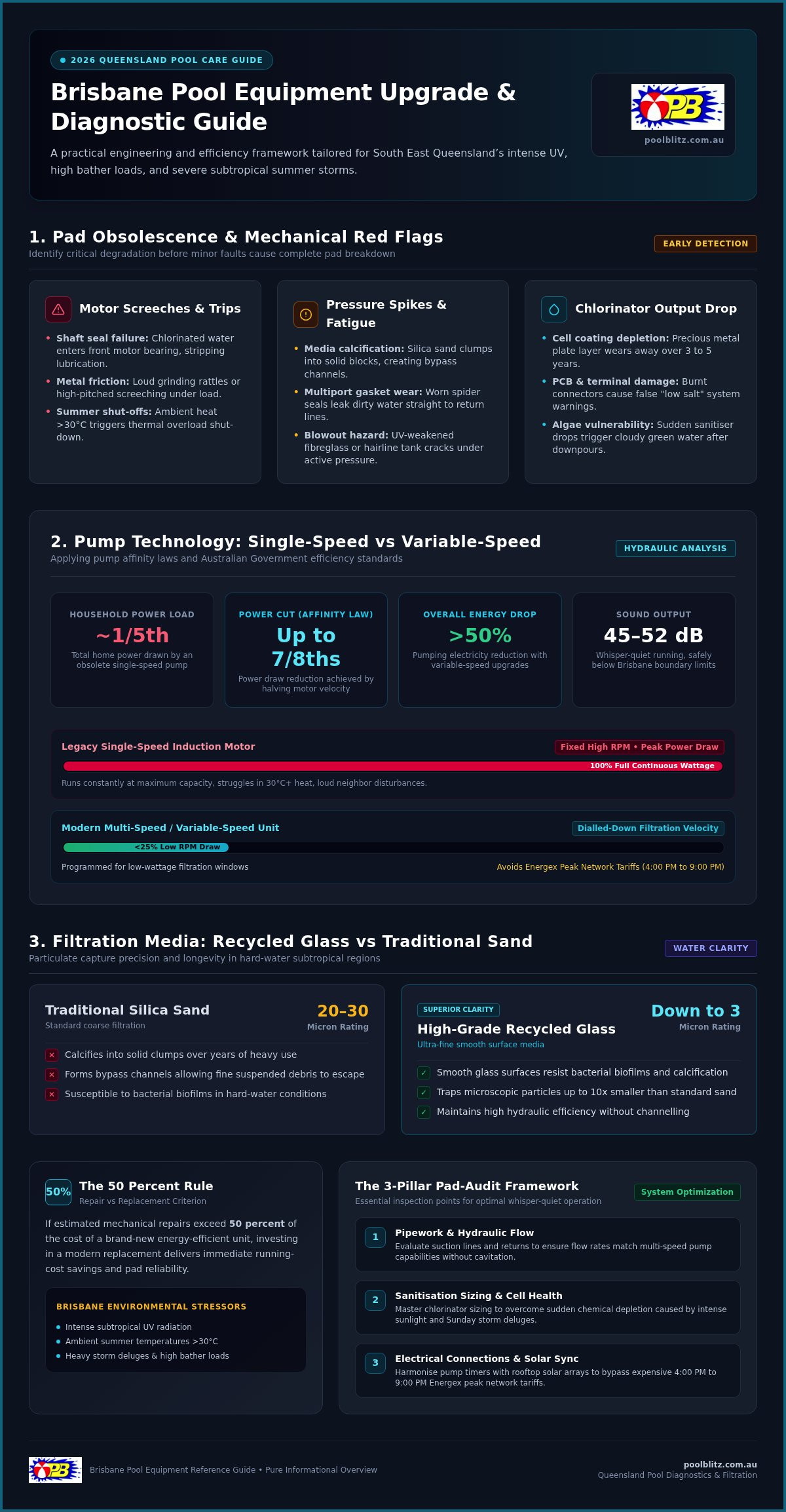
In harsh subtropical climates, pool equipment reaches functional obsolescence when accumulated mechanical wear, UV degradation, and efficiency losses cause operating costs to outstrip the asset value of the machine. An ageing single-speed induction motor running on standard domestic tariffs can quietly inflate household power bills, while failing filtration allows summer storms to turn clear water cloudy overnight. Seeking timely Brisbane pool equipment upgrade advice helps homeowners spot critical mechanical red flags before a minor operational hiccup escalates into a catastrophic pad failure.
Loud Bearing Screeches and Motor Overheating
Pool pumps shouldn’t sound like jet engines spooling up in your backyard. When a pump shaft seal deteriorates, chlorinated water slowly seeps past the seal housing and migrates directly into the front motor bearing, washing away factory lubrication. The resulting metal-on-metal friction generates a high-pitched mechanical screech or grinding rattle. During humid Brisbane summers with ambient temperatures exceeding 30°C, these stressed bearings cause internal windings to draw excessive current, routinely tripping the motor’s internal thermal overload switch and shutting the pump down midway through its cycle.
Pressure Gauge Spikes and Media Deterioration
Your filter tank operates under constant pressure, making structural integrity non-negotiable. Over years of heavy use, silica sand calcifies into solid clumps, forming channels that bypass filtration and leave fine debris suspended in the water. Worn spider gaskets inside multiport valves similarly allow dirty water to leak straight back into the return lines, undermining established swimming pool sanitation and filtration principles while wasting expensive chemicals. Inspect the outer filter housing carefully; UV-weakened fibreglass or hairline tank cracks under active pressure represent genuine blowout hazards that require immediate replacement.
Inconsistent Sanitisation and Output Drop
Even the best water balance falters if your chlorinator loses the ability to produce adequate sanitiser. Electrolytic cell plates carry a precious metal coating that steadily wears away over three to five years, reducing chlorine generation capacity. Ageing control boxes also suffer from burnt terminal connectors or failing printed circuit boards that misread salinity levels, prompting false “low salt” warnings. When recurring algae blooms strike despite balanced water chemistry, professional diagnostic testing via expert pool equipment repairs Brisbane will pinpoint whether a cell clean, component rebuild, or complete system upgrade provides the most durable solution.
Evaluating Core Upgrades: Pumps, Filtration, and Chlorination
Upgrading your plant pad isn’t simply about swapping like-for-like parts; it’s an opportunity to modernise hydraulic efficiency and chemical stability across your entire pool system. Sound Brisbane pool equipment upgrade advice focuses on building a balanced, cohesive setup where each component supports the next under extreme subtropical conditions. Aligning your equipment selection with local environmental demands guarantees effortless water clarity and minimises wasted energy.
Variable-Speed Pumps vs Single-Speed Units
The pump affinity laws dictate that halving a motor’s operational speed cuts its power draw by up to an astonishing seven-eighths. While single-speed motors churn continuously at maximum power, multi-speed units let you dial down velocity during standard daytime filtration. In line with Australian Government guidance on pool pump efficiency, moving from fixed-speed units to variable-speed models can reduce pumping power use by well over 50 percent. Low-RPM running also keeps operational sound levels between 45 and 52 decibels, comfortably below Brisbane boundary limits. For suburban properties, homeowners can programme quiet, low-wattage cycles during off-peak windows or run them alongside rooftop solar arrays to avoid pricey Energex peak network tariffs (typically 4:00 PM to 9:00 PM).
Glass Media vs Sand and Cartridge Filters
Filtration efficiency hinges on the media inside your vessel. High-grade recycled glass media captures fine particles down to 3 microns, outperforming traditional silica sand which generally traps debris only down to 20 or 30 microns. Smooth glass surfaces also resist the bacterial biofilms and calcification common to Queensland’s hard-water regions, cutting backwash frequency by roughly a quarter. For properties lacking dedicated storm sewer drainage or bound by strict backwash run-off rules, large-format cartridge units offer exceptional water savings. You can explore complete setup mechanics in our detailed ultimate Brisbane pool filtration guide to identify the ideal media profile for your site.
High-Efficiency Salt Chlorinators and Dosing
Modern salt chlorinators employ intelligent reverse-polarity cycles that switch electrical current across the plates, actively preventing calcium scale accumulation in warm weather. Advanced digital units automatically dial output up or down based on ambient water temperature, preventing sudden chlorine depletion during blistering heatwaves. Pairing your cell with automated peristaltic acid dosing preserves perfect water balance, ensuring your sanitiser remains fully active without manual guesswork.
| Equipment Category | Legacy Technology | Modern Upgrade Choice | Core Operational Benefit |
|---|---|---|---|
| Circulation Pump | Single-speed induction motor | Variable-speed (MEPS-compliant) | Cuts electricity consumption by 70% to 80% on low-flow cycles |
| Filtration Unit | Standard silica sand | Activated recycled glass media | Filters to 3-5 microns, resists channelling, and reduces backwashing |
| Sanitiser System | Manual salt chlorinator | Self-cleaning cell with automated pH dosing | Prevents cell scaling and maintains constant free chlorine in high heat |
If you’re unsure how these components fit together on your existing equipment slab, reaching out to the team at poolblitz.com.au can help you design a harmonious, high-efficiency setup tailored to your backyard.
The Repair vs Replace Decision Framework for Brisbane Pools
Deciding between rebuilding an ailing unit or investing in new hardware often comes down to clear mathematics. Objective Brisbane pool equipment upgrade advice relies on two foundational benchmarks: the operational age of the component and the 50 percent rule. If an equipment repair quote exceeds half the cost of a modern replacement, replacing the unit is almost always the smarter financial move. This holds especially true when the existing unit is past its midpoint lifespan, as sunk repair costs rarely halt the physical decline of nearby ageing parts.
The 5-to-8-Year Equipment Lifecycle Benchmark
Subtropical Queensland conditions are notoriously punishing on pool machinery. Intense solar radiation and chronic humidity degrade exterior composite plastics, making pump strainer lids brittle and filter clamp rings prone to stress fractures. Once a pump motor or chlorinator control box reaches five to eight years of continuous operation, original replacement parts often become scarce or discontinued. Prolonged heat cycles can also warp the motor seal plate housing itself. When this occurs, pressing in new mechanical seals fails to create a watertight seal, leading to persistent leaks within weeks of a rebuild.
Evaluating the True Cost of Repeated Patch Repairs
Minor fixes often feel economical in isolation, yet they can become an expensive ongoing habit. Replacing a run capacitor or swapping out motor bearings restores mechanical rotation, but it leaves an inefficient motor drawing heavy continuous wattage from your switchboard. Homeowners must weigh these factors carefully:
- Cumulative service fees: Multiple diagnostic callouts, ad-hoc fittings, and intermittent labour charges quickly erode any initial savings.
- Warranty protection: Patch repairs generally carry limited 90-day parts warranties, whereas new MEPS-compliant units backed by mandatory Energy Rating label standards for pool pumps offer extensive multi-year manufacturer coverage.
- Compounded energy penalties: Sunk repair money keeps obsolete hardware running on expensive domestic power tariffs, throwing good money after bad.
Assessing Hydraulic Compatibility and Pipework Health
A successful equipment upgrade requires a comprehensive view of your entire plumbing pad. Modern variable-speed pumps deliver high peak flow rates that can easily overwhelm older 40mm suction lines or fracture sun-baked, brittle PVC manifold fittings. High water velocity through undersized suction pipes increases dynamic head loss, creating pump cavitation that strips impellers and strains the motor. Before ordering high-capacity filtration hardware, conducting a complete hydraulic audit ensures pipe diameters, valve configurations, and filter flow ratings match perfectly, protecting your new investment from premature failure.
Sizing Equipment for Brisbane Subtropical Heat and Storms
Subtropical weather patterns present severe operating conditions that quickly overwhelm standard hardware configurations. In our humid climate, undersized chlorinators consistently fail during prolonged heat spells because daytime solar radiation destroys free available chlorine faster than an underpowered electrolytic cell can replace it. Tailored Brisbane pool equipment upgrade advice ensures your pumps, filters, and sanitisation units possess the physical capacity to endure intense solar loading and sudden summer deluges without clouding your water.
Water Turnover Rates in Queensland Conditions
High ambient heat accelerates micro-organism growth, demanding two complete pool water turnovers every 24 hours between November and March. To calculate your minimum required flow rate, divide your total pool volume in litres by the desired daily turnover duration. For instance, circulating a typical 50,000-litre pool through two complete turnovers (100,000 litres total) across an eight-hour operating window requires a flow rate of approximately 208 litres per minute. Variable-speed pumps achieve this volume efficiently by running at lower RPM settings across extended 10-to-12-hour cycles, ensuring continuous chemical distribution across every corner of the pool shell.
Combating UV Degradation and Torrential Rain Dilution
Violent afternoon storms frequently dump dozens of millimetres of rainwater into backyard pools within minutes. This rapid dilution immediately strips out cyanuric acid stabiliser and drops salinity levels, leaving your water vulnerable to opportunistic algae. Sizing your chlorinator output up to a capacity of at least 25 to 30 grams per hour for a 50,000-litre pool provides the reserve output needed to recover sanitiser levels instantly, avoiding reactive chemical overdosing. Maintaining precise pH and total alkalinity buffers your water, shielding expensive heater elements, pump seals, and chlorinator plates from mineral corrosion.
Relieving Filter Strain with Robotic Pool Cleaners
Afternoon storm fronts sweep heavy eucalyptus leaves, fine airborne silt, and organic debris straight across suburban properties. Independent robotic cleaners capture this immense waste load within internal micro-baskets before it ever reaches your skimmer boxes or chokes the main filter vessel. By keeping coarse debris off your media bed, robotic technology dramatically reduces required backwash cycles and extends media operational lifespans. Check our comprehensive best robotic pool cleaner Brisbane buying guide to assess high-performance models suited to leafy yards.
Need assistance calculating exact turnover rates or selecting the right hardware capacity for your yard? Contact the seasoned team at poolblitz.com.au to schedule an expert on-site sizing evaluation today.
Planning Your Upgrade: Professional Assessment to Handover
Transforming an ageing plant pad into an energy-efficient powerhouse demands structured, methodical execution. Expert Brisbane pool equipment upgrade advice prioritises a seamless transition, ensuring every new unit integrates cleanly with your existing layout. By adhering to a five-step commissioning roadmap, you avoid common installation pitfalls and ensure your equipment operates at peak performance for years to come.
- Pad audit: Evaluate plumbing geometry, valve health, and circuit capacity.
- Custom engineering: Match flow ratings and sanitisation output directly to pool volume.
- Precision plumbing and electrical: Install compliant pipework, unions, and mandatory earthing.
- System calibration: Programme custom speed profiles to capitalise on off-peak energy tariffs.
- Scheduled preventive maintenance: Protect manufacturer warranties through regular balancing.
On-Site Equipment Audit and Pad Assessment
Every upgrade begins with a thorough structural inspection of the equipment pad. Concrete slabs must be level and free from ground subsidence, as uneven surfaces amplify motor vibration and strain rigid PVC connections. Electricians must confirm that dedicated circuits feature modern Type A residual current devices (RCDs) capable of handling inverter electronics. Reviewing pipework geometry also eliminates convoluted 90-degree elbows, dramatically reducing dynamic head loss before any replacement units are dry-fitted.
Precision Installation, Earthing, and Pressure Testing
Electrical safety around water is governed by stringent regulatory standards. Under Australian wiring rules (AS/NZS 3000:2018), equipotential bonding is legally required for conductive metal items within 1.25 metres of the pool perimeter, protecting bathers from dangerous stray voltages. Plumbers must use pressure-rated PVC, high-grade primer, and heavy-duty solvent cement to guarantee watertight seals across all new joins. Pressure testing the system under full operating load prevents micro-leaks that could introduce air into the pump basket. To keep your newly configured system running at maximum efficiency, booking routine upkeep through professional pool service Brisbane specialists safeguards the mechanical integrity of your investment over the long haul.
System Calibration and Homeowner Handover
The final handover bridges modern technology with practical daily operation. Technicians fine-tune pump speeds, assigning ultra-low RPM cycles for quiet daytime filtration and reserve high-RPM slots for robotic vacuuming or backwashing. Homeowners learn how to read the filter pressure gauge, identify the baseline clean reading, and manage seasonal timers. For comprehensive support backed by three decades of local experience, contacting Pool Blitz ensures your equipment upgrade delivers quiet reliability, sparkling clarity, and genuine power savings.
Transform Your Backyard Filtration with Confidence
Modernising your pool pad turns relentless maintenance stress into effortless backyard enjoyment. Moving away from obsolete, power-hungry motors to modern variable-speed pumps dramatically reduces household electrical bills while restoring peace and quiet to your outdoor living space. By pairing advanced glass media filtration with appropriately sized sanitisation systems, you give your pool the hydraulic muscle required to withstand intense Queensland UV rays and sudden storm deluges.
Serving the local community continuously since 1994, Pool Blitz brings over three decades of specialised diagnostics, equipment repairs, and balanced water care formulated specifically for local subtropical conditions. When you need clear, honest Brisbane pool equipment upgrade advice, our team evaluates whether component repairs or full replacements offer the best long-term value for your property.
Ready to build a resilient, whisper-quiet filtration setup that runs smoothly season after season? Book an expert Brisbane pool equipment assessment with Pool Blitz to secure lasting efficiency, reliable hardware, and crystal-clear water year-round.
Frequently Asked Questions
How much can a variable-speed pool pump save on Brisbane electricity bills?
Upgrading to an energy-efficient variable-speed pump can lower pump-related power consumption by 70 to 80 percent compared to older single-speed induction units. Because circulation pumps traditionally account for nearly a fifth of total household electrical usage, this efficiency shift delivers substantial running cost reductions. Running the pump on low flow settings during daylight hours also helps households with solar systems maximise self-consumption.
Can I install new pool equipment myself or do I need a qualified technician?
You should always engage a qualified professional. Under Queensland electrical safety regulations, pool equipment is classified as prescribed electrical equipment, meaning hardwired connections, modifications, and equipotential bonding must be carried out by a licensed electrical contractor. Experienced technicians also ensure watertight PVC solvent joints and balanced hydraulic flow rates, preserving both equipment warranties and domestic safety.
How long does modern pool equipment typically last in Queensland climate?
In Brisbane’s subtropical climate, high-quality pumps and filter tanks typically deliver between eight and twelve years of dependable service before mechanical fatigue sets in. Salt chlorinator electrolytic cells generally last three to five years before their rare-metal plate coatings deplete. Seeking tailored Brisbane pool equipment upgrade advice ensures you select equipment housings with high UV resistance, prolonging operational life despite intense summer heat.
What is the difference between glass filter media and traditional silica sand?
Recycled glass media provides far finer filtration than silica sand, trapping microscopic particles down to three microns rather than twenty. Its smooth, negatively charged surface resists bacterial clumping and mineral calcification, preventing water from carving bypass channels through the bed. As a result, glass media keeps pool water noticeably clearer, requires roughly 25 percent less backwash water, and lasts substantially longer than standard sand.
Will upgrading my pool pump require changes to my electrical switchboard?
It depends on the age and setup of your existing electrical switchboard. Upgrading to modern variable-speed equipment often requires a Type A residual current device (RCD) safety switch to safely manage modern inverter-driven electronics. If your current installation lacks compliant RCD protection or equipotential earthing bonding, a licensed electrician will need to bring the circuit up to current Australian Standards before commissioning your hardware.
How do I know if my salt chlorinator cell needs cleaning or total replacement?
White, crusty calcium bridging between the cell plates simply requires a gentle cleaning wash to restore normal conductivity. However, if the plates appear completely clean but chlorine generation remains low, or if the dark ruthenium coating has flaked away to expose bare metal, the cell is exhausted. Seasoned Brisbane pool equipment upgrade advice helps homeowners test cell output accurately to determine whether cleaning or replacement is warranted.
What happens if my new pool pump is too powerful for my existing filter?
An oversized pump drives water through the filter vessel faster than the internal media can effectively process. This excessive velocity forces dirt straight through the media bed back into the swimming pool, causes high internal pressure spikes, and risks cracking internal laterals or the tank body. Properly matching pump flow curves to your filter’s maximum flow rating is essential to protect pipework and maintain water clarity.
No responses yet