
Imagine spending your Saturday morning topping up the water after a classic South East Queensland storm, only to wake up to a cloudy, uninviting pool on Sunday. It feels like a constant battle to maintain the correct pool ph level brisbane conditions demand, especially when your chlorine seems to lose its effectiveness for no apparent reason. We understand the frustration of seeing mineral scale build up on your expensive heater or watching your pH spike every time you turn on the hose. You aren’t alone in this struggle; many local pool owners find our unique water profile a persistent challenge to balance.
This guide will show you how to stop the cycle of constant chemical adjustments by focusing on the crucial link between total alkalinity and pH stability. We’ll outline exactly how to manage Brisbane’s subtropical climate and alkaline tap water to keep your pool sparkling clear while extending the life of your pumps and filters. You will learn the 2026 best practices for professional water balancing that protect your investment and ensure your swimming season is never interrupted by chemistry issues. We’re going to break down the technical side into a simple, manageable routine for long-term clarity and peace of mind.
Key Takeaways
- Maintain the “Golden Range” of 7.2 to 7.6 to ensure your pool ph level brisbane remains perfect for both swimmer comfort and sanitiser efficiency.
- Use total alkalinity as a chemical “anchor” to prevent the frustrating pH bounce often caused by Brisbane’s heavy summer rainfall and tap water top-ups.
- Protect your expensive filtration systems and heaters by understanding how stable water chemistry prevents corrosive damage and mineral scale buildup.
- Adopt safer chemical handling practices and more accurate testing methods tailored to the unique demands of South East Queensland’s subtropical climate.
- Recognise when to call in a professional to identify “hidden” issues like high cyanuric acid that can render your standard DIY treatments ineffective.
Understanding the Ideal Pool pH Level in Brisbane
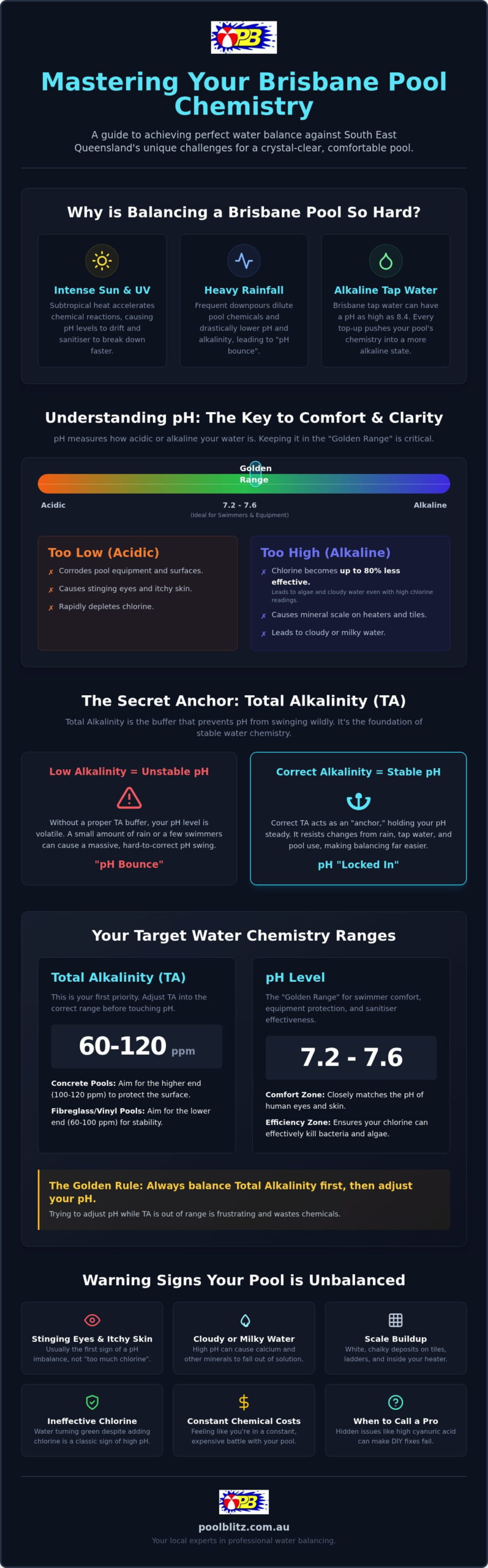
Maintaining a stable pool ph level brisbane requires more than just a passing glance at a test strip once a month. At its core, pH is a logarithmic scale measuring how acidic or alkaline your water is, ranging from 0 to 14. For a swimming pool, the sweet spot is slightly alkaline, specifically between 7.2 and 7.6. This is often referred to as the ideal pH for swimming pools because it closely matches the pH of human eyes and skin, ensuring a comfortable swim without the sting. When you keep your water within this narrow window, you create a harmonious environment where your equipment lasts longer and your family stays protected.
Brisbane’s intense subtropical heat and high UV radiation create a volatile environment for water chemistry. As the sun beats down on your backyard, it doesn’t just warm the water; it accelerates the chemical reactions that cause pH to drift. When your levels climb too high, your sanitiser loses its muscle. As pH rises above 8.0, your chlorine becomes up to 80% less effective at killing bacteria. This means you could have plenty of chlorine in the water, yet still find yourself facing a green pool because the high pH is preventing that chlorine from doing its job.
The Brisbane Tap Water Factor
Many locals are surprised to learn that our municipal water supply is a primary culprit for rising alkalinity. Seqwater often delivers water with a pH as high as 8.4 to protect city pipes from corrosion. Every time you top up your pool from the garden hose after a hot day or a weekend of splashing, you are inadvertently pushing your pool’s chemistry toward a more alkaline state. Because our local water is so consistently high, a “set and forget” approach simply won’t work for Brisbane pool owners who want to avoid a chemistry crisis.
Signs Your pH Levels are Out of Whack
Recognising the early warnings of a pH imbalance can save you from expensive repairs and uncomfortable swims. If your family complains of stinging eyes or itchy skin, it’s rarely just “too much chlorine”; it’s usually a pH level that has drifted outside the comfortable range. You might also notice several visual and mechanical cues:
- A distinct “pool smell”: This often indicates the presence of chloramines, which form when chlorine is struggling to work in imbalanced water.
- Cloudy or milky water: This often happens when high pH causes minerals to fall out of solution and float in the water.
- White, chalky deposits: These calcium scales appear on your tiles or along the waterline and are difficult to remove once they harden.
- Equipment warnings: Reduced water flow from the pump or small white flakes returning through the jets are signs of calcium scaling inside your internal plumbing.
Water Alkalinity: The Secret Anchor for Your pH
Total Alkalinity is the silent guardian of your pool chemistry. While many owners focus entirely on the pH reading, it is actually the alkalinity that dictates how easily that reading will change. We often describe alkalinity as the “anchor” for your water. It provides a necessary buffer that prevents your pool ph level brisbane from drifting wildly every time it rains or when the kids jump in for a swim. Without this chemical foundation, your water becomes volatile and difficult to manage.
For most residential pools in South East Queensland, the ideal range for alkalinity sits between 60 parts per million (ppm) and 120 ppm. The specific target depends largely on your pool’s internal surface. Concrete pools generally require a higher alkalinity level, often closer to 100 or 120 ppm, to prevent the water from becoming aggressive and leaching minerals from the walls. Fibreglass or vinyl-lined pools are usually more stable at the lower end of the scale. When your alkalinity is correctly set, your pH stays “locked” in that healthy 7.2 to 7.6 range for much longer.
Why Alkalinity Matters More Than pH
You simply cannot stabilise your pH until your alkalinity is corrected first. Total Alkalinity measures the water’s ability to neutralise acids, acting as a shield for your pH level. If you attempt to lower a high pH without checking your alkalinity, you might find the reading refuses to budge even after adding significant amounts of acid. This leads to a frustrating cycle of over-treating your water and wasting money on chemicals that don’t produce results. Following CDC guidelines for pool safety ensures a healthy environment, but achieving that balance requires a methodical approach to these two linked measurements. Investing in expert water balancing is often the most cost-effective way to break this cycle and protect your equipment from chemical wear.
The “pH Bounce” vs. “pH Lock”
Understanding the relationship between these two factors helps you diagnose common backyard pool issues. When your alkalinity is too low, you will likely experience “pH bounce.” This is a phenomenon where your pH levels swing from dangerously acidic to overly alkaline almost overnight. It makes the water unpredictable and can cause rapid corrosion of metal components in your pump or heater.
Conversely, high alkalinity leads to “pH lock.” This occurs when the alkalinity is so high that it prevents the pH from moving at all. In Brisbane, this is a frequent headache because our tap water is naturally quite alkaline. You might add acid to lower the pH, only to find the reading remains stuck at 8.0 or higher. Identifying which of these issues is plaguing your pool is the first step toward a crystal-clear swimming season. If you find yourself constantly battling these swings, our team can help you establish a regular pool maintenance routine to keep your chemistry effortlessly stable.
High vs. Low pH: Risks to Your Brisbane Pool
The structural health of your pool is inextricably linked to its chemical balance. While we often focus on water clarity for aesthetic reasons, the chemical state of your water is constantly interacting with every surface and mechanical component it touches. When your pool ph level brisbane drifts too far in either direction, it stops being a refreshing oasis and begins to act as either a corrosive agent or a source of stubborn mineral deposits. Understanding the distinct risks of high and low pH allows you to intervene before minor imbalances turn into expensive repair bills.
In many jurisdictions, maintaining specific chemical parameters is a matter of law for communal facilities. For instance, the public swimming pool operational requirements in various regions mandate a strict pH range to ensure both public safety and infrastructure longevity. While residential pools aren’t subject to the same inspections, following these professional standards is the best way to safeguard your investment. In Brisbane, the battle is usually fought against rising levels, though our seasonal weather patterns can occasionally send the scale sliding in the opposite direction.
High pH: The Scaling Menace
High pH is the more common “silent killer” of Brisbane pool equipment because its effects are cumulative and often invisible until a major component fails. When pH levels climb, the water becomes “oversaturated” with minerals. This causes calcium to fall out of suspension, leading to cloudy pool water in Brisbane that no amount of filtering can solve on its own. Beyond the cloudiness, high pH creates several critical issues:
- Salt Cell Calcification: High pH accelerates the buildup of white calcium scale on the electrodes of your salt chlorinator, forcing the unit to work harder and significantly shortening its lifespan.
- Reduced Filtration Efficiency: Mineral scale can develop inside your filter media, effectively “petrifying” sand or cartridges and reducing their ability to trap debris.
- False Algae Signs: Water with a high pH often takes on a dull, greenish tinge even when chlorine levels are adequate, leading many owners to add unnecessary algaecides when the real culprit is simply imbalanced chemistry.
Low pH: The Corrosive Threat
While less frequent in our region, low pH represents an immediate threat to the physical integrity of your pool. Acidic water is “hungry” and will look for minerals to consume from any available source. This often occurs after heavy summer storms, as Brisbane’s rainwater is naturally acidic and can quickly pull your pH down. The consequences of acidic water are often rapid and destructive:
- Surface Etching: In concrete pools, acidic water leaches calcium directly from the render, resulting in a rough, pitted surface that is uncomfortable for swimmers and provides a perfect home for algae.
- Vinyl and Liner Damage: Low pH can cause vinyl liners to lose their elasticity, leading to permanent wrinkling or even brittle patches that eventually crack.
- Mechanical Failure: Acidic water is particularly aggressive toward metal, often eating through the delicate copper heat exchangers found in pool heaters or corroding the internal seals of your pool pump.
How to Test and Adjust pH in the Subtropical Climate
Achieving a stable pool ph level brisbane owners can rely on starts with using the right tools for the job. While test strips are convenient for a quick mid-week check, they often lack the nuance required for major chemical adjustments. We recommend using a high-quality liquid reagent kit, which allows you to see the subtle colour transitions that indicate exactly where your balance sits. Precision is your best friend in this process; even a small miscalculation in pool volume can lead to an over-correction that takes days to fix. Once you have your reading, calculate your dose based on your pool’s total litres, remembering that it’s always better to under-treat and test again than to add too much at once.
The golden rule of chemical safety is absolute: always add acid to water, never water to acid. Adding water to a concentrated acid can cause a violent reaction that results in dangerous splashing. After you have carefully introduced your chemicals, the pump must remain running to circulate the water thoroughly. Allow at least 4 to 6 hours for the chemistry to integrate before you reach for your test kit again. This waiting period ensures you are measuring the true state of the entire pool rather than a concentrated pocket of treated water.
Managing pH After a Brisbane Storm
Our summer storms are notorious for dumping large volumes of acidic rainwater into backyard pools, which can crash your pH levels in a matter of hours. We suggest following a strict “Storm Protocol” to restore order. Your first step is always physical: empty the skimmer and pump baskets and remove all organic debris like leaves or twigs. You should never attempt to adjust your pH while the pool is full of garden waste, as these contaminants consume chemicals and skew your test results. Once the water is clear of debris, check your levels and consider how to shock a pool to neutralise pathogens introduced by the rain before you begin fine-tuning the pH balance.
Lowering pH Safely
When you need to bring your levels down, you will generally choose between liquid Hydrochloric Acid or granular Sodium Bisulphate, often called dry acid. Hydrochloric acid is the industry standard for its strength and efficiency, though it requires careful handling due to its potent fumes. Dry acid is a reliable alternative for those with limited storage space, as it is less prone to leaking and easier to measure. Regardless of your choice, safety is paramount. Wear chemical-resistant gloves and eye protection, and always stand upwind when pouring to avoid inhaling vapours.
The way you add the acid also matters. If your alkalinity is already in the target range and you only want to lower the pH, use the “slug” method by pouring the dose in a single spot in the deep end. If you find yourself battling both high pH and high alkalinity, “walking the acid” by pouring a thin stream around the entire perimeter is the more effective technique. If the chemistry feels overwhelming after a major weather event, our casual pool servicing provides the expert calibration needed to get your water back on track safely.
Professional Water Balancing: Peace of Mind for Your Pool
While understanding the mechanics of your pool’s chemistry is a vital first step, achieving true long-term stability often requires a more sophisticated approach. DIY kits are excellent for routine monitoring, but they frequently fail to detect complex issues like rising Cyanuric Acid levels. When this “stabiliser” becomes too high, it can lock your chlorine’s effectiveness and create a deceptive reading on your standard test strip. Our team uses professional-grade photometers to provide a laboratory-level analysis that ensures your pool ph level brisbane is perfectly balanced alongside every other critical metric. This precision eliminates the “chemical see-saw” that often leads to wasted money on unnecessary additives.
Regular oversight from a seasoned expert provides more than just clear water; it offers the relief of knowing your equipment is protected by stable chemistry. By maintaining a consistent schedule, we can catch subtle drifts in alkalinity or calcium hardness before they manifest as visible problems. This proactive stewardship is the most effective way to ensure your swimming season is never interrupted by preventable water quality issues.
The Pool Blitz Approach to Water Care
Our methodology is built on over three decades of experience in the unique conditions of South East Queensland. During every visit, we perform a comprehensive 7-point water test that looks far beyond simple pH and chlorine levels. We calibrate your chemical dosing and filtration equipment to match the specific environmental pressures of your backyard, from heavy leaf fall to intense afternoon sun. By maintaining a balanced Langelier Saturation Index (LSI), we ensure your water is in a state of perfect equilibrium. This technical precision results in significant long-term savings by preventing the mineral scale and corrosion that typically shorten the lifespan of pool pumps and heaters.
When to Call in the Experts
There are specific moments when professional intervention becomes the most logical choice for a pool owner. If you have just performed a major top-up with Brisbane’s naturally alkaline tap water, the sudden shift in chemistry can be difficult to correct without professional-strength buffers. You should also consider an expert review in these scenarios:
- Stubborn pH levels: If your pH refuses to stay within the 7.2 to 7.6 range despite repeated acid treatments, there is likely an underlying alkalinity or mineral imbalance.
- Event Preparation: If you are preparing for a large social gathering or the official start of the summer swim season, a professional calibration ensures the water stays clear under heavy use.
- Equipment Longevity: If you have recently invested in new pool filtration systems or heaters, professional water balancing is essential to validate your warranty and protect your investment.
Choosing a professional pool service in Brisbane means you can stop worrying about the technicalities and start enjoying the lifestyle benefits of a perfect pool. Since 1994, Pool Blitz has acted as a dependable partner for local families who value precision and reliability. We handle the “heavy lifting” of chemical calibration so you can experience the clarity and safety of a professionally maintained pool all year round.
Secure Your Swimming Season with Expert Care
Brisbane’s subtropical climate is often unforgiving, but it’s entirely manageable with a proactive strategy. You now understand how total alkalinity acts as the essential anchor for your water and why high pH represents a silent threat to your salt cells and pumps. Achieving a stable pool ph level brisbane demands consistent attention and a methodical approach to your maintenance routine.
Since 1994, we’ve acted as trusted stewards for backyard pools across the city. Our comprehensive 7-point water analysis identifies hidden issues before they turn into costly headaches. By choosing regular servicing, you protect your equipment from mineral damage and ensure your water remains a safe, inviting sanctuary for your family. We invite you to Book a Professional Water Balance with Pool Blitz Today to experience the relief of a perfectly calibrated pool. We’re here to help you keep your water sparkling and ready for every summer swim.
Frequently Asked Questions
What is the correct pool pH level for Brisbane pools?
The ideal range for your pool ph level brisbane is between 7.2 and 7.6. This specific window is often called the “Golden Range” because it ensures maximum swimmer comfort while allowing your chlorine to work at its most effective capacity. Keeping your water within these parameters protects your pool’s surface and mechanical equipment from the dual threats of corrosion and mineral scaling.
Why does my pool pH keep going up after I add acid?
This persistent rise is usually caused by high total alkalinity or the frequent addition of alkaline tap water during top-ups. If your alkalinity is too high, it acts as a powerful force that constantly pushes your pH upward, regardless of how much acid you add. You must balance your alkalinity first to provide the necessary “anchor” that keeps your pH level stable over the long term.
Can I swim in a pool with high pH?
You can technically swim, but it is likely to be an uncomfortable experience for everyone involved. High pH levels often cause stinging eyes, itchy skin, and a general lack of water clarity. Because chlorine becomes significantly less effective as pH rises, the water may also contain higher levels of bacteria than a properly balanced pool, making it less hygienic for your family.
How does heavy rain affect my pool pH in Brisbane?
Heavy summer rain in South East Queensland is naturally acidic and will typically cause your pH levels to drop quite sharply. Storms also introduce organic debris and contaminants that can further disrupt your water chemistry. We recommend performing a thorough test and clearing all baskets immediately after a significant weather event to ensure your balance hasn’t crashed.
What is the difference between pool pH and total alkalinity?
pH is a direct measurement of how acidic or alkaline your water is on a scale of 0 to 14. Total alkalinity, on the other hand, measures the water’s ability to resist changes in that pH level. You can think of alkalinity as a protective buffer; without it, your pH would “bounce” uncontrollably every time a chemical or environmental factor changed.
How often should I test my pool water in the Brisbane summer?
We suggest testing your water at least twice a week during the peak of the summer season. The combination of intense UV radiation, high evaporation rates, and increased swimming frequency means your chemicals are consumed much faster than in the cooler months. Frequent testing allows you to make small, inexpensive adjustments rather than dealing with a major chemistry crisis.
Is Brisbane tap water safe to fill my pool with?
It is perfectly safe to use, but you must be prepared for its naturally high pH, which often sits around 8.4. This alkalinity is intentional to protect city pipes, but it will immediately pull your pool’s balance out of the ideal range. Always test your water and be ready to add the appropriate dose of acid after topping up your pool from the garden hose.
Why are my eyes stinging if the chlorine level is normal?
Stinging eyes are almost always a symptom of an incorrect pH level rather than too much chlorine. When the water is either too acidic or too alkaline, it becomes an irritant to human eyes and skin. This sensation can also be caused by chloramines, which are “used up” chlorine particles that require a pool shock treatment to clear from the water.
No responses yet