
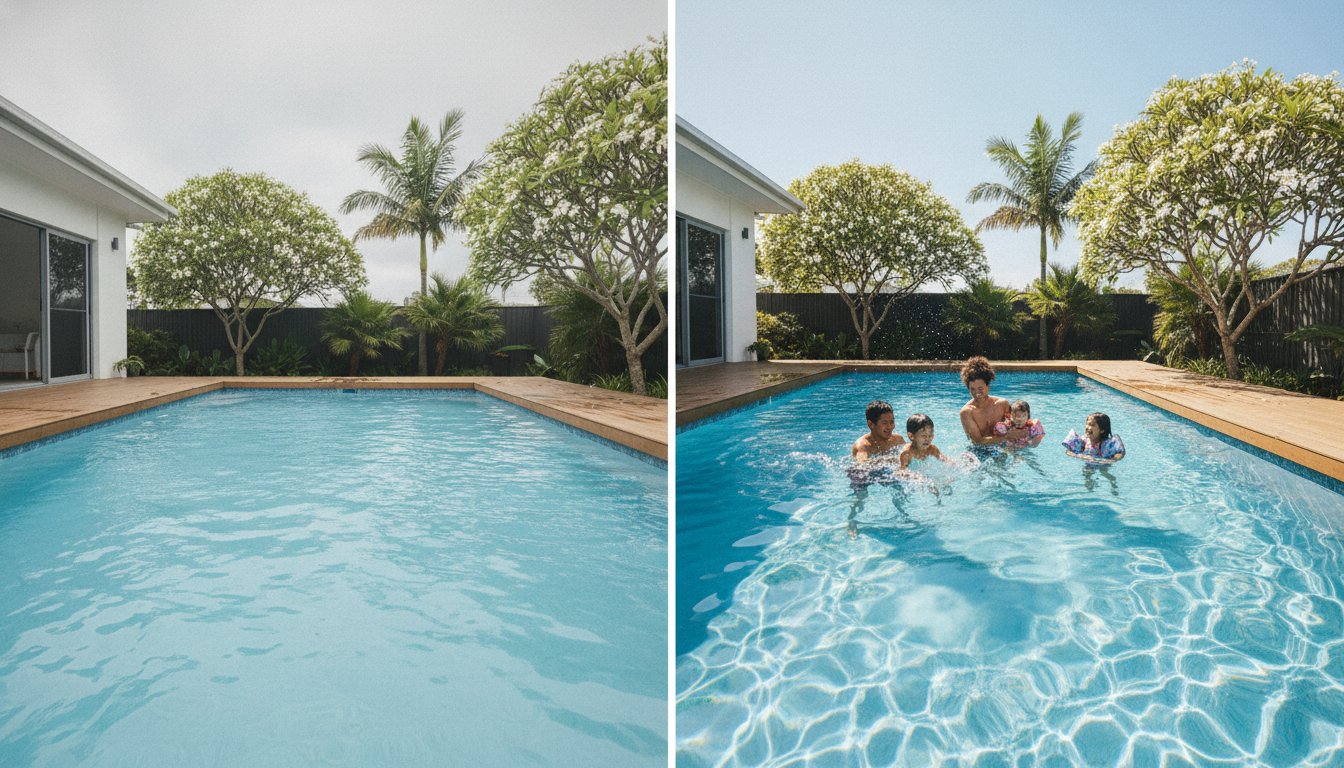
Why does your pool remain stubbornly hazy despite testing the chlorine levels every single afternoon? It is a common frustration for many local homeowners who find that typical “quick fix” solutions often fail to address the underlying issues in our unique South East Queensland climate. When you are dealing with cloudy pool water in Brisbane, the problem is rarely just a chemical imbalance; it is typically a dual failure of water chemistry and mechanical filtration. We understand the anxiety that comes with a dull pool, especially when you are worried about equipment failure or the embarrassment of hosting guests by a milky lagoon.
It’s exhausting to spend your weekends pouring money into expensive chemicals without seeing results. This guide will help you accurately diagnose the causes of hazy water and provide a professional, step-by-step recovery process to restore your pool to its crystal-clear perfection. We will look at the specific impacts of the Brisbane environment, evaluate your filtration health, and establish a straightforward maintenance routine that keeps your water safe and sparkling. By following this 2026 recovery guide, you can regain confidence in your equipment and ensure your backyard remains a clear, inviting sanctuary for your family.
Key Takeaways
- Understand how Brisbane’s high humidity and UV levels degrade sanitisers, leading to the tiny suspended particles that cause visible haze.
- Master the essential chemistry required to fix cloudy pool water brisbane, starting with a precise pH balance between 7.2 and 7.4.
- Verify your mechanical equipment to ensure that poor circulation or filtration “dead spots” aren’t undermining your water treatment efforts.
- Follow a structured 5-step recovery process to determine whether your pool requires a gentle clarifier or a more intensive flocculent treatment.
- Implement a seasonal maintenance routine that anticipates weather changes to keep your Brisbane oasis sparkling throughout the summer months.
Understanding the Causes: Why is Your Brisbane Pool Water Cloudy?
Cloudy water is essentially a collection of microscopic particles suspended in your pool that are too fine for your filtration system to capture immediately. These particles can include anything from organic matter and bacteria to mineral deposits that have “fallen out” of the solution. While a few leaves on the bottom are easy to spot and remove, cloudy pool water brisbane residents often struggle with is a far more complex issue involving water chemistry and environmental stressors. It is the difference between simple debris and a chemical precipitation that requires a more methodical approach to resolve.
During a typical hot Brisbane arvo, a high bather load can quickly overwhelm even the most robust systems. Sunscreen, sweat, and oils enter the water simultaneously, creating a massive surge in organic contaminants that your sanitiser must work overtime to neutralise. If your filtration and chemical levels aren’t perfectly aligned, these contaminants remain suspended, resulting in that characteristic hazy appearance. Understanding the fundamental pool water sanitation methods is the first step in identifying why your specific system is falling behind during the peak of summer.
The Impact of the South East Queensland Climate
The Brisbane climate is particularly harsh on pool water stability. Our intense UV rays effectively “eat” free chlorine, breaking down the chemical bonds that allow it to sanitise the water. Without adequate protection, this leads to microscopic algae growth that might not look green yet but definitely creates a dull, cloudy look. It’s a subtle change that often signals a more significant bloom is just around the corner.
Heavy tropical storms also play a significant role in our local region. These downpours wash nitrates, phosphates, and dust from the surrounding landscape directly into your pool. When water temperatures consistently sit above 30°C during the summer months, these nutrients act as a high-speed fuel for bacterial and algae reproduction. This often outpaces your pump’s ability to clear the water, leaving it looking stagnant and uninviting.
Common Chemical Culprits
If you are struggling with cloudy pool water brisbane summers often exacerbate, chemical imbalances are frequently the primary reason. If your pH or Total Alkalinity is too high, the water becomes “saturated” and can no longer hold minerals like calcium in a liquid state. This causes the calcium to crystallise into tiny white flakes that hang in the water column, creating a milky effect that no amount of simple vacuuming will fix.
You might also fall into the “Chlorine Demand” trap. This occurs when your test kit indicates a presence of chlorine, but it’s actually “combined chlorine” that is no longer active. In this state, the sanitiser is bound to contaminants and is ineffective at clearing the water. It leaves you with a pool that looks unsafe despite your best efforts to maintain it. Proper balancing is the only way to break this cycle and restore the clarity you expect from a professional-grade pool.
The Essential Chemistry for Restoring Water Clarity
Restoring clarity begins with a disciplined approach to the water’s foundation rather than searching for a “magic” chemical cure. Many homeowners make the mistake of adding massive doses of chlorine to hazy water without checking the underlying balance first. If your water’s chemistry is skewed, that expensive sanitiser simply won’t work. We advocate for a methodical process that prioritises stability, ensuring that every drop of chemical you add can actually perform its intended job. It’s about working with the water’s natural properties to create a sustainable, clear environment.
The most critical factor in this foundation is your pH level. For chemicals to be effective, your pH must sit precisely between 7.2 and 7.4. When the pH drifts higher, chlorine loses its ability to kill algae and bacteria, which often results in the very cloudy pool water brisbane residents find so frustrating. Following established CDC water treatment guidelines ensures that your sanitiser remains active and your swimmers stay safe. Total Alkalinity acts as a vital partner here, serving as a buffer that keeps your pH from swinging wildly after a heavy storm or a busy weekend of swimming.
Balancing pH and Alkalinity in High Humidity
Brisbane’s high humidity and frequent summer downpours often introduce slightly acidic rainwater into your pool, which can rapidly lower your pH levels. This acidity makes the water look dull and hazy while potentially irritating the eyes of swimmers. To fix this, you must follow the correct order of operations: adjust your Total Alkalinity first, then your pH, and finally your sanitiser. Properly balanced Total Alkalinity prevents pH bounce and ensures water stability, giving you a reliable base for long-term clarity. For a deeper understanding of how to manage the pool pH level Brisbane’s subtropical climate demands, including the impact of our alkaline tap water, a dedicated guide can help you stop the cycle of constant chemical adjustments.
Managing Stabiliser (Cyanuric Acid) Levels
Cyanuric Acid, or stabiliser, is essential for protecting your chlorine from the harsh Queensland sun, but too much of it creates its own set of problems. When CYA levels exceed the ideal range of 30 to 50 ppm, it can “lock” your chlorine, preventing it from working and leaving the water cloudy despite high test readings. If your levels have crept too high over a long summer, the most effective solution is to partially drain and refill the pool with fresh water. Achieving this delicate balance is a core part of expert water balancing that prevents recurring issues. If you find these chemical interactions confusing, seeking professional assistance can save you from the cycle of trial and error.
Mechanical Verification: Is Your Equipment the Culprit?
Even the most precise chemical balance cannot compensate for a filtration system that has reached its limit. While your test strips might show perfect levels, a mechanical failure means the fine particles causing your haze simply have nowhere to go. Many homeowners facing cloudy pool water brisbane residents deal with each summer find that their pump isn’t circulating the water effectively enough to reach ‘dead spots’ behind stairs or in deep corners. These stagnant areas become breeding grounds for the very contaminants we discussed in the previous section. In the long run, investing in pool equipment repairs is significantly more cost-effective than spending an entire season purchasing ‘miracle’ chemicals that only mask a deeper mechanical issue.
Your ‘Turnover Rate’ is the time it takes for every drop of water in your pool to pass through the filter once. In 2026, with our increasingly warm Brisbane summers, we recommend aiming for at least two complete turnovers per day. This usually means running your pump for 8 to 10 hours, depending on your pool’s volume and pump efficiency. If your pump is struggling to maintain this pace, you’ll find that the water loses its sparkle regardless of your sanitiser levels. Understanding how to clear cloudy pool water often starts with inspecting these mechanical components for wear and tear.
Troubleshooting Your Filter and Pump
Sand filters can suffer from ‘channelling’, where the water carves permanent paths through the media rather than being filtered by it. This allows fine dirt to pass straight back into the pool. Cartridge filters, on the other hand, can become ‘calcified’ by mineral build-up and body oils. A simple rinse isn’t enough when the fabric itself is blocked and hardened. You should also listen for a screeching or grinding sound from your pump, as this often indicates failing bearings that prevent the motor from circulating water at the required pressure.
The Role of Robotic Cleaners in Water Clarity
A modern robotic pool cleaner acts as a vital secondary filtration system for your pool. By scrubbing the floor and walls, it prevents organic build-up from settling and clouding the water column. This mechanical intervention is critical to preventing the fine haze that forms when debris is left to decay on the pool floor. If your robot is moving slowly or losing suction, it may need a professional service to restore its ability to trap fine debris. Maintaining floor hygiene is one of the simplest ways to reduce the load on your primary filter and keep your Brisbane oasis crystal clear.
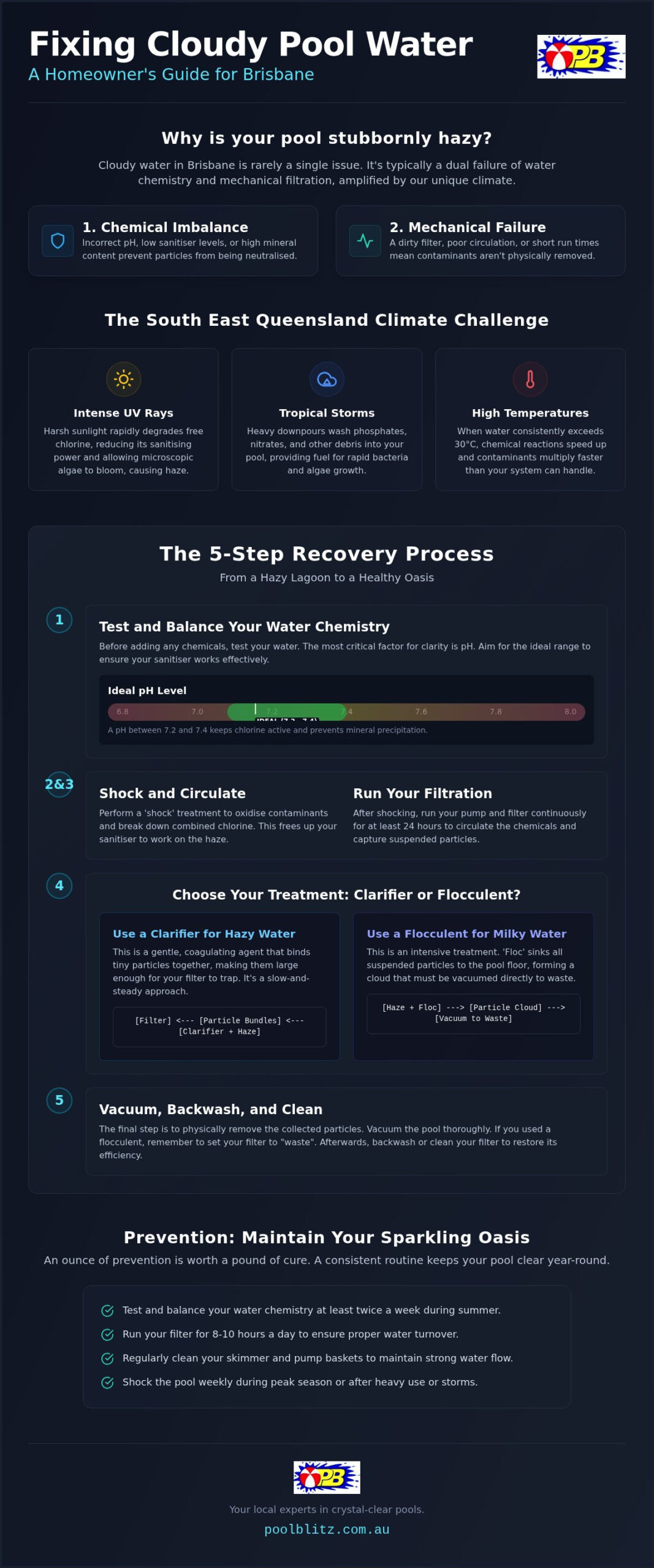
The 5-Step Recovery Process: From Hazy to Healthy
Restoring cloudy pool water brisbane families can enjoy again requires a disciplined sequence of physical and chemical actions. It isn’t enough to simply adjust the levels; you must actively remove the contaminants and help your equipment finish the job. This recovery process is methodical and thorough, ensuring that the clarity you achieve is stable and safe for everyone. If the process feels overwhelming or you simply don’t have the time to manage the multiple steps required, booking a casual pool servicing visit can provide the expert intervention needed to clear the water without the guesswork.
Step 1-3: Clean, Balance, and Shock
The first stage is preparation. Start by emptying all skimmer and pump baskets to ensure maximum water flow through your system. Skim the surface to remove organic “algae food” like leaves and insects that may have blown in during a recent storm. Physical labour is non-negotiable at this stage; you must use a pool brush to scrub the walls and floor thoroughly. This dislodges biofilm and microscopic algae colonies, allowing your chemicals to reach and neutralise them effectively.
Once the physical debris is managed, re-adjust your pH to the 7.2 to 7.4 “sweet spot” we discussed earlier. This level is essential because it allows your sanitiser to work at peak efficiency. Follow this by applying a high-quality shock treatment. We recommend doing this in the evening to prevent the intense Brisbane sun from degrading the chlorine before it has a chance to oxidise the microscopic contaminants and bacteria that are causing the haze. For precise dosage rates and timing specific to our local conditions, our guide on how to shock a pool in Brisbane walks you through the professional method step by step.
Step 4-5: Clarify or Floc and Filter
The final stage involves helping your filter capture the remaining particles. If you are dealing with a mild haze, a clarifier is usually sufficient. It works by clumping tiny particles together into larger groups that your filter can easily trap. However, if your water is a thick, milky white, you will need a flocculant. This powerful chemical binds everything in the water and sinks it to the pool floor overnight, leaving the water above it clear.
If you use a flocculant, you must use the “Vacuum to Waste” method. This involves setting your filter’s multi-port valve to “waste” and vacuuming the settled debris directly out of the pool. Never send “flocced” debris through your filter media, as it can cause significant blockages and may lead to a costly sand or cartridge replacement. Finally, run your filtration system for 24 to 48 hours straight until the water sparkles. Always perform one last water test to ensure the balance is perfect before letting anyone jump back in for a swim.
Prevention: Maintaining Your Brisbane Oasis Year-Round
Transitioning from a recovery phase to a sustainable maintenance routine is the only way to avoid the recurring frustration of cloudy pool water brisbane summers often bring. A proactive approach focuses on stopping the build-up of contaminants before they can overwhelm your sanitiser. By establishing a consistent “Brisbane Summer Routine,” you can account for our high bather loads and intense humidity, ensuring your water remains inviting even during the most demanding months of the year. This shift from reactive fixes to steady care is the hallmark of a well-managed property.
One of the most effective mechanical upgrades for long-term clarity is the installation of a variable speed pump. These modern systems allow you to run your filtration for longer periods at a lower flow rate, which significantly improves the filter’s ability to trap the fine silt and organic matter that cause haze. Because the water moves more slowly through the media, it’s filtered more thoroughly than it would be during a short, high-speed burst. Investing in regular pool servicing ensures that these settings are optimised for your specific pool volume and local environment.
Storm Preparation and Recovery
Our local weather can change in an instant, and being prepared is the best defence against a hazy pool. If a significant storm is forecast for the SEQ region, it’s wise to slightly lower your water level to prevent overflow and “super-chlorinate” the water in anticipation of the organic load the rain will bring. This extra sanitiser helps neutralise the dust, nitrates, and phosphates that are washed in from the atmosphere and surrounding garden beds. Knowing exactly how to shock a pool correctly before and after a Brisbane storm ensures your chlorine levels are strategically timed to handle the surge of contaminants that heavy rain introduces.
Once the rain clears, the “48-hour rule” is essential: you should test and rebalance your water within two days to prevent a full-scale algae bloom. Remove all leaves and debris immediately to stop phosphate levels from spiking, and check your salt cell or chlorinator output. Heavy rain often dilutes your salt levels, which can lead to a sudden drop in chlorine production if your equipment isn’t adjusted to compensate for the fresh water influx.
The Value of Professional Support
Sometimes, despite your best efforts, the complexity of water chemistry or equipment wear requires a more experienced hand. A “Casual Service” can save your weekend when a DIY fix fails to deliver the results you expect, providing a thorough diagnostic check of your entire system. There is a profound peace of mind that comes with a “Seasoned Authority” inspecting your pump, filter, and robotic cleaner to ensure everything is operating at peak efficiency. If you are tired of the guesswork and want a guaranteed path back to a sparkling pool, Book your Brisbane pool recovery service with Pool Blitz today and let our experts handle the heavy lifting for you.
Enjoying a Crystal-Clear Brisbane Summer
Transforming your pool from a hazy frustration into a sparkling sanctuary is a matter of methodical care and technical precision. As we’ve explored, successfully managing cloudy pool water brisbane residents face requires balancing your water’s chemical foundation while ensuring your mechanical equipment is up to the task. By maintaining a strict pH range and verifying your filter’s health, you create an environment where clarity is the standard rather than a lucky coincidence. It’s about being proactive before the next tropical storm arrives and having confidence in your system’s ability to recover.
If you would prefer to leave the technical diagnosis to the experts, we’re here to help. Serving Brisbane families since 1994, our team operates as an Expert Robotic Cleaner and Pump Repair Centre with Qualified Water Balancing Specialists ready to restore your water. Get your pool back to its best with a Pool Blitz Professional Service. You deserve the peace of mind that comes with a perfectly maintained pool, and with the right routine in place, your clear water is here to stay. We look forward to helping you keep your backyard oasis ready for every swim.
Frequently Asked Questions
Is it safe to swim in a pool that is slightly cloudy?
It’s generally not recommended to swim in water that isn’t crystal clear. Cloudiness indicates that your sanitiser levels may be low, which allows bacteria and pathogens to survive in the water. From a safety perspective, poor visibility makes it difficult to see the bottom of the pool or a swimmer in distress, which is a significant risk for families with children. It is always better to wait until the water is fully restored to a safe, transparent state.
How much chlorine should I add to a cloudy pool in Brisbane?
The specific amount of chlorine required depends on your pool’s volume and the severity of the cloudiness. To address cloudy pool water brisbane homes often experience during peak summer, you typically need to raise your free chlorine to “shock” levels, which is approximately 10 ppm. Always test your water first to ensure your pH is between 7.2 and 7.4, as chlorine is significantly less effective in high-pH environments. Precise water testing is the only way to avoid wasting expensive chemicals.
Why is my pool cloudy after I added shock or chlorine?
This is a common temporary reaction that usually clears within 24 hours with proper filtration. The cloudiness is often caused by the shock treatment killing large amounts of microscopic algae or bacteria, which then remain suspended in the water as “organic dust.” It can also occur if you use a calcium-based shock in water that already has a high pH, causing a minor mineral precipitation that looks like a white haze. Running your pump continuously will eventually clear this residue.
Can a dirty filter cause my pool water to turn milky?
Yes, a dirty or failing filter is one of the most frequent causes of milky water. If your filter media is saturated with body oils, minerals, or fine debris, it can no longer trap the microscopic particles that cause haze. In sand filters, “channelling” can allow water to bypass the sand entirely, while calcified cartridge filters lose their ability to sieve out debris. Regularly cleaning your filter is essential for maintaining the clarity we expect from a healthy system.
How long does it take for a clarifier to clear a cloudy pool?
You should expect to see results within 24 to 48 hours of continuous filtration. Clarifiers work by gathering tiny particles into larger clumps that your filter can finally capture. For this to work effectively, you must run your pump non-stop during the treatment period and ensure your filter is clean enough to handle the increased load of gathered debris. If the water hasn’t cleared after two days, you may have an underlying mechanical issue or a more severe chemical imbalance.
What is the difference between a pool clarifier and a flocculant?
A clarifier is a “maintenance” product that clumps particles for your filter to remove, while a flocculant is a “heavy-duty” solution that sinks everything to the floor. When you use a flocculant, you must vacuum the settled waste directly out of the pool using the “waste” setting on your filter. Flocculants provide faster results for very murky pools but require more manual labour and significant water loss compared to the slower, filter-based clarifier process.
How do Brisbane summer storms affect my pool water clarity?
Brisbane’s intense tropical storms wash dust, nitrates, and phosphates from the air and surrounding gardens directly into your pool water. These contaminants act as a high-speed fertiliser for algae, while the heavy rain dilutes your sanitiser and alters your pH balance. Following the “48-hour rule” to test and rebalance your water after a storm is the best way to prevent these environmental factors from overwhelming your system and turning your water cloudy.
Do I need to drain my pool if the water is very cloudy?
Draining is almost never required for cloudiness alone, as even the murkiest water can usually be recovered with the right chemicals and professional filtration. The only time we recommend a partial drain is if your Cyanuric Acid (stabiliser) levels have exceeded 100 ppm, which causes “chlorine lock” and makes your sanitiser ineffective. In most other cases, a methodical recovery process will restore your clarity without the need to waste thousands of litres of water.
No responses yet