
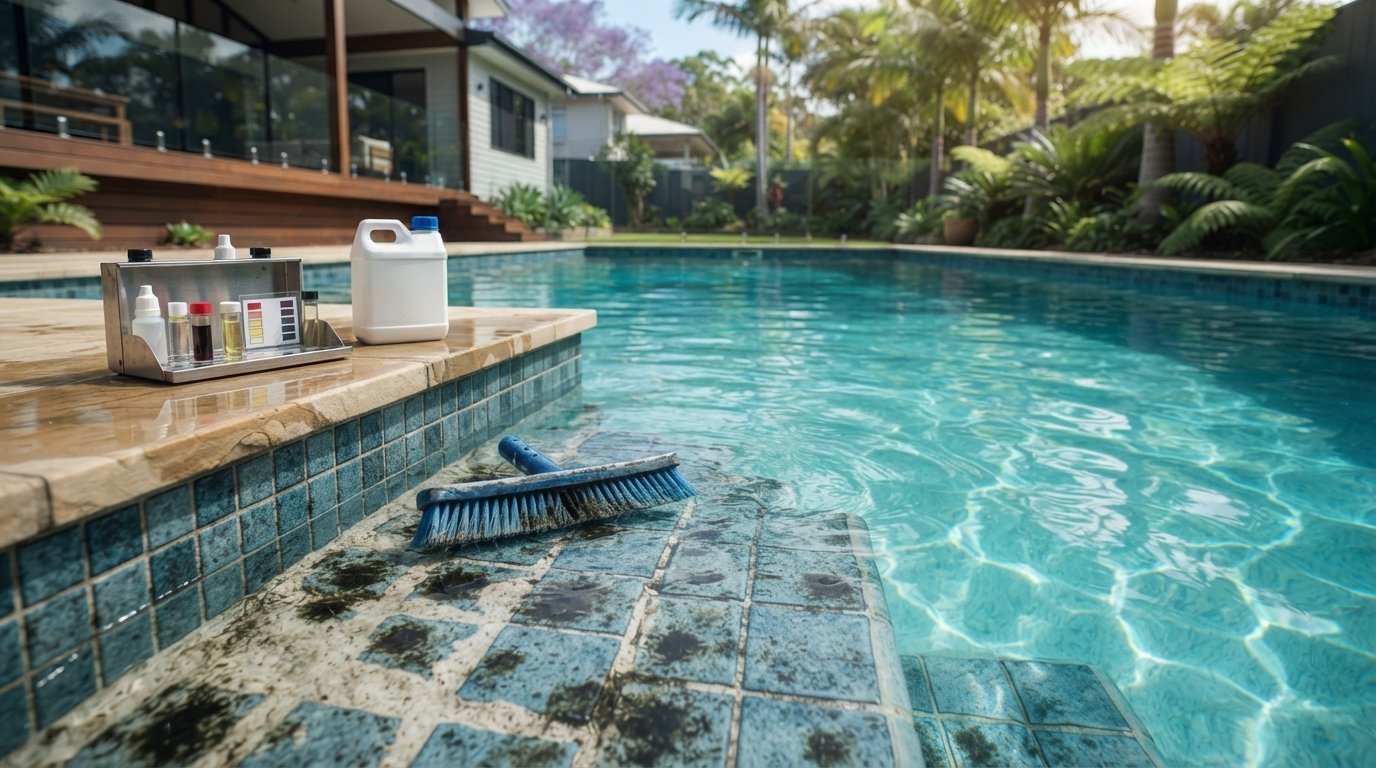
Black spot algae removal in Brisbane takes more than scrubbing visible marks. The algae can embed in porous surfaces and protect itself with an outer layer that resists chemicals. Brush the affected area, balance the water and use an algaecide formulated for black spot, following the product instructions. Draining the pool alone won’t clear the issue: spores and residue on exposed surfaces also need attention before refilling.
If spots return after cleaning, it doesn’t necessarily mean you missed something obvious. Black spot can cling to walls and grout, while poor circulation, low sanitiser levels and warm water can create conditions for regrowth.
This guide explains what causes black spot, why it can resist treatment and how to approach removal safely. You’ll learn how algaecide, surface cleaning and the condition of a drained pool can affect the result, along with maintenance steps that help limit regrowth.
Key Takeaways
- Learn how poor circulation, low sanitiser and warm water can create conditions for black spot to thrive.
- See why brushing the affected areas daily for a week can help expose algae’s protective outer layer.
- Understand why a black spot-specific algaecide and careful use according to its instructions matter.
- Find out why visible cleaning may not remove algae embedded in porous surfaces, grout or pool crevices.
- Follow practical steps for treatment, then keep water balanced and surfaces clean to help limit regrowth.
What is black spot and what causes it?
- Identify the marks before choosing a treatment. Black spot algae commonly appears as small, dark spots on pool walls, floors and grout lines. It is a form of cyanobacteria that can thrive in warm, sunlit water when circulation or sanitation is inadequate. Poor water balance and organic debris can also create favourable conditions. Look closely at textured surfaces, where spots may be harder to see and reach.
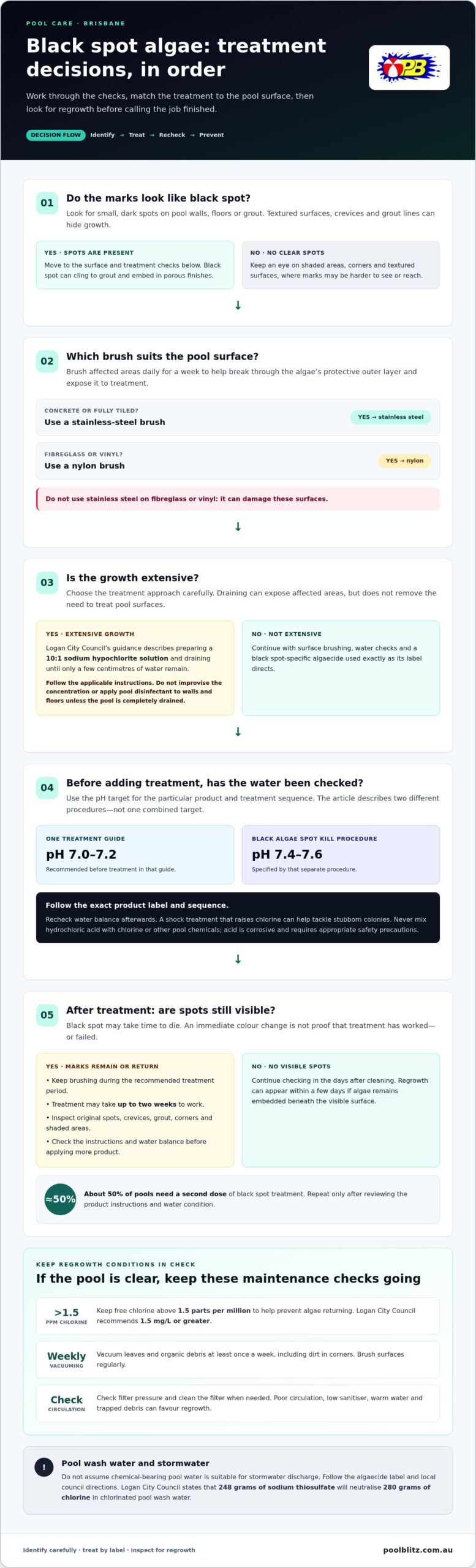
- Brush affected areas daily for a week. Black spot can form a protective outer layer, so brushing helps break through the barrier and expose the growth to treatment. Choose a brush suited to the pool surface: stainless steel is recommended for concrete and fully tiled pools, while nylon suits fibreglass and vinyl. Avoid stainless steel on fibreglass or vinyl, as it can damage these surfaces.
- Test and adjust the water before applying chemicals. One treatment guide recommends a pH between 7.0 and 7.2 before treatment, while the black algae Spot Kill procedure calls for 7.4-7.6. These are different procedures, not a single combined target. Follow the particular algaecide’s label and its treatment sequence, then check the water balance again afterwards. A shock treatment that raises chlorine can help tackle stubborn colonies.
- Assess extensive growth before deciding whether surface treatment is suitable. For extensive black spot algae, Logan City Council recommends preparing a 10:1 sodium hypochlorite solution and draining the pool until only a few centimetres of water remain. Draining exposes affected areas, but it does not remove the need to treat pool surfaces. Avoid improvising the concentration or applying pool disinfectant to walls and floors unless the pool is completely drained.
- Use hydrochloric acid only as part of a specific, controlled treatment. For very heavy black spot, the procedure specifies 5 litres of hydrochloric acid per 50,000 litres of pool water, diluted at a 1:10 ratio with pool water, then mixed by running the pump for two hours. Acid is corrosive, so don’t handle or dose it casually. Never mix it with chlorine or other pool chemicals; follow the product instructions and appropriate safety precautions.
- Allow the treatment time to work, then inspect and repeat only as directed. Black spot may take up to two weeks to die after algaecide treatment, so an immediate colour change won’t tell you whether it has worked. Keep brushing visible spots during the recommended treatment period, maintain circulation when the procedure calls for it, and recheck stubborn areas. If spots remain, review the treatment instructions and water balance before applying more product.
Algae regrowth after cleaning
- Keep treated water away from stormwater drains. Brisbane and Queensland requirements can depend on the water and where it goes, so don’t assume chemical-bearing pool water is suitable for stormwater discharge. Follow the algaecide label and local council directions for handling discharge. Logan City Council states that 248 grams of sodium thiosulfate will neutralise 280 grams of chlorine in chlorinated pool wash water.
- Inspect the pool again in the days after cleaning. Black spot can regrow within a few days if the visible surface is removed but growth remains embedded in a crevice or porous finish. Check the original spots, nearby corners, grout lines and shaded areas. A surface that looks clean immediately after scrubbing doesn’t show whether treatment reached the underlying algae.
- Plan for follow-up rather than assuming one application will finish the job. Approximately 50% of pools need a second dose of black spot treatment. If spots remain, review the algaecide instructions and water condition before repeating treatment. A pool may look as it did before within two weeks if black spot remains after treatment, so inspect systematically instead of judging by the first day.
- Maintain sanitiser levels after treatment. Keeping free chlorine above 1.5 parts per million helps prevent black spot and other algae from returning. Logan City Council recommends maintaining free chlorine at 1.5 mg/L or greater in swimming pools. Test the water as part of ongoing care, and respond to readings that fall below the target rather than waiting for dark marks to reappear.
- Remove debris that can support new growth. Vacuum leaves and other organic matter, including from corners where dirt settles, at least once a week. Logan City Council recommends weekly vacuuming to remove leaves and debris. Brush surfaces regularly and check the filter pressure gauge. Clean the filter when needed to support circulation, filtration and water quality.
- Track what changes before spots return. Note where algae reappears, whether circulation reaches those areas, and how water balance shifts between tests. Persistent recurrence can point to a combination of poor circulation, inadequate sanitation or trapped debris, rather than a need for stronger chemicals alone. Expert water balancing can help assess changing water conditions, while a robotic pool cleaner can support routine debris removal. Explore pool water balancing as part of a consistent maintenance routine.
Because black spot algae in swimming pools can regrow within a few days after its visible top is removed, treat your first post-cleaning check as an early checkpoint, not a final verdict. Compare marked areas with how they looked just after cleaning, and keep the timing in mind when judging whether the improvement has lasted. A mark returning within a few days is consistent with regrowth, so the initial appearance alone can’t confirm the pool will remain clear.
Applying black spot algaecide
- Choose an algaecide formulated specifically for black spot algae. Other algaecides may be less effective against growth protected by a resistant outer layer. Some treatment approaches pair a copper-based black spot algaecide with a specialised granular formula containing slow-release trichlor. Formulations differ, so follow the instructions for the exact product rather than combining methods or assuming doses are interchangeable.
- Test the pool water and prepare it according to the product directions. Water balance affects treatment performance, so assess pH and chlorine before adding chemicals. A pool water sample can help identify imbalances that may interfere with treatment. Follow the label’s sequence and dose instructions, including any required adjustments, rather than applying a general target from a different treatment procedure.
- Calculate the dose from the pool’s water volume and the stated level of growth. For light black algae growth, the Spot Kill procedure calls for 125 grams per 10,000 litres of pool water. For heavy growth, it calls for 250 grams per 10,000 litres. These are procedure-specific directions, not a universal dose for every algaecide. Measure carefully and follow the product label.
- Apply treatment at night or when the pool isn’t in use. The Spot Kill procedure recommends avoiding circulation for 12 to 24 hours after application, allowing the treatment to contact affected areas. This is specific to that procedure, so don’t transfer its pump instructions to another product. Keep people out of the pool during treatment and follow the manufacturer’s directions for safe use.
- Give the treatment time to work before judging the result. Black spot algae may take up to two weeks to die, and its appearance may not change immediately. Follow the product directions for brushing, filtration and water testing during this period. When the instructions call for circulation again, brush affected areas and remove dead algae debris from the pool.
- Inspect the same spots after the treatment period. A second dose may be necessary if the algae has been present for longer than a month, but repeat treatment only as directed by the product instructions. Persistent marks can indicate surviving growth or a water-balance issue. Review the pool water and treatment sequence before adding more chemicals.
- Check the pool’s sanitising system before choosing a treatment. Spot Kill should not be used in biguanide pools. An algaecide that conflicts with the pool’s sanitiser can disrupt treatment and water care. Identify the sanitising system first, then match the product directions to it. Never mix pool chemicals or substitute one product’s instructions for another’s.
Why black spot algae is difficult to remove
Pressure washing may clear surface marks, but it can’t reliably reach algae embedded in grout or porous finishes. Strong jets can also erode grout or damage pool surfaces, so use brushing and a treatment suited to the surface instead.
Keep children and pets away while handling bleach or algae remover, and protect nearby plants from splashes and drift. Follow the product label, prevent chemical runoff and never mix pool chemicals.
- Check where the spots sit before choosing a removal method. Black spot can attach to pool walls or become embedded between tiles, so a clean-looking surface may still conceal growth in grout lines, corners or textured finishes. Note the affected areas, then compare them after treatment.
- Match the brush to the pool surface. A stainless steel brush is recommended for concrete and fully tiled pools, while nylon suits fibreglass and vinyl-lined pools. Stainless steel can scratch or damage softer finishes. On pebblecrete, careful scrubbing can help break through the algae’s protective outer layer.
- Don’t use visible colour as your only measure of success. The protective layer can shield black spot from chemical treatments, and algae may remain attached beneath the surface. Brush thoroughly around each mark, including its edges, then follow the algaecide instructions for timing and follow-up. A quick pass may disturb only the exposed growth.
- Assess circulation as well as the affected surface. Poor circulation can leave some areas with less sanitiser movement, allowing growth to persist in recesses and behind fittings. Check whether water reaches the marked wall or floor. Brushing can loosen growth, while effective filtration and circulation help treatment reach more of the pool.
- Use pressure washing cautiously, especially near grout, pebble finishes and pool fittings. The effect depends on the surface and the force applied, so a jet that removes a mark may also strip or weaken the finish. Don’t use pressure washing instead of identifying the pool surface, brushing appropriately and following the chemical treatment label.
- Protect surrounding areas during chemical treatment. Read the label before opening a container, apply the product only as directed, and prevent splashes from reaching plants, pets or stormwater. Keep pets away from the pool and treated area until the product instructions allow access. Store chemicals securely and separately, rather than combining leftovers or transferring them into unlabelled containers.
- Reassess the whole treatment process if spots remain. Check whether the brush suited the surface, the chemical matched the pool’s sanitising system, and circulation and water balance supported treatment. Black spot is difficult to remove because surface cleaning, water conditions and chemical contact all matter. Addressing only one factor can leave growth behind.
What are the step-by-step instructions for removing black spot algae safely?
- Test the pool water before adding treatment. Have it professionally assessed before starting chemical treatment, so the product and dose suit the water condition. Check the sanitising system and read the algaecide label first. Products differ, and instructions for one formulation shouldn’t be transferred to another.
- Brush affected areas with a brush suited to the surface. Use stainless steel for concrete and fully tiled pools, and nylon for fibreglass or vinyl-lined pools. Avoid stainless steel on fibreglass and vinyl, where it can cause damage. Scrub spots and nearby crevices to break through the algae’s protective surface.
- Apply an algaecide formulated for black spot, following its manufacturer’s instructions. Use the stated dose for your pool volume and treatment conditions. Some procedures recommend brushing first, switching off the pump, then waiting 4 to 6 hours for the water to become still. Follow that sequence only when it matches the chosen product’s directions.
- Restart circulation when the product instructions say to do so. During treatment, run the pool filter for 8 hours per day, as the guide recommends. Brush the affected spots again after restarting the pump, then manually vacuum the pool to remove loosened algae from corners and crevices. Check the filter and clear collected debris.
- Repeat treatment only if black spots remain and the product directions permit it. Recheck the water and the affected areas before applying another dose, rather than adding chemicals by guesswork. After treatment, readjust the pool water pH to between 7.4 and 7.6, as the guide recommends, and continue monitoring the remaining marks.
- Keep swimmers out until the water meets the treatment procedure’s re-entry condition. One procedure says not to swim until free chlorine has dropped to 5.0 or lower. Check the product instructions for the applicable measure and timing; don’t treat that chlorine threshold as a universal rule for every product or pool.
- For a drained pool, use a separate surface-disinfection procedure rather than adapting an in-water dose. Logan City Council recommends disinfecting drained pool walls and floors with a 1 mg/L sodium hypochlorite solution, keeping surfaces wet for half an hour, then hosing them off. The council also recommends refilling and ensuring free chlorine residual is at least 1.5 to 2 mg/L.
- Use expert water balancing when test results or repeat growth make the sequence difficult to manage. Accurate water assessment helps guide chemical treatment and ongoing care. Arrange expert pool water balancing to help you interpret the pool’s condition and plan the next treatment steps.
Pool Blitz: Regular Pool Servicing
Pool Blitz provides regular pool servicing to help keep pool care consistent after black spot treatment. Ongoing attention to water balance, filtration and debris can help address conditions that favour algae growth. If spots keep returning or you need help maintaining the pool between treatments, regular servicing offers practical continuity. Casual pool servicing is also available for a particular maintenance task.
Robotic pool cleaners and repairs can support routine cleaning, and Pool Blitz also supplies pool chemicals for pool care. The right approach depends on your pool’s needs, from managing water condition to keeping surfaces and equipment in working order.
Contact Pool Blitz to discuss pool servicing and care.
Make ongoing pool care part of the plan
Black spot algae removal in Brisbane is easier to manage as part of a deliberate maintenance routine than as a response to marks that have already spread. Use what you’ve learned to decide which tasks you can manage consistently and where ongoing support could make pool care simpler.
Pool Blitz offers regular pool servicing, robotic pool cleaners and repairs, and casual pool servicing. These options suit different needs, whether you want continuing assistance, help with pool cleaning equipment or support with a particular maintenance task. Choose the approach that fits your pool and the level of care you want to manage yourself.
For a considered next step, contact Pool Blitz for pool help. A steady routine can make it easier to keep your pool ready for a clear, comfortable swim.
Frequently Asked Questions
What is black spot algae and how can you identify it on surfaces in Brisbane?
Black spot algae is cyanobacteria that appears as dark marks on pool surfaces. To inspect a Brisbane pool, look closely along tile grout, steps, shaded walls and areas that are harder to brush. Note whether marks sit on the surface or seem fixed within a textured finish. For black spot algae removal in Brisbane, recording where marks remain after cleaning can help distinguish persistent growth from loose debris or shifting stains.
Which Brisbane companies provide black spot algae cleaning and what do their services include?
Pool Blitz provides pool servicing and water-care support in Brisbane, including regular and casual servicing and expert water balancing. Its pool offerings also include chemicals, filtration systems, pumps and pool equipment repairs. For black spot algae removal in Brisbane, these services support pool maintenance and equipment care, whether you need help with water balance, ongoing care or equipment performance.
How long does black spot algae removal take and how long do results last?
Black spot treatment may take up to two weeks to kill the algae, depending on the procedure. Visible regrowth can appear within a few days if growth remains after surface cleaning, and a second treatment dose may be needed. How long the pool stays clear depends on follow-up care, including balanced water, debris removal and monitoring. Inspect treated areas again rather than judging success immediately after brushing.
How can you prevent black spot algae from returning in Brisbane’s climate?
Keep the water sanitised, circulation working and pool surfaces free of trapped debris. Logan City Council recommends maintaining free chlorine at 1.5 mg/L or greater in swimming pools, and vacuuming at least once a week to remove leaves and debris. In Brisbane’s warm conditions, make regular checks of water balance, filter pressure and shaded corners part of your routine, so developing issues are addressed before dark spots spread.
No responses yet