
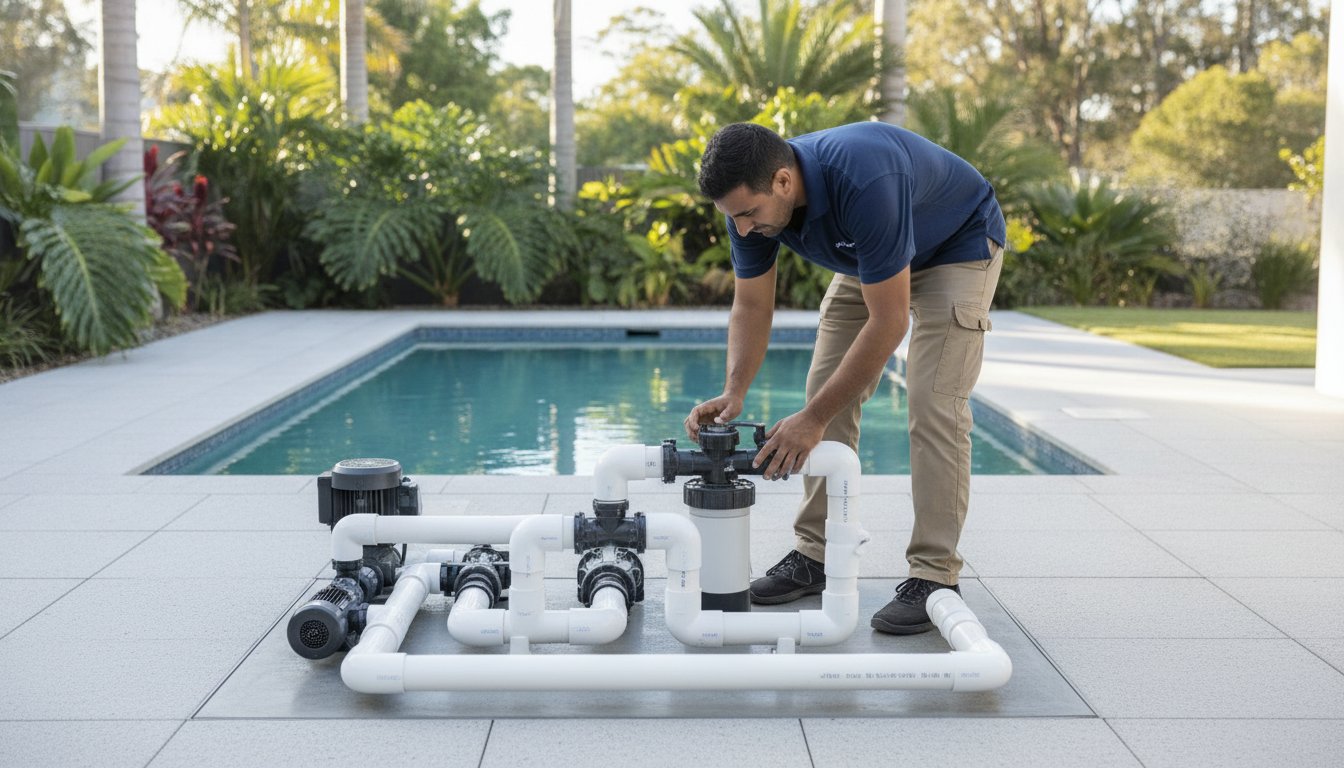
Your pool’s plumbing is the vital circulatory system that keeps every component from the filter to the chlorinator functioning, yet it remains the most overlooked part of the setup until a major fault occurs. When you’re facing a drop in water levels or a struggling pump, seeking professional pool plumbing repair Brisbane wide is the most effective way to prevent a minor leak from turning into a total system burnout. It’s completely understandable to feel a sense of dread when you notice your equipment making strange noises or see your water bills climbing unexpectedly. You want a backyard that offers relaxation, not a source of technical confusion over complex pipe layouts and multi-port valve settings.
This guide will provide the clarity you need to identify critical plumbing issues and restore your pool to peak operating condition. We’ll show you how to detect hidden leaks, simplify your valve configurations, and regain the whisper-quiet efficiency your system was designed for. We’ll take a methodical look at pressure testing, seal replacements, and the preventative steps that guarantee the long-term health and longevity of your pool hardware. By addressing these concerns now, you can ensure your water remains crystal clear and your equipment stays protected for years to come.
Key Takeaways
- Learn why your pool’s plumbing acts as an essential circulatory system, ensuring effective water balancing and chemical distribution throughout your setup.
- Discover how to spot early warning signs like air bubbles in return jets or water pooling around the equipment pad before they lead to costly pump burnout.
- Understand the unique impact of Brisbane’s intense UV rays and shifting clay soils on the long-term integrity of your underground and exposed PVC pipework.
- Gain confidence in deciding when to tackle simple O-ring maintenance yourself and when to enlist professional pool plumbing repair brisbane for complex valve or pressure pipe issues.
- Explore how 30 years of local experience can help you maintain a quiet, efficient filtration system that survives the rigours of the Queensland climate.
Understanding Your Brisbane Pool’s Plumbing Network
Pool plumbing is the network of pipes and valves connecting the pool to the filtration plant. Think of this network as the circulatory system for your swimming pool, where every pipe serves as a vital artery or vein to keep the water moving. Proper flow is not just about aesthetics; it is absolutely essential for effective water balancing and chemical distribution. In our local region, Brisbane systems often face unique pressure due to high evaporation rates and intense summer heat, which can stress the PVC joints and seals more than in cooler climates. When the flow is restricted, your chemicals won’t circulate properly, leading to dull water and potential algae growth that compromises your swimming pool sanitation standards.
The Suction Side vs. The Pressure Side
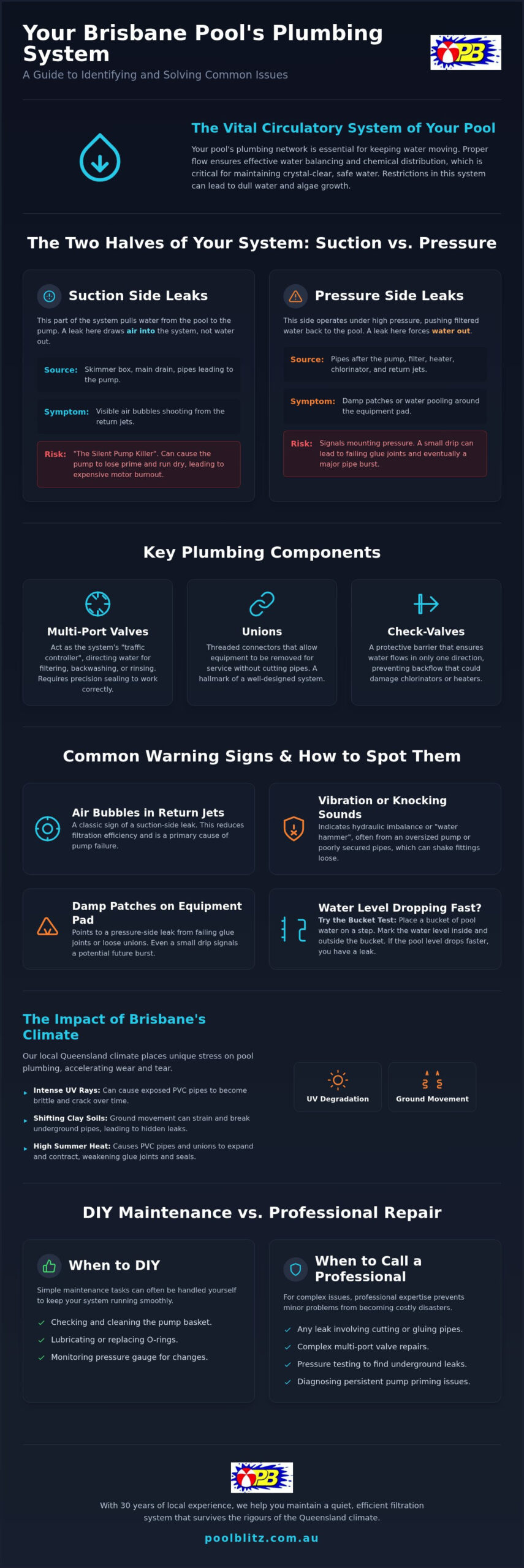
The suction side encompasses everything from the skimmer box and main drain to the front of the pump basket. This is where the pump pulls water under a vacuum, meaning any tiny crack or loose fitting will draw air into the system rather than leaking water out. Conversely, the pressure side begins after the water leaves the pump and passes through the filter. Identifying which side is compromised is the fundamental first step in any pool plumbing repair Brisbane homeowners undertake, as it dictates whether we are looking for a vacuum leak or a visible water spray. A suction leak often results in air bubbles at the return jets, while a pressure leak is usually identified by damp patches around the equipment pad.
Key Components: Valves, Unions, and Check-Valves
Multi-port valves act as the traffic controllers for your filtration system, allowing you to switch between filtering, backwashing, and rinsing with a simple turn of a handle. These components are complex and require precision sealing to prevent water from bypassing the filter. Unions are another essential feature; these threaded connectors allow for the easy removal of equipment without the need to cut pipes, which is a hallmark of a well-designed system. Finally, check-valves serve as a protective barrier to prevent water from flowing backwards through the pipes. This is particularly important for protecting your chlorinator and ensuring consistent water quality throughout the day. Investing in a professional pool plumbing repair Brisbane service ensures these components are aligned correctly, preventing backflow issues that could damage your expensive pump or heater.
Common Pool Plumbing Issues: Identifying the Culprits
Identifying a fault in your system requires a keen eye for subtle changes. Air bubbles dancing in the return jets are a classic indicator of a suction-side leak, a common reason for pool plumbing repair Brisbane homeowners encounter during the humid summer months. This symptom suggests that air is being drawn into the pipes before it reaches the pump, which can severely impact filtration. Damp patches on the concrete equipment pad often point toward failing glue joints or loose unions. While a small drip might seem insignificant, it often signals a mounting pressure issue within your pipework that could eventually lead to a major pipe burst.
Determining the source of water loss is best achieved through a simple “bucket test”. Place a bucket of water on the pool step and mark the water level both inside the bucket and in the pool; if the pool level drops faster than the bucket, you likely have a leak rather than just evaporation. Vibration or knocking sounds in your plumbing are signs of hydraulic imbalance. This often occurs when pipes are poorly mounted or when the pump is oversized for the existing pipe diameter, causing water hammer that can shake fittings loose over time.
Suction Leaks: The Silent Pump Killers
Air entering the system is the primary cause of a pump losing its prime. Common culprits include perished o-rings in the pump basket lid or loose unions that have expanded over time due to heat. Running a pump dry because of excessive air intake is a significant risk that can lead to expensive motor failure. It’s a silent threat that slowly degrades the internal seals of your equipment, making it vital to address even minor bubbles as soon as they appear.
Pressure Leaks and Cracked Manifolds
High-pressure zones are where PVC glue joints are most likely to fail under the strain of the Queensland climate. Identifying hairline cracks in filter manifolds or heater bypasses requires a methodical approach to pool plumbing repair Brisbane experts have refined over decades. While these leaks are easier to see, they are often harder to fix because they require cutting and re-plumbing sections of the manifold. When performing any repairs, it’s vital to remain compliant with Queensland pool safety laws to ensure your barrier and equipment remains secure. If you suspect your system is losing more water than it should, seeking professional equipment repairs can save you from a catastrophic failure.
The Impact of Brisbane’s Climate on Plumbing Longevity
Brisbane’s subtropical climate provides the perfect environment for year-round swimming, yet the same conditions that make a pool so appealing also place significant stress on its infrastructure. Intense Queensland UV rays are a leading cause of pool plumbing repair Brisbane residents face, as prolonged exposure gradually degrades the integrity of PVC pipework. Beyond the sun, our local clay-heavy soil is prone to significant movement during the dramatic shifts between wet and dry seasons. This constant expansion and contraction of the earth can cause rigid underground pipes to shear or pull away from the pool shell, leading to hidden water loss that is difficult to detect without expert intervention.
Thermal expansion also plays a critical role in the lifespan of your system. During a typical Brisbane summer heatwave, PVC pipes can expand considerably. If the original installation didn’t account for this movement, the resulting pressure can cause glue joints to fail or manifolds to crack. Chemical balance is the final piece of the longevity puzzle. Following healthy pool maintenance tips ensures your water chemistry doesn’t become aggressive, which would otherwise eat away at delicate valve seals and gaskets over time.
UV Protection for Your Equipment Pad
Exposed PVC pipes on your equipment pad are particularly vulnerable to the sun’s harsh rays. Over time, these pipes become sun-bleached and chalky, which is a clear sign that the material has become brittle and is likely to fail. Applying a simple coat of outdoor-rated paint can provide a protective barrier, significantly extending the life of your pipework. Protecting your filtration for swimming pool from direct sunlight not only prevents leaks but also keeps the plastic components of your filter and chlorinator from warping or cracking under extreme heat.
Managing Soil Movement and Pipe Stress
Rigid PVC is strong, but it lacks the flexibility to withstand the powerful forces of shifting clay soil. When the ground moves, these pipes can snap cleanly, especially near fixed points like the skimmer box or the pool returns. Signs of underground failure often include soft spots in the lawn or a pool level that drops consistently even when the pump is turned off. We use professional pressure testing to locate these hidden faults, ensuring that any pool plumbing repair Brisbane homeowners require is targeted and effective. This methodical approach saves you from unnecessary excavation and provides peace of mind that your pool’s foundation remains secure.
DIY Maintenance vs. Professional Repair: A Decision Guide
Maintaining a pool involves a mix of regular vigilance and technical skill. While many homeowners are comfortable with basic skimming, understanding when to attempt a fix yourself and when to call for pool plumbing repair Brisbane is vital for the long-term health of your equipment. Simple tasks, such as cleaning pump basket o-rings or gently tightening hand-unions that have vibrated loose, are well within the reach of a weekend DIY project. However, tasks that involve cutting into the main pipework or dismantling complex multi-port valves carry significant risks to your system’s integrity.
PVC cement is not a standard adhesive; it is a solvent weld that chemically fuses plastic together. Once the bond is set, it is permanent. A single misalignment or a failure to properly prime the joint can result in a leak that is impossible to patch, often requiring an entire manifold to be cut out and rebuilt from scratch. For these high-stakes tasks, it is often more cost-effective to secure pool equipment repairs in Brisbane before a minor drip becomes a major infrastructure project.
The Homeowner’s Plumbing Toolkit
Every pool owner should keep a small selection of essentials on hand to keep their system running smoothly. A high-quality, silicone-based lubricant is the most important tool for maintaining o-rings, as petroleum-based products will cause the rubber to swell and perish. If you suspect a suction-side leak, a simple spray bottle filled with soapy water can be used to identify air being drawn into fittings. You can also make minor valve handle adjustments to ensure water is flowing through the filter with maximum efficiency without needing a full system overhaul.
When Professional Intervention is Mandatory
Certain scenarios demand the precision of a seasoned expert. If you are planning to relocate your equipment pad or need to rebuild a cracked manifold, the hydraulic calculations required are best left to professionals. Leaks located under concrete slabs or timber decking require specialised listening devices and pressure testing equipment to locate without destroying your landscaping. When the complexity of a pool plumbing repair Brisbane project involves underground pipework or hydrostatic valves, the stakes are simply too high for guesswork. If you are unsure about the state of your pipework, you can book a professional plumbing inspection to ensure your system remains leak-free and efficient.
Professional Pool Plumbing Solutions by Pool Blitz
Reliability in pool maintenance is built on a foundation of experience and a deep understanding of local conditions. Since our founding in 1994, Pool Blitz has dedicated over three decades to diagnosing and resolving the most complex pool plumbing repair Brisbane homeowners encounter. We don’t believe in temporary patches that only mask deeper issues. Instead, our team focuses on high-quality PVC pressure pipe repairs and precision valve replacements that restore the long-term stability of your entire system. This commitment to excellence ensures that your backyard remains a sanctuary of clear water rather than a site for constant mechanical frustration.
Our approach is fundamentally holistic, ensuring your plumbing network operates in perfect harmony with your pump and filtration equipment. A poorly configured pipe layout can place unnecessary strain on a motor, leading to premature failure and inflated energy costs. By optimising the hydraulic flow, we help your hardware run at peak efficiency, which ultimately extends the lifespan of your investment. You can trust our seasoned experts to act as protective stewards of your property, providing the peace of mind that comes from a job done right the first time.
Our Methodical Repair Process
Precision is the hallmark of our service, and we follow a rigorous three-step process to guarantee results. We begin with systematic pressure testing and a thorough visual inspection to pinpoint the exact source of any leak or restriction. Once the issue is identified, we use premium materials specifically engineered to withstand the harsh Australian climate and intense UV exposure. Finally, we conduct comprehensive post-repair flow testing. This final check ensures that every union, valve, and joint is performing exactly as intended, giving you a whisper-quiet system that filters water with maximum effectiveness.
Securing Your Pool’s Future
Preventative care is the most effective way to avoid major plumbing emergencies and the high costs associated with them. Transitioning from a reactive “fix-it” mindset to a proactive maintenance schedule allows you to identify small o-ring perishes or minor valve leaks before they compromise your pump’s motor. Regular servicing acts as an insurance policy for your pool’s longevity, keeping your water chemistry balanced and your equipment pad dry. If you’ve noticed a drop in pressure or unusual vibrations, it’s time to act before the damage spreads. You can Organise a professional plumbing inspection with Pool Blitz today to ensure your system is ready for the seasons ahead.
Restoring Efficiency and Peace of Mind to Your Backyard
A high-functioning plumbing network is the foundation of a healthy swimming environment. We’ve explored how identifying the difference between suction and pressure leaks can save your pump from burnout, and why protecting your pipes from Brisbane’s intense UV rays is essential for long-term durability. While small maintenance tasks keep things ticking over, complex issues like cracked manifolds or shifting soil damage require the precision of a seasoned expert. When you need pool plumbing repair brisbane residents have trusted since 1994, it’s about choosing a solution that prioritises stability over speed.
As Brisbane equipment repair specialists, we’re dedicated to the precision and care your property deserves. We understand the unique challenges of the Queensland climate and provide the expertise needed to keep your system whisper-quiet and leak-free. You don’t have to navigate technical pipework alone. Book your expert pool plumbing repair with Pool Blitz today and ensure your system operates at peak efficiency all year round. Your pool should be a source of relaxation, and we’re here to make sure it stays that way.
Frequently Asked Questions
Why is my pool pump sucking air and how can I stop it?
Air in the system usually indicates a suction-side leak where the pump draws air through a loose fitting or perished seal. You should first inspect the pump basket lid o-ring for cracks and apply a silicone-based lubricant. Ensure your pool water level is halfway up the skimmer box opening. If bubbles persist, professional pool plumbing repair Brisbane experts can pressure test the lines to find hidden intake points.
How do I find a leak in my underground pool plumbing?
Identifying underground leaks requires a combination of observation and specialised equipment. You can start by looking for unexplained damp patches in the garden or sunken pavers near the pool shell. Professionals use pressure testing to isolate specific lines and sonic leak detectors to pinpoint the exact location of the break. This methodical approach avoids unnecessary excavation and ensures a precise repair that protects your pool’s structural integrity.
Can I repair a cracked pool pipe myself with epoxy or tape?
Epoxy and tape are only temporary fixes and will eventually fail under the high pressure generated by your filtration system. Pool plumbing relies on solvent welding, which chemically fuses PVC pipes together to create a permanent, leak-proof bond. Attempting a “quick fix” often leads to a more expensive manifold rebuild later on. It’s always better to cut out the damaged section and replace it with new pressure-rated PVC pipework.
What causes pool plumbing to rattle or vibrate during operation?
Rattling is often caused by hydraulic imbalance or pipes that haven’t been secured properly to the equipment pad. When water flow is restricted or the pump is too powerful for the pipe diameter, it creates a “water hammer” effect that vibrates the fittings. Checking for loose mounting brackets or clearing debris from the pump basket can often resolve minor noise. Persistent vibration should be inspected to prevent the joints from shaking loose over time.
How much does it typically cost to repair pool plumbing in Brisbane?
The cost of repairs depends on the complexity of the leak and the specific parts required for the job. Minor repairs like replacing a multi-port valve spider gasket are relatively affordable, while repairing underground pipes requires more labour and specialised diagnostic tools. We recommend a professional assessment to receive an accurate quote tailored to your system’s needs. Investing in quality pool plumbing repair Brisbane wide prevents the much higher costs of equipment burnout.
How often should pool valves and o-rings be serviced?
You should have your pool valves and o-rings inspected and lubricated at least once a year. Brisbane’s heat can cause rubber seals to become brittle and lose their elasticity, leading to slow leaks and air intake. Regular lubrication with a silicone-based product prevents these seals from sticking or tearing. Proactive servicing every twelve months ensures your filtration system remains airtight and operates at peak efficiency throughout the swimming season.
Why does my multi-port valve leak water out of the waste line?
Water leaking from the waste line while the valve is in the “filter” position usually points to a perished spider gasket. This internal rubber seal prevents water from bypassing the intended ports. If the gasket is worn or the internal spring has lost tension, water escapes through the waste outlet. Replacing these internal components promptly is essential to prevent significant water loss and chemical imbalance in your pool.
Is it normal for pool pipes to change colour in the sun?
It is common for white PVC pipes to turn yellow or brown when exposed to intense Queensland UV rays. This colour change indicates that the plastic is becoming brittle and losing its structural integrity. To prevent sun-bleached pipes from cracking, we recommend painting exposed sections with outdoor-rated paint. This simple protective measure acts as a shield against the sun, significantly extending the lifespan of your equipment pad plumbing.
No responses yet