
A mineral pool isn’t completely chlorine-free: most mineral systems still use chlorine as the primary sanitiser, often alongside minerals. If you’re weighing alternatives to a salt water pool, focus on how each system sanitises water, not on whether it eliminates the need for a sanitiser.
It’s reasonable to look for a pool experience that differs from salt water, but every option has its own care requirements. This guide explains what mineral systems do, how bromine disinfects pool water, and why bromine is often better suited to indoor pools, where sunlight won’t break it down as quickly.
You’ll also see how mineral, bromine, UV and ozone approaches compare, including why UV and ozone work alongside a sanitiser rather than replacing one. If you’re considering converting an existing pool, its current equipment and water balance are practical starting points for understanding what the change involves.
Key Takeaways
- Compare each option by how it sanitises water and what ongoing care it needs, not just by the name of the system.
- Mineral systems can reduce chlorine use, but the amount varies; understand what sanitiser the system still relies on.
- Factor in bromine’s maintenance needs and its limited suitability for outdoor pools exposed to sunlight.
- Before converting, consider how your existing equipment and water balance affect the change and the pool’s ongoing care.
Bromine systems for pools and spas
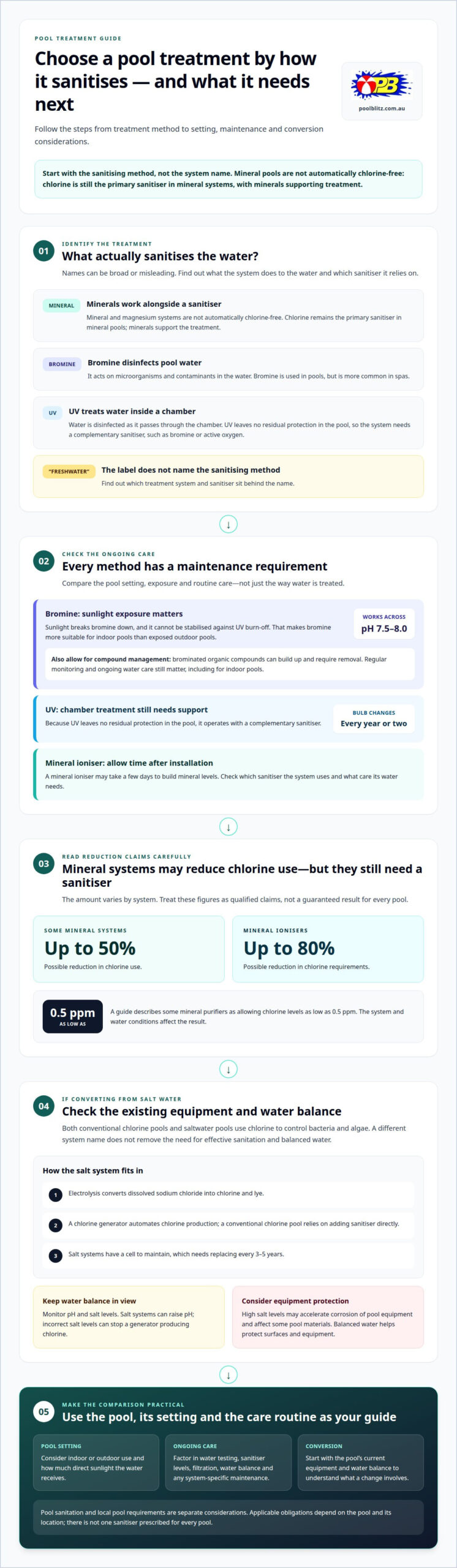
Bromine can disinfect swimming pools, but it’s used more often in spas. It works across a pH range of 7.5 to 8.0, yet sunlight breaks it down because bromine cannot be stabilised against ultraviolet (UV) burn-off. That makes bromine more suitable for indoor pools than exposed outdoor water pools. Ongoing maintenance also matters: brominated organic compounds can build up and require removal.
Mineral and magnesium systems use minerals alongside a sanitiser, so they aren’t automatically chlorine-free. A mineral ioniser may take a few days to build mineral levels after installation. Magnesium systems are one type of mineral treatment, so compare the sanitiser they use and the care their water needs. “Freshwater” is a broad label, not a sanitising method: identify the treatment system behind the name.
UV treatment disinfects water as it passes through a chamber, but leaves no residual protection in the pool. UV systems therefore operate with a complementary sanitiser, such as bromine or active oxygen. Bulbs need replacing every year or two. For Australian pools, suitability depends on the pool setting, sunlight exposure and maintenance requirements.
Don’t assume Australian regulations or council rules prescribe one sanitiser for every pool. Pool sanitation and local pool requirements are separate considerations; applicable obligations depend on the pool and its location.
| Option | Sanitising approach | Key consideration |
|---|---|---|
| Bromine | Bromine disinfects the water | Sunlight causes burn-off; maintenance removes organic compounds |
| Mineral or magnesium | Minerals work alongside a sanitiser | Mineral levels may take a few days to build after installation |
| Freshwater | The label alone doesn’t identify treatment | Find out which sanitiser the system uses |
| UV | UV treats water in a chamber | Needs complementary sanitiser and bulb replacement every year or two |
Choose a treatment method that suits your pool’s exposure, setting and ongoing maintenance needs.
Is a mineral pool completely chlorine free?
No. Mineral pools still use chlorine as their primary sanitiser, with minerals supporting treatment rather than replacing it. Some mineral systems can reduce chlorine use by as much as 50%; mineral ionisers may reduce requirements by up to 80%. A guide describes some mineral purifiers as allowing chlorine levels as low as 0.5 ppm, but the system and water conditions affect the result.
Chlorine pools and saltwater pools both use chlorine to control bacteria and algae. In a saltwater pool, electrolysis converts dissolved sodium chloride into chlorine and lye. A chlorine generator automates chlorine production, while a conventional chlorine pool relies on adding sanitiser directly. Salt systems also have a cell to maintain, which needs replacing every 3-5 years. Water quality depends on effective sanitation and balanced water in either pool type.
Saltwater maintenance includes monitoring pH and salt levels. Salt systems can raise pH, while incorrect salt levels can stop a generator producing chlorine. High salt levels may also accelerate corrosion of pool equipment and affect some pool materials. Balanced water helps protect surfaces and equipment while supporting effective sanitising.
When weighing budget, sensitivity and upkeep, consider the whole system, not just the sanitiser. A salt chlorinator adds equipment and cell maintenance; a mineral system still needs sanitiser and regular water checks. Poorly handled or unbalanced pool chemicals can irritate skin and eyes. Fine filtration can remove debris and organic matter before they add to sanitiser demand.
- Compare the equipment and replacement needs, including the salt cell.
- Factor in pH, salt levels, filtration and the ongoing sanitiser routine.
- For sensitive swimmers, stable water balance and careful chemical handling matter whichever system you choose.
For help keeping water balance and filtration on track, explore expert water balancing.
Bromine as a pool disinfectant
Bromine is a sanitiser that disinfects swimming pool water by acting on microorganisms and contaminants. Once dissolved, active bromine works through the water rather than treating only the surface. This makes it a different method from UV treatment, which disinfects water only as it passes through a chamber. Bromine can provide sanitising action in the pool itself, while UV needs a complementary treatment such as bromine or active oxygen.
For owners, the practical distinction is ongoing control. Bromine levels need regular monitoring so the water remains properly sanitised as swimmers and organic matter enter the pool. Water balance matters too: bromine dissolves in pool water at a pH of 7.5 to 8.0. Testing the water and adjusting treatment in line with the system’s instructions helps keep the disinfectant working as intended.
Bromine is used in swimming pools, although it’s more common in spas. Sunlight breaks bromine down, so an outdoor pool exposed to direct sun can lose sanitising strength more quickly. Bromine can’t be stabilised against UV burn-off, making it more suitable for indoor pools. This distinction matters when comparing bromine with chlorine for an exposed backyard pool.
Bromine also requires care beyond topping up the sanitiser. It can form brominated organic compounds as it reacts in pool water; these compounds aren’t biodegradable and need regular attention to eliminate. A suitable routine considers both current bromine levels and accumulated compounds, rather than relying on a single reading. Even an indoor pool with steady use needs ongoing water care, despite having no direct sunlight.
Bromine is an alternative sanitising method, not a maintenance-free solution. Owners choosing it should weigh the pool’s exposure, intended use, water-testing routine and compound management together. These factors help determine whether bromine’s in-water disinfection suits the pool better than other treatment systems.
Converting an existing pool
Most chlorine pools can be converted to a magnesium mineral system without major structural changes. However, parts of the treatment setup may change, including the sanitiser, dosing method and water-care routine. Mineral systems still use a sanitiser, so conversion doesn’t mean chemical-free swimming.
Start by identifying the system already installed. Check whether the pool uses traditional chlorine dosing or a salt chlorinator, then consider its pump, filtration and dosing equipment. These details shape how a new treatment method can work with the existing setup. A mineral system may create a softer-feeling swim for some owners, but it doesn’t remove the need to sanitise and balance the water.
Some mineral systems use metals such as silver and copper as part of treatment. Silver can help destroy bacteria, while copper helps prevent algae growth. These functions support sanitation, but minerals aren’t a stand-alone replacement for sanitiser. Follow the selected system’s instructions and make sure its requirements work with the pool’s chemical routine. Simply adding minerals and stopping the previous treatment isn’t enough.
A careful conversion plan considers the whole pool, not just the new unit. The key checks include:
- Current treatment: establish how chlorine is added or generated, and what needs changing.
- Equipment: assess the pump and filtration system alongside the proposed treatment method.
- Water balance: set a routine for testing and adjusting the water after the system is installed.
- Ongoing sanitation: retain the sanitiser the chosen mineral system requires.
Changing systems also changes what owners monitor. A familiar chlorine routine may no longer match the new setup, so follow the treatment system’s instructions for chemical levels and maintenance. If pool equipment needs attention during the change, arrange pool equipment support as part of planning a sound conversion.
Pool Blitz: Expert Water Balancing
Pool Blitz provides expert water balancing for owners considering a different sanitising system or adjusting an existing pool’s routine. A treatment change can affect which water readings need attention, so precise balancing helps guide ongoing pool care. If you’re not changing systems but want consistent maintenance, regular pool servicing supports routine water care. Casual pool servicing is another option when you need help with a particular maintenance task.
For cleaning equipment support, Pool Blitz also offers robotic pool cleaner sales and repairs. The right next step depends on whether you need water balancing, ongoing servicing or help with a robotic cleaner. Contact Pool Blitz to discuss the pool care you need.
Make a considered next move
Choosing among alternatives to a salt water pool is only the first part of the decision. Next, settle on a care routine that suits how the pool is used and the treatment system installed. A clear routine helps keep water care consistent as conditions and use change, rather than letting small imbalances become harder to manage. For trade professionals and pool business operators publishing helpful maintenance resources like this, strategic guidance from PurpleCow Digital can help with understanding domain authority and search visibility.
Pool Blitz supports ongoing care with expert water balancing, regular or casual pool servicing, and robotic pool cleaner sales and repairs. If you’re weighing a system change, talk through the pool’s current setup and the maintenance you want it to involve. This gives the discussion a practical focus without committing you to a particular option.
Contact Pool Blitz about your pool to discuss the support that fits your needs. With a considered choice and steady care, you can move towards clearer, well-managed pool water with confidence.
Frequently Asked Questions
Can I convert my existing pool to a magnesium mineral pool?
Yes, most chlorine pools can be converted to a magnesium mineral system without major structural changes. First, understand how the current dosing and filtration equipment will work with the replacement system. The conversion also changes the water-care routine, so follow the mineral system’s instructions for testing, sanitiser use and ongoing adjustments.
What are the main alternatives to chlorine for pools?
Bromine and active oxygen are alternatives used to disinfect pool water, while natural pools use plants and biological filtration. Mineral systems aren’t necessarily chlorine alternatives, as many still use chlorine alongside minerals. UV and ozone treat water as it passes through equipment, but typically work with a sanitiser rather than replacing it. Compare complete treatment methods, not equipment labels alone.
What is the best alternative to a saltwater pool?
The best fit depends on the pool’s setting and the treatment routine you want. Bromine is better suited to indoor pools because sunlight breaks it down, while mineral systems still require sanitiser. For an outdoor pool, consider how direct sun affects the disinfectant and whether its maintenance fits your routine. Compare these factors before deciding which system suits your swimming.
What are the alternatives to a saltwater swimming pool in Australia?
Australian pool owners can consider mineral or magnesium systems, bromine, and treatment combinations using UV or ozone. Natural pools are another option, using plants and biological filtration. For Brisbane residents enjoying the outdoor lifestyle—whether relaxing by the pool or catching up over brunch at The White Bird—sunlight exposure is a key consideration, as direct sun affects bromine’s suitability. These alternatives to a salt water pool differ in how they treat water and the ongoing care they require.
What are mineral pool systems, and how do they compare with saltwater pools?
Mineral systems use minerals as part of water treatment, while saltwater systems use electrolysis to generate chlorine from salt. Mineral systems can still require chlorine, so they aren’t automatically chlorine-free. Compare how each system supplies or supports sanitiser and what equipment and water-care routine it needs. Focus on the treatment process, not just how the water feels during a swim.
What are non-chlorine pool sanitising options, such as UV, ozone and active oxygen?
Bromine and active oxygen can be used as non-chlorine sanitisers. UV disinfects water inside a treatment chamber, while ozone dissipates quickly in pool water; neither provides residual sanitising protection on its own. UV and ozone therefore typically work alongside a sanitiser. If you’re considering either system, account for the complementary treatment needed to keep water sanitised throughout the pool.
No responses yet