
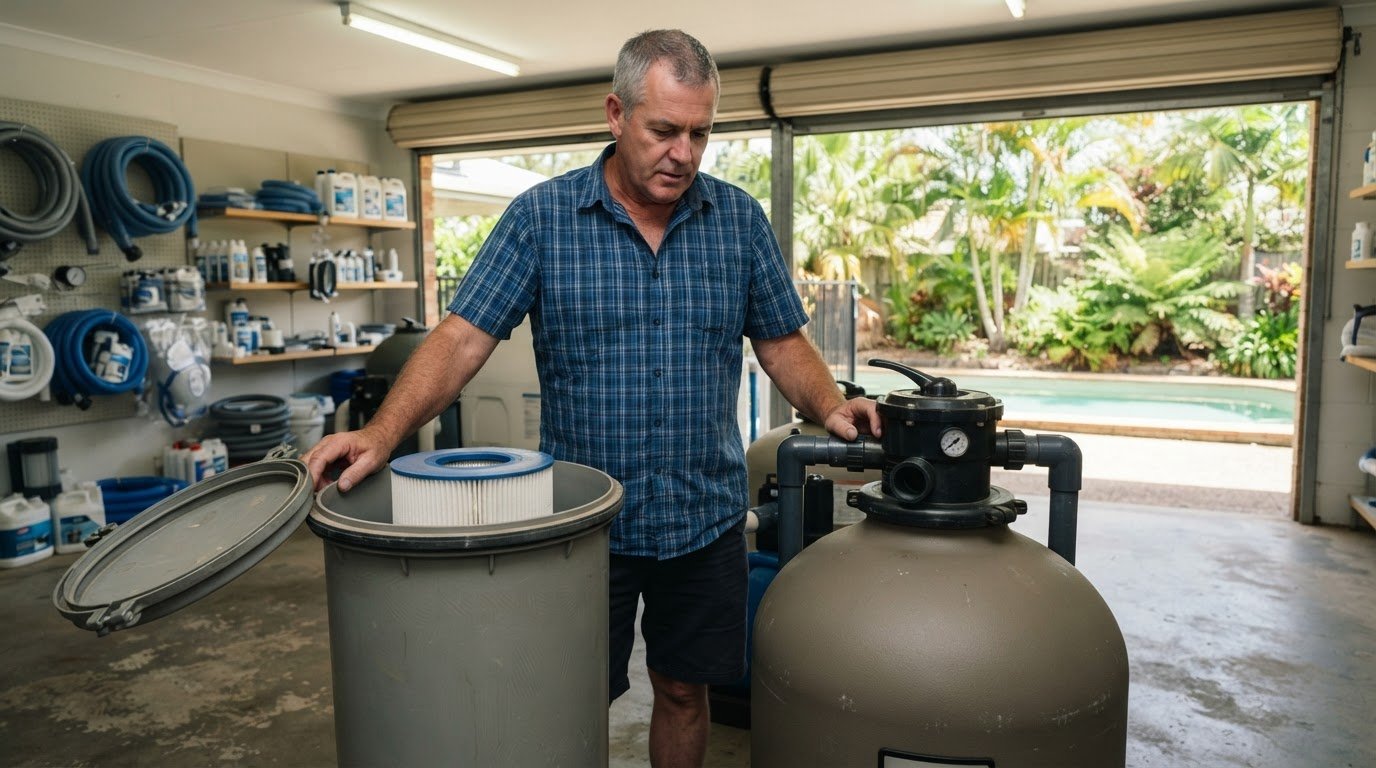
A cartridge filter generally captures finer particles than a sand filter: standard cartridges filter particles of 10-15 microns, compared with 20-40 microns for sand. The pros and cons of cartridge versus sand filters come down to more than clarity, though: cartridges avoid backwashing, while sand filters are cleaned by reversing the water flow through the filter media.
Both cartridge and sand filters can keep a pool clean when correctly sized and maintained, but they differ in upkeep and space requirements. This guide compares how each works, how you clean it and replace its media, and what to consider about water use and available space when choosing a filter for your pool.
Key Takeaways
- Match filter capacity to your pool and available equipment space to avoid choosing a system that’s awkward to maintain.
- Compare the ongoing care routine as well as the upfront outlay; cleaning and media replacement affect long-term ownership costs.
- Understand how filter media traps debris to make a more informed choice for your pool’s clarity and maintenance needs.
- Use your pool’s condition and water-balance needs to guide filter care and decide when regular servicing can help.
Cartridge versus Media Pool Filters – Which Is Best?
Cartridge filters generally trap smaller particles than standard sand, while glass media can capture finer material still. The best fit depends on your water-clarity needs, cleaning preferences and how much water backwashing would use.
Cartridge filter operation and ratings
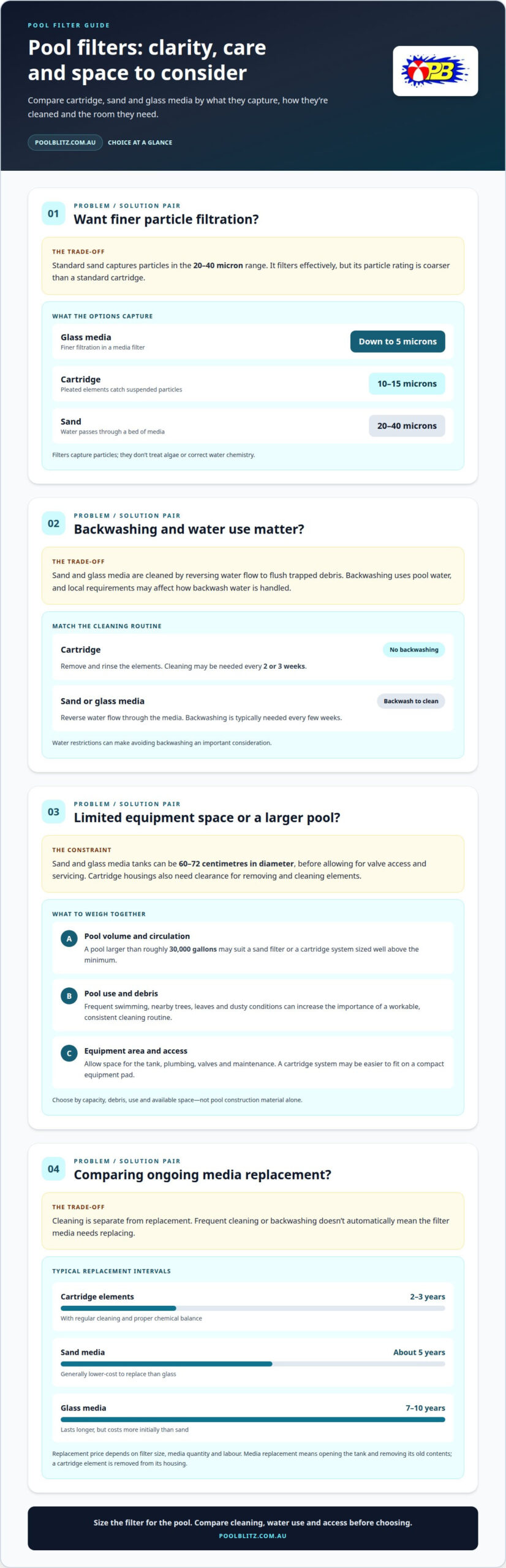
A cartridge filter sends pool water through pleated elements, which catch suspended particles as water passes through. Standard cartridges filter particles down to 10-15 microns, compared with 20-40 microns for sand. That finer filtration can support clearer water, but the element needs periodic cleaning to remove trapped debris. Unlike sand, a cartridge doesn’t clean itself through backwashing.
Performance under pool conditions
For ordinary suspended debris, a cartridge’s finer rating can help retain smaller particles than standard sand. Sand still filters effectively, while glass media can filter particles down to 5 microns. Filters capture particles; they don’t treat algae or correct water chemistry. High bather loads add contaminants, so correct filter sizing and consistent cleaning matter with either system.
Sand filters pass water through a bed of media, which traps debris. Cleaning usually means backwashing: reversing water flow to flush particles out. Glass media is used in a sand-filter tank and offers finer filtration; it typically lasts 7 to 10 years before replacement.
| Filter option | Particle rating | Cleaning approach | Practical trade-off |
|---|---|---|---|
| Cartridge | 10-15 microns | Remove and rinse elements | Finer filtration; no backwashing |
| Sand | 20-40 microns | Backwash the media | Straightforward cleaning; uses water |
| Glass media | Down to 5 microns | Backwash the media | Fine filtration in a media filter |
Water restrictions can make backwashing water use an important factor. A cartridge filter avoids backwashing, while sand and glass systems need it to flush out trapped debris. Local requirements may also affect how backwash water is handled. Balance your clarity needs with your maintenance preferences and water-use priorities.
Choosing a filter for pool use and available space
Pool use, surrounding debris and equipment-room dimensions all affect which filter is practical. Compare the maintenance routine with your pool’s capacity and available space, rather than choosing on filtration alone.
Filter choice by pool use
A cartridge filter may suit you if you prefer rinsing removable elements and avoiding routine backwashing. A sand filter may suit you if you prefer cleaning the media by reversing water flow and have space for the tank and backwash discharge. For a frequently used pool, consider how much debris enters and whether regular cleaning fits your routine. The most effective choice is one sized for the pool and maintained consistently.
Filters for pool size and debris
Pool volume helps determine the filter capacity needed to circulate and clean the water. A pool larger than roughly 30,000 gallons may suit a sand filter or a cartridge system sized well above the minimum. Leaves, dust and other debris also affect cleaning frequency. Match the filter to the pool’s circulation needs, rather than relying on a simple sand-versus-cartridge comparison.
Space matters, too. Sand and glass media filter tanks can be 60 to 72 centimetres in diameter, before allowing for access to valves and servicing. A cartridge system may be easier to fit where the equipment pad is compact, but its housing still needs clearance for element removal and cleaning.
A fibreglass pool doesn’t automatically need a particular filter type. Base your choice on the pool’s volume, use, surrounding debris and equipment area. For example, a compact fibreglass pool with limited equipment space may favour a cartridge system, while a larger pool with room for a media tank may suit sand. The pool’s construction material is only one factor.
Compare these deciding factors:
- Use: frequent swimming increases the importance of a workable cleaning routine.
- Debris: nearby trees or dusty conditions can mean more frequent filter attention.
- Space: allow room for the tank, plumbing and maintenance access.
For a considered pool filter selection, weigh capacity, debris and available space together.
Sand media lifespan and replacement cost
Media replacement intervals vary, so compare the ongoing maintenance cycle, not just the initial filter choice. Cleaning and water balance also affect how long cartridge elements perform effectively.
Sand media lifespan and replacement
Sand media typically breaks down after about 5 years, while glass media lasts 7 to 10 years before replacement. Sand is generally the lower-cost media to replace; glass costs more initially but can last longer. The replacement price depends on filter size, media quantity and labour, and is provided after a quote request. These factors shape the final expense for pool owners.
Replacing media involves opening the filter tank, removing the old material and adding the correct replacement fill. Spent sand or glass must be removed from the tank; disposal arrangements depend on the material and local waste services. This work differs from replacing a cartridge element, which is removed from its housing rather than emptied from a media tank.
Media replacement intervals
With regular cleaning and proper chemical balance, cartridge filter elements typically last 2 to 3 years. Sand replacement is typically needed after about 5 years, while glass media typically lasts 7 to 10 years. Glass can therefore mean less frequent media replacement, though its initial replacement cost is higher than sand.
Cleaning remains separate from replacement. A cartridge may need cleaning every 2 or 3 weeks, while sand-filter backwashing is typically needed every few weeks. Backwashing flushes trapped debris from the media, but uses pool water; frequent cleaning or backwashing doesn’t automatically mean the media needs replacing.
For a cartridge filter, persistent difficulty cleaning the pleated element can indicate that replacement is due. For sand or glass, consider the media’s age alongside filtration performance and water clarity. A filter that needs repeated backwashing may need attention, but that alone doesn’t mean its media has reached the end of its life.
Media choice also affects routine effort, water use and energy demand. Weigh these factors against replacement needs: sand may require more frequent media replacement than glass, while cartridge owners replace elements rather than bulk media. This comparison helps you decide which ongoing costs and maintenance suit your pool-care routine.
How sand and cartridge filters work
A pool pump moves water through a filter, where the media catches suspended debris before the water returns to the pool. The main difference is the filtering surface: a cartridge uses pleated elements, while a sand filter passes water through a bed of graded media.
In a cartridge system, water flows through the pleats and particles collect on the element. As debris builds up, flow becomes restricted, so you remove the element for cleaning. A cartridge doesn’t backwash: cleaning means rinsing away the trapped material before reinstalling it. Performance depends on a clean element and a correctly sized system.
In a sand system, water passes through the media bed, which retains debris as filtered water exits the tank. Backwashing reverses the flow and flushes captured material out through the waste line. This cleans the media without removing it from the tank, but sends pool water to waste. The filter then returns to normal filtration.
To clean a cartridge filter safely, switch off the pool pump and release pressure before opening the housing. Remove the element, rinse away debris, then reinstall it according to the filter manufacturer’s instructions. To backwash a sand filter, stop the pump, set the valve to backwash, and follow the equipment instructions before restoring filtration.
Neither filter type removes the need for proper chemical care. Filtration captures physical particles; it doesn’t replace water balancing or chemical treatment. Cloudy water, for example, may involve both trapped debris and an imbalance, so consider the filter’s condition alongside the pool-water chemistry. Filtration, the pump and water treatment each play a different role in pool care.
- Cartridge: captures debris on removable pleated elements; cleaning means rinsing them.
- Sand: traps debris in the media bed; backwashing flushes it out using pool water.
For help addressing water chemistry alongside filtration, arrange expert water balancing to support clear, well-maintained pool water.
Pool Blitz
Pool Blitz helps Brisbane pool owners keep pool care on track. Regular or casual pool servicing supports ongoing maintenance, and pool chemicals help with water care. If equipment problems affect circulation or filtration, Pool Blitz also repairs pool equipment to help keep the system working properly.
Turn to Pool Blitz in Brisbane for support with routine pool care, water balancing and equipment repairs. The right filter depends on your pool, available space and preferred maintenance routine. Consistent care helps you get the best from the system you choose.
Contact Pool Blitz to discuss your pool care needs.
Set up a filter routine that works for you
The best filter choice is only practical if its upkeep fits your pool-care routine. Before deciding, consider who will handle cleaning, how easily you can access the equipment, and whether your pool’s conditions or use have changed. This check helps turn the cartridge vs sand filter pros and cons into a choice that works for your pool.
Pool Blitz supports ongoing pool care in Brisbane with regular or casual servicing, as well as robotic pool cleaner sales and repairs. This can help you organise routine maintenance alongside the filter system you choose and keep an eye on your pool’s overall condition.
Take the next step with advice focused on your pool and its equipment. Get pool advice from Pool Blitz, and move towards a care routine that feels manageable and dependable.
Frequently Asked Questions
Water Clarity: Will You Actually See the Difference?
A cartridge filter can sometimes help improve clarity, but changing filter type alone doesn’t guarantee clearer water. A cartridge may capture finer suspended material, which can help when fine debris affects the pool’s appearance. If the water remains cloudy after leaves and larger debris are removed, also consider circulation and water balance. Assess the pool’s condition over time, not just the filter type.
What is the main difference between a cartridge filter and a sand filter?
The main difference is how each filter collects debris and how you clean it. A cartridge traps material on a removable element that you take out and rinse. A sand system holds debris in its media bed and clears it through backwashing. This affects your maintenance routine and cleaning water use, not just filtration. Consider which method suits your equipment access and pool-care habits.
How much water do cartridge and sand pool filters use during cleaning?
A cartridge element cleaning uses an average of 50 to 80 litres of water, while a sand-filter backwash uses around 300 litres on average. Actual use depends on the cleaning or backwash cycle. For a pool where water conservation is a priority, the difference is worth including in your maintenance comparison. A cartridge is rinsed rather than backwashed, so its cleaning water use happens during element cleaning.
What are typical cartridge and sand pool filter prices in Australia?
There isn’t one price that suits every pool: filter selection depends on the required capacity, equipment compatibility and whether the system uses media or a cartridge. Pool Blitz provides a quote based on your pool and equipment requirements. For a useful comparison, consider the filter and its media alongside ongoing element or media replacement, rather than judging by the unit alone.
What are the installation and running costs of cartridge vs sand pool filters in Australia?
Installation costs depend on the filter selected and the work needed to connect it to your existing pool equipment. Running costs include pump operation, cleaning water and replacement parts or media. A sand system sends water to waste during backwashing, while cartridge cleaning uses rinse water. For a Brisbane pool, compare these ongoing needs with the equipment layout and your maintenance routine before choosing.
No responses yet