
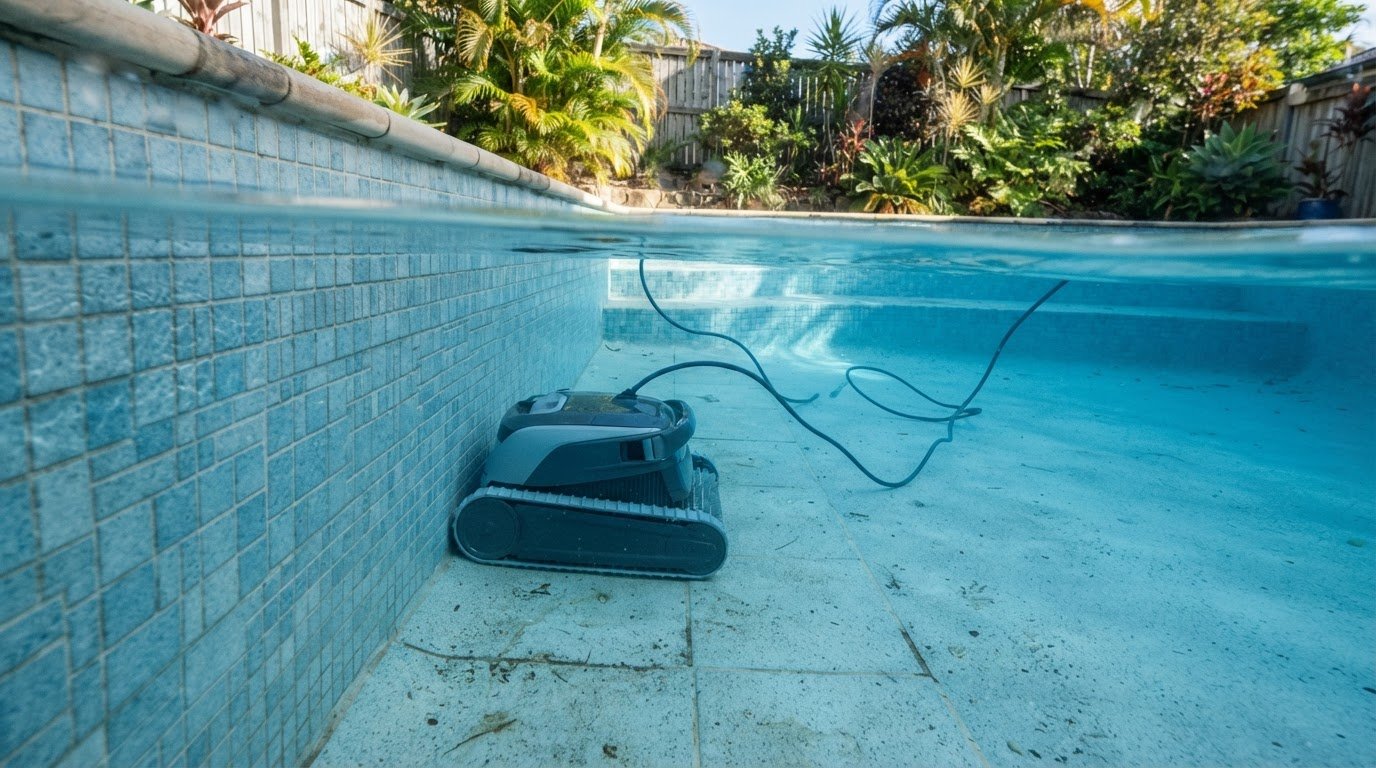
Wall climbing depends on more than the cleaner’s motor. If my pool cleaner is not climbing walls, water flow or level, slippery surfaces, worn traction parts and the selected cleaning cycle are all worth considering; some robotic cleaners are designed to clean pool floors only. A methodical diagnosis separates water and surface conditions from wear, pool features and cleaner settings.
It’s understandable to suspect a fault when your pool cleaner stays on the floor, but the cause may be a mismatch between its condition, the pool and its operating settings. Replacing parts before identifying what is affecting grip or movement can miss the real issue.
This guide explains how water conditions, filters, brushes and tracks, pool features and cleaning modes affect wall climbing. You’ll also learn which signs point to routine maintenance and when a mechanical or electrical fault may need professional attention, so you can choose a practical next step.
Key Takeaways
- Water flow, water level and slippery wall build-up can all affect a cleaner’s grip, so water conditions and surfaces are useful starting points.
- A technician can assess brushes, tracks, tyres and climbing rings for wear or slick residue that may reduce traction.
- Pool shape, ledges and transitions can influence how a cleaner moves around the pool and reaches its walls.
- Check whether the cleaner’s cycle includes wall cleaning; some models are designed for floor cleaning only.
1. Water chemistry and surface conditions
A cleaner may lose its grip if the pool surface is slick. Water flow, water level and wall condition all affect climbing. A low water level can disrupt an automatic cleaner’s movement. In many pools, the water sits around the middle of the skimmer opening, unless the pool design requires otherwise.
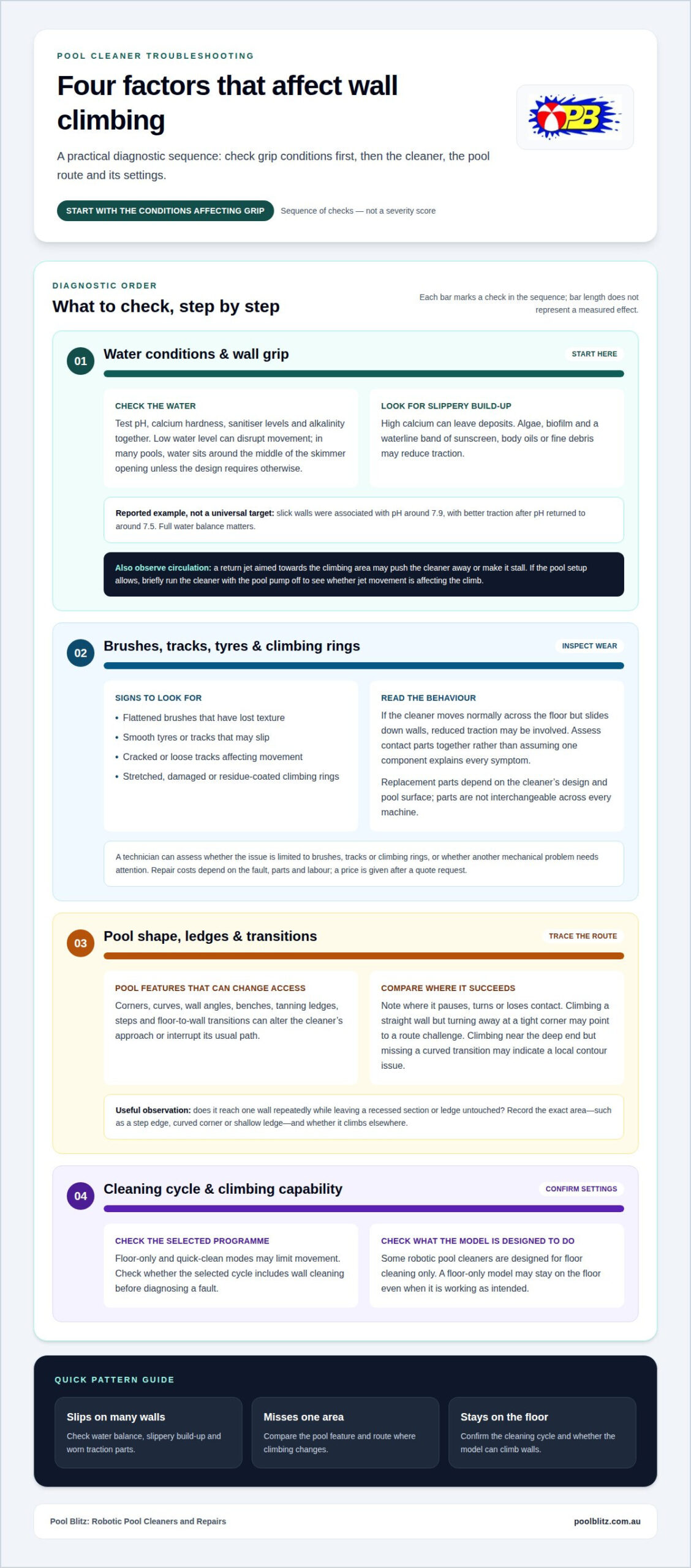
Water testing should cover pH, calcium hardness, sanitiser levels and alkalinity. High calcium can leave deposits on walls, while algae and slippery biofilm can reduce traction. Reported examples have linked slick walls with a pH around 7.9, then better traction after pH returned to around 7.5. Those examples aren’t a universal target; the full water balance matters.
Waterline build-up is another clue. Sunscreen, body oils and fine debris can collect where water meets the wall, leaving a slippery band that interrupts a cleaner’s grip. A technician can assess the surface and brush or clean affected areas as part of resolving the underlying condition.
Return jets can also affect a cleaner’s position. A jet aimed towards the climbing area may push the cleaner away or cause it to stall. If your pool setup allows, briefly running the cleaner with the pool pump off can help show whether return-jet movement is affecting its climb.
Expert water balancing can help determine whether chemistry is contributing to poor traction, rather than treating every climbing problem as a mechanical fault. pH, calcium hardness, sanitiser and alkalinity work as a connected system. Correcting one reading without considering the others may leave deposits, algae or slick surfaces unresolved.
When my pool cleaner is not climbing walls, a technician can assess water conditions alongside surface build-up and circulation. That joined-up check helps distinguish a chemistry or traction issue from a cleaner fault, and guides the next maintenance step.
2. How a technician checks worn brushes and tracks
Worn traction parts can prevent a cleaner gripping the wall. Replacement brushes, tracks or tyres can restore grip when they’re worn smooth. A technician may also replace climbing rings if they’re stretched, damaged or slick with residue. In Australia, professional repair costs depend on the fault, parts and labour. The price is given after a quote request.
Start by inspecting the parts that touch the pool surface. Flattened brushes may lack the texture needed to hold against a wall. Smooth tyres or tracks can slip during a climb, while cracked or loose tracks may affect movement. Assess the parts together rather than assuming one worn component explains every symptom.
Climbing rings need attention too. Check for stretching, wear and slick build-up, then consider whether their condition matches the cleaner’s behaviour. For example, a cleaner that moves normally across the floor but slides down walls may have reduced traction. This helps distinguish a grip problem from a wider drive or movement fault.
Assess wear against the cleaner’s model and pool surface. Brushes and tracks aren’t interchangeable across every machine, and the correct replacement depends on the cleaner’s design. Identify the affected part and whether related components also need attention. Replacing one worn part may not solve the problem if other contact parts have also deteriorated.
If an inspection points to damaged or worn components, professional robotic pool cleaner repairs can address the fault and restore the cleaner’s working condition. The assessment also helps explain whether the issue is limited to brushes, tracks or climbing rings, or whether another mechanical problem needs attention. This gives you a clearer basis for deciding on the repair.
3. Pool shape, ledges, and transitions
A cleaner’s route depends partly on the pool’s layout. Consider how corners, curves and wall angles affect its approach and contact. For example, it may climb a straight wall but turn away where that wall meets a tight corner. This pattern can point to a route or access challenge rather than worn traction parts.
Built-in benches and tanning ledges create changes in level. A cleaner crossing a shallow ledge may need to get over an edge before reaching the wall. Its movement can differ from a clear floor-to-wall transition, especially where a bench interrupts its usual path. Observe where the cleaner pauses, turns or loses contact.
Steps can divide the pool into smaller areas and change the route between them. A cleaner may move around a broad step but struggle to pass a narrow opening beside it. The step positions, their edges and the route towards the wall can explain why climbing succeeds in one area but not another.
Floor-to-wall transitions matter too. A sharp angle, curved cove or change from shallow to deep water can affect the cleaner’s approach. For instance, a unit that climbs near the deep end but misses a curved transition elsewhere may be responding to the pool’s contours. Compare its movement across those different surfaces.
Pool shape can affect coverage as well as climbing. A cleaner may repeatedly reach one wall while leaving a recessed section or ledge untouched. This pattern helps distinguish a local access issue from a problem affecting every wall. Assess the pool’s features alongside the cleaner’s route, movement and wall contact.
When reporting a climbing problem, describe the exact area, such as a curved corner, step edge or shallow ledge, and whether the cleaner climbs elsewhere. These details give a clearer starting point for assessing how the pool’s design affects its movement.
4. Cleaner settings and wall-climbing capability
A cleaner can stay on the floor because its selected cycle excludes wall cleaning. Floor-only and quick-clean modes may limit movement, even when the unit works properly. A technician checks the selected programme against the cleaner’s intended cleaning tasks before diagnosing a fault.
The cleaner’s capabilities matter as much as its cycle. Some robotic pool cleaners are designed only for floors, so changing settings won’t make them climb. Identify the model and check its manual for the stated cleaning functions. This distinguishes a normal design limitation from a problem that needs repair.
For a model designed to clean walls, check its control settings and operating mode. A floor-only option, quick cycle or incorrect programme may explain why it misses the walls. Its route matters too: climbing in one cycle but not another points towards settings, while no wall contact across suitable cycles calls for further diagnosis.
Other operating conditions can help narrow down the cause. Place a robotic cleaner slowly in the water and let it sink to the pool floor before starting it, so trapped air can escape. A twisted cable can restrict movement or pull the unit away from a wall. Check cable movement and length alongside the selected programme.
If the appropriate mode is selected but the cleaner still won’t climb, the cause may be mechanical or electrical. A weak drive motor, damaged impeller or sensor issue can affect movement. Assess these possibilities and consult the manufacturer’s manual before accessing internal components. Check warranty coverage before doing work beyond normal maintenance access.
Settings checks help rule out an unsuitable cycle before more involved diagnosis. If your cleaner’s programme or operation remains unclear, arrange a professional cleaner assessment to identify whether its capabilities, settings or a fault are affecting wall climbing.
Pool Blitz: Robotic Pool Cleaners and Repairs
Pool Blitz sells and repairs robotic pool cleaners when a suitable cycle, pool conditions and routine maintenance haven’t resolved poor wall climbing. A technician can assess the cleaner’s movement and identify whether worn parts or a mechanical or electrical fault needs attention. This helps distinguish a repairable problem from a model designed for floor cleaning only.
If water balance or ongoing pool care is also contributing, Regular Pool Servicing, Casual Pool Servicing and Pool Chemicals can support broader maintenance. The right next step depends on the assessment, rather than replacing parts without identifying the cause.
To discuss a wall-climbing problem or arrange an assessment, contact Pool Blitz.
Set up a clearer next step
If my pool cleaner is not climbing walls during a suitable cycle, note what it does instead. Does it stay on the floor, lose contact at one point or stop moving altogether? Record when the issue began and whether it happens throughout the pool. These observations give a technician a useful starting point without guessing at replacement parts.
It also helps to have the cleaner’s make and model available, along with any recent changes to its settings or pool conditions. Keep the unit’s manual and warranty information handy if they’re accessible. A professional assessment can then focus on the cleaner’s behaviour and the most relevant checks, rather than treating every wall-climbing problem alike.
Pool Blitz provides robotic pool cleaner repairs, alongside regular and casual pool servicing. If you’re ready to discuss the problem and decide on a practical next step, contact Pool Blitz for pool help. A clear description of the symptoms is a good place to begin.
Frequently Asked Questions
Why is my pool cleaner not climbing the walls?
Common causes include a floor-only cleaning mode, worn traction parts, restricted flow or a problem with the cleaner’s drive. Note where it stops: at the floor-to-wall join, halfway up or only in one area. This pattern helps narrow the possibilities. A cleaner that never attempts a climb may have a different issue from one that starts climbing and slips back.
How does low pool pump flow or water pressure affect a suction pool cleaner’s wall climbing?
A suction cleaner relies on water moving through its hose to create the suction that draws it across the pool. If flow is insufficient, it may lose the pull needed to move up a wall. A technician assesses the cleaner alongside the pool’s circulation and filtration, since a flow problem can affect cleaning performance beyond wall climbing.
How do technicians assess hose length, floats and flow when a pool cleaner won’t climb walls?
Check whether the hose reaches the cleaner’s full working area without excess length dragging or pulling it away from a wall. Assess float placement and hose movement in the water, then observe whether the cleaner travels freely. The correct arrangement depends on the model. An unsuitable hose setup can limit movement even when the unit runs.
How does a technician troubleshoot a robotic pool cleaner that won’t climb walls?
Start by matching the cleaner’s behaviour to its selected cycle and wall-cleaning capability. Then assess whether restricted filtration, an obstruction or cable movement is affecting operation. If those checks don’t explain the fault, the drive system, impeller and sensors may need further assessment. The manufacturer’s manual and warranty guide appropriate access and repair.
How do pool shape, surface material and waterline tiles affect cleaner wall climbing?
A cleaner may climb a broad wall but struggle at curved corners, narrow transitions or ledges, so its route matters. Surface material also affects grip: very smooth tile can challenge some rollers. Oily or fine debris may collect on waterline tiles, creating a slick strip where the cleaner needs contact. Consider the pool finish and the cleaner’s traction parts together.
Can algae, slippery surfaces or incorrect pool chemistry stop a cleaner climbing walls?
Yes. Algae or slippery build-up can reduce traction, while water imbalance may contribute to deposits or surface conditions that interfere with grip. A technician considers the pool’s appearance alongside tests for pH, calcium hardness, sanitiser and alkalinity. If the readings or wall condition need attention, expert water balancing can address the pool-care side of the problem.
No responses yet