
Your pool filter sand doesn’t just get dirty; it actually loses its ability to clean by physically wearing down until it’s as smooth as a river stone. This mechanical process, known as “rounding,” means that even the most meticulous backwashing won’t restore its original filtration power. You’ve likely felt the frustration of cloudy water that won’t clear despite heavy chlorination, or perhaps you’ve noticed grains of sand settling on the pool floor near the return jets. Understanding exactly when to replace pool filter sand is the essential first step toward reclaiming a healthy, sparkling swimming environment for your family.
We believe that maintaining a pool should bring peace of mind, not a list of equipment headaches. In this 2026 Brisbane guide, we’ll show you how to identify the subtle signs of media failure and explain why timely maintenance leads to lower electricity bills and better pump efficiency. We will cover everything from the typical three to five year lifespan of traditional silica to the benefits of modern glass media, ensuring your pool remains a refreshing sanctuary all year round. By the end of this guide, you will have a clear plan to restore your filtration system to peak performance.
Key Takeaways
- Learn why the natural “rounding” of silica sand grains inevitably leads to cloudy water and how your filter’s internal components manage this essential mechanical process.
- Recognise the five tell-tale indicators, such as rising tank pressure and debris bypass, that signal precisely when to replace pool filter sand for optimal clarity.
- Evaluate the performance differences between traditional sand and high-efficiency glass media to extend the lifespan of your filtration system and reduce backwashing frequency.
- Understand how the unique Queensland climate and high bather loads during Brisbane’s school holidays can accelerate the wear on your filter media.
- Discover how professional maintenance takes the heavy lifting out of sand replacement, ensuring your pool pump operates efficiently and your water remains healthy.
Understanding Your Sand Filter and How It Functions
Sand filters remain the preferred choice for Brisbane homeowners because they offer a reliable, low-maintenance solution for our unique subtropical climate. Sand filters rely on a bed of specialised silica sand to catch debris, ensuring that your swimming area remains inviting even after a heavy summer storm. The multiport valve acts as the brain of the system, directing water through the sand bed to trap contaminants before sending the purified water back to your pool. This simple mechanical process is why sand remains a staple in local backyards, providing a balance of affordability and performance for decades.
While you can’t see them, sand is capable of trapping particles as small as 20 to 40 microns. To put that in perspective, a human hair is about 50 microns wide, meaning the sand is catching debris far smaller than the naked eye can detect. This level of filtration is generally sufficient for most residential settings in Queensland, providing that crisp clarity we all expect when diving in on a hot afternoon. However, the efficiency of this process relies entirely on the physical condition of the sand grains themselves.
The Science of Sand: How Silica Traps Dirt
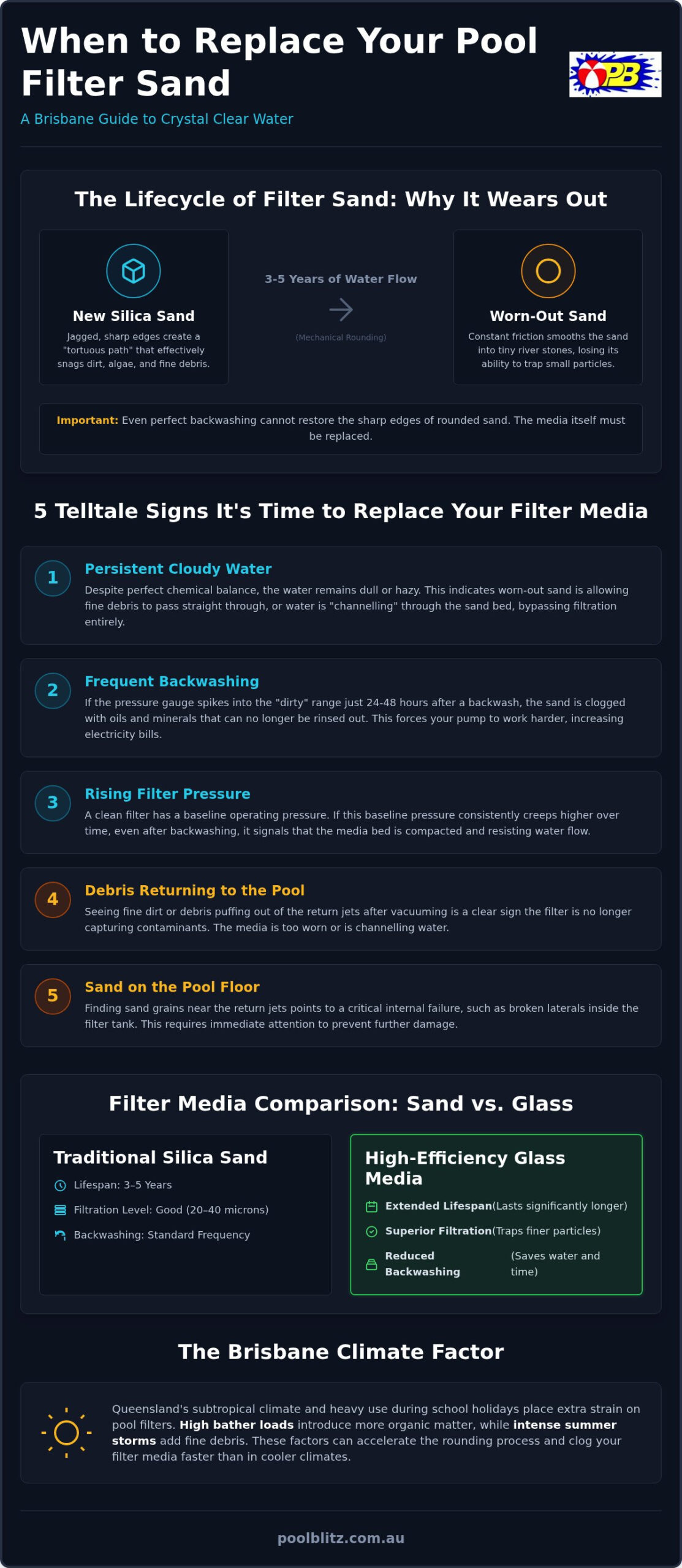
New silica sand isn’t smooth like the sand you’d find at Gold Coast beaches. Instead, each grain is incredibly jagged and sharp, creating what experts call a “tortuous path” for water to navigate. As water moves through the sand bed, these sharp edges snag dirt, algae spores, and organic matter. The depth of the sand bed is critical here, as a shallower bed would allow debris to “punch through” and return to the pool. Maintaining the correct volume of media is a key factor in determining when to replace pool filter sand to keep your equipment running at peak performance.
Why Sand Filter Efficiency Decreases Over Time
Even the most durable silica sand isn’t immune to the constant friction of moving water. Over several years, the once-sharp edges of the sand grains are slowly eroded by the water flow, rendering them less effective at catching fine debris. Smooth sand creates larger gaps in the filter bed, which allows smaller contaminants to bypass the filtration process entirely. Rounding is the mechanical degradation of silica edges over 3-5 years that eventually necessitates a complete media swap. If you notice your water looks dull despite perfect chemical balance, it is often a sign that the sand has simply lost its “grip” on the dirt. Knowing when to replace pool filter sand ensures you don’t waste money on excess chemicals trying to clear up a mechanical filtration issue.
5 Tell-Tale Signs It Is Time to Replace Pool Filter Sand
Recognising the warning signs of a failing filter bed saves you from wasting money on unnecessary chemicals and prevents long-term damage to your pump. Your pool equipment communicates its health through pressure readings and water clarity, providing clear indicators of when the internal media has reached its limit. While silica sand is durable, it eventually succumbs to the pressures of constant water flow and chemical exposure.
The Persistent Cloudy Water Dilemma
If you’ve achieved perfect chemical balance but the water remains dull or hazy, the issue is almost certainly mechanical. “Tired” sand has lost the jagged edges required to snag fine debris, but a more concerning phenomenon is “channeling.” This occurs when water carves direct tunnels through the sand bed, bypassing the filtration media entirely and returning unfiltered contaminants back to your swimming area. When this happens, no amount of chlorine will restore that elusive Brisbane sparkle.
Frequent backwashing is another primary indicator of when to replace pool filter sand. A healthy, clean filter should maintain a steady operating pressure for several weeks under normal conditions. If you find the pressure gauge spiking back into the “dirty” range within 24 to 48 hours of a thorough backwash, the sand is likely gunked up with oils and minerals that can no longer be rinsed away. This constant high-pressure operation forces your pump to work harder, leading to higher electricity bills and premature equipment wear.
Spotting Sand Inside the Pool
Finding gritty residue on the pool floor or seeing grains puffing out of the return jets is a clear distress signal. While it might look like environmental dirt, actual filter sand indicates a structural failure inside the tank. This usually points to broken laterals, the small plastic “fingers” at the bottom of the filter designed to keep sand in while letting water out. For those comparing these symptoms with other systems, it’s helpful to review our Essential Cartridge Maintenance Checklist to see how failure signs differ across filter types.
In many Brisbane suburbs with high mineral content, calcification can turn your filter media into a solid, sandstone-like mass. This clumping prevents water from flowing evenly through the tank, creating “dead zones” where algae can thrive undisturbed. If you’re shocking the pool repeatedly but a green tinge returns within days, your filter media is likely harbouring the very spores you’re trying to eliminate. Scheduling expert water balancing can help confirm if your issues are chemical or if a full media replacement is required to protect your investment.
Sand vs Glass vs Zeolite: Choosing the Right Media
Choosing the right filtration media is a decision that impacts your pool’s health for years to come. While you are assessing when to replace pool filter sand, it’s an ideal time to evaluate whether traditional silica is still the best fit for your lifestyle. Brisbane pool owners are increasingly moving toward modern alternatives that offer superior clarity and a longer service life, particularly as we face more intense summer bather loads. Each material offers distinct advantages in how it handles debris and chemical interactions.
Traditional silica sand remains the reliable standard for many residential pools in Queensland. It is the most cost-effective option upfront, with a 20kg bag typically priced around A$24.90. While it has served backyards well for decades, its filtration limit of 20 to 40 microns means it can miss the finer particles that alternative media easily capture. Understanding the lifespan of these different materials helps you decide exactly when to replace pool filter sand to maintain peak efficiency.
The Benefits of Switching to Glass Media
Crushed glass media is rapidly becoming the favourite choice for those seeking a premium swimming experience. It offers superior filtration, catching particles as small as 3 to 5 microns, which results in noticeably polished water. One of the greatest advantages of glass is its smooth surface, which resists the buildup of bio-film and bacteria far better than porous silica. This resistance translates to significant water savings; glass is less dense and fluidises more easily during backwashing. You’ll find that backwash cycles are shorter and less frequent, which is a major benefit for water conservation in Brisbane. While sand usually requires replacement every three to five years, high-quality glass media can last up to a decade, providing a much higher return on investment.
Zeolite and Chemical Balancing
Zeolite is a volcanic mineral that provides a unique chemical advantage over other media types. This material contains a porous structure that allows it to act as a molecular sieve, specifically trapping ammonia and nitrogen. By removing these precursors, zeolite prevents the formation of chloramines, which are responsible for the “chlorine smell” and eye irritation often associated with heavy pool use. For pool owners in humid Brisbane suburbs who struggle with persistent chloramine issues, zeolite is an excellent specialist choice. It filters down to roughly 3 microns, making it the most efficient mechanical filter on the market. However, it does require a “recharging” process, involving a salt water soak every year or two, to release the trapped ions and maintain its chemical effectiveness.
While the initial cost for glass or zeolite is higher than silica, the long-term benefits often outweigh the price gap. Glass media (around A$35.00 per 15kg bag) and zeolite (around A$44.65 per 15kg bag) reduce the need for expensive clarifiers and frequent backwashing. Investing in higher-quality media ensures your equipment operates under less stress, ultimately extending the life of your pool pump and filtration tank.
The Step-by-Step Process for Replacing Filter Media
Safety is the paramount concern before you begin the physical work of a media change. Start by switching off the pool pump at the mains and releasing the internal tank pressure by turning the multiport valve handle or opening the air relief valve. Once the pressure is neutralised, you must drain the water from the tank using the plug at the base. Sand scooping is arguably the most labour-intensive part of the process, as old, wet silica is heavy and difficult to manoeuvre. This stage is also the perfect time to evaluate when to replace pool filter sand based on the physical state of the media you are removing.
While the tank is open, it is essential to inspect the internal laterals and the standpipe for any hairline cracks or structural weaknesses. These plastic components become brittle over time, and a small crack now can lead to sand leaking into your pool later. If you discover any damage during this inspection, it is much easier to address it while the tank is empty rather than after you have added hundreds of kilos of new sand.
Preparing the Filter for New Media
Removing the old sand requires patience to avoid damaging the delicate internal components. We recommend using a high-powered wet and dry vacuum to extract the media, as this method is far safer for the laterals than using a shovel. While the tank is empty, take a moment to inspect the multiport valve gasket for signs of flattening or wear. It is also vital to cover the top of the standpipe with tape or a plastic cap before you start pouring. This simple step prevents sand from entering the pipe and blowing straight back into your pool once the system is restarted.
Filling and Rinsing the New Sand
Before you introduce any new media, you must apply the “water cushion” trick. Fill the filter tank about one-third full with water to provide a protective buffer for the laterals at the bottom. Without this cushion, the falling weight of the sand can easily snap the plastic fingers, leading to a costly repair. Add your sand or glass media slowly, ensuring it is level as you go to promote even water flow across the entire bed. If the physical demand of sand replacement feels overwhelming, our team provides expert pool equipment repairs to handle the heavy lifting for you.
Once the tank is sealed, never start the system on the “Filter” setting. Instead, run a “Backwash” cycle for several minutes to rinse out the fine dust that comes with new sand. The Rinse setting’s role is to settle the sand bed and clear any remaining debris from the multiport valve before you return to normal operation. Following this sequence ensures that your new media starts its life with maximum filtration efficiency and zero mess in your swimming area.
Professional Filter Maintenance in the Brisbane Climate
Brisbane’s subtropical climate presents a unique set of challenges for residential filtration systems. While our warm weather allows for year-round enjoyment, the combination of high humidity and intense summer storms introduces a significant volume of organic debris and dust into your water. These environmental factors accelerate the buildup of bio-film within the filter tank, making it harder for the media to remain free-flowing. Understanding when to replace pool filter sand in Queensland often comes down to how well your system handles these seasonal surges in contaminants.
The impact of heavy bather loads during the Queensland school holidays cannot be understated. As swimmers introduce sunscreens, body oils, and bacteria into the pool, your filter sand must work overtime to maintain clarity. This oily residue eventually coats the silica grains, creating a sticky mass that even the most aggressive backwashing cannot dislodge. For many local families, this “gunking” effect is the primary reason for a decline in water quality after a busy summer season, as the sand becomes too saturated with waste to function effectively. If your chlorinator is also struggling to keep up during these peak periods, our guide to Astral chlorinator repair Brisbane can help you determine whether a repair or replacement is the smarter investment for your equipment.
Attempting a DIY sand replacement often leads to unintended consequences and costly repairs. A standard residential filter can contain over 100 kilograms of wet, heavy sand that requires careful extraction to avoid damaging the delicate internal laterals. We frequently see cases where homeowners have accidentally snapped these plastic components during a swap, resulting in a pool floor covered in sand and a system that requires an immediate professional teardown. Trusting a seasoned expert ensures that the heavy lifting and disposal are handled correctly, protecting both your physical health and your equipment’s longevity.
The Pool Blitz Approach to Filtration Health
Our team brings over 30 years of experience to every service, providing a level of precision that goes beyond a simple media swap. When we perform a sand replacement, we include a comprehensive equipment health check to ensure your multiport valve, pump, and pipework are all operating at peak efficiency. Following the installation of new media, we provide expert water balancing to protect your investment and ensure your pool is safe for immediate use. To understand how this fits into your broader care plan, see our guide on Professional Pool Service Brisbane: Casual vs Regular Maintenance (2026 Guide).
Booking Your Filter Service in Brisbane
We recommend scheduling your media replacement during the autumn or winter months. During this off-peak period, bather loads are lower and the demand on your pump is reduced, which allows us to perform a thorough service without interrupting your summer swimming schedule. Our mobile team covers all Brisbane suburbs, bringing everything needed to refresh your filtration system and restore your peace of mind. Organise a professional sand filter inspection with Pool Blitz today to ensure your pool is ready for the heat of the next Queensland summer.
Reclaiming Your Crystal Clear Sanctuary
Maintaining a healthy swimming environment shouldn’t be a source of stress for your family. By understanding the mechanical limits of your filtration media and recognising the physical signs of “rounding,” you can make an informed decision on when to replace pool filter sand before your water quality declines. Whether you choose the reliable standard of silica or upgrade to the decade-long lifespan of crushed glass, your choice ensures that your equipment operates at peak efficiency through the toughest Queensland summers.
Since 1994, our Brisbane-owned and operated team has helped local pool owners navigate these technical challenges with ease. We provide expert technicians for all major filter brands and include comprehensive equipment health checks with every service to guarantee your long-term peace of mind. Book your Brisbane pool filter service with Pool Blitz today to restore your water’s sparkle and ensure your filtration system is perfectly balanced for local conditions. We look forward to keeping your backyard oasis healthy and inviting for years to come.
Frequently Asked Questions
How many years does pool filter sand actually last in Brisbane?
Silica sand typically lasts between three and five years under standard Brisbane conditions. While the sand doesn’t disappear, the grains physically wear down and lose their sharp edges, which reduces their ability to trap fine debris. Our local climate’s high bather loads and summer storms can accelerate this degradation, making it essential to monitor your water clarity once your media passes the four-year mark.
Can I just wash my old filter sand instead of replacing it?
No, washing or chemically cleaning old sand cannot restore its filtration efficiency once the grains have become rounded. While backwashing removes loose dirt, it cannot sharpen the smoothed edges of the silica grains that have been eroded by years of water friction. When the physical structure of the media has failed, a complete replacement is the only way to ensure your water remains sparkling and healthy.
Why is there pool filter sand in pool return jets after backwashing?
Finding sand in your return jets almost always indicates a structural failure of the internal laterals or the standpipe. These plastic components can become brittle or crack over time, allowing the filtration media to bypass the system and enter your pool. This is a clear signal of when to replace pool filter sand and simultaneously repair the internal housing to prevent further equipment damage.
Is glass media better than sand for a Brisbane pool?
Glass media is generally considered superior because it filters down to 3 to 5 microns compared to the 20 to 40 micron limit of traditional sand. It also resists bio-film buildup and lasts up to ten years, which is double the lifespan of silica. For Brisbane homeowners, the reduced backwashing time and improved water clarity often justify the higher initial investment in glass over traditional sand.
How much sand does a standard 24-inch pool filter need?
A standard 24-inch (600mm) sand filter typically requires approximately 120kg to 150kg of filtration media to operate correctly. It is vital to leave enough “freeboard” space at the top of the tank to allow the sand bed to expand during the backwash cycle. Overfilling the tank can lead to sand being washed out of the waste line, while underfilling will significantly reduce your filtration efficiency.
What happens if I never change my pool filter sand?
Neglecting to change your sand leads to chronic water cloudiness and puts immense strain on your pool pump. As the sand becomes smooth or calcified, the pump must work much harder to push water through the compacted bed, which increases your electricity bills and shortens the motor’s lifespan. Eventually, your pool will become susceptible to persistent algae outbreaks that chemicals alone cannot resolve.
Can I change the pool filter sand myself or do I need a pro?
While some homeowners attempt a DIY swap, the process involves heavy lifting and a high risk of breaking the delicate internal laterals. Professional technicians use specialised vacuums to extract the old media safely and conduct a thorough health check of the tank’s internals. Hiring a professional ensures the job is done correctly the first time, saving you from the frustration of finding sand on your pool floor later.
Does the type of chlorine I use affect how long my sand lasts?
Yes, using high-calcium chlorine products in Brisbane’s hard water areas can lead to calcification, where the sand grains clump together like sandstone. This process creates “channels” in the filter bed that allow unfiltered water to bypass the media entirely. If you use calcium hypochlorite regularly, you may need to assess when to replace pool filter sand more frequently to prevent your filter from turning into a solid block.
No responses yet