
Adding more chemicals straight away can turn an acid overdose into a second water-balance problem. If you’re wondering what to do if you put too much acid in the pool, pause, keep swimmers out and test the water before deciding how to correct it. Low pH can irritate skin and eyes and, if left unchecked, may harm pool surfaces or equipment.
It’s tempting to try to restore the balance quickly, especially if you’re unsure whether to act on the pH or total alkalinity reading. But guessing at a dose of soda ash or another pH increaser can overcorrect the water. This guide covers immediate precautions, how to test both readings and how to make gradual adjustments, with a fresh test after each step. It also explains when confusing or persistently low results are a reason to arrange expert water balancing, so you can protect your pool and know when it’s suitable for swimming again.
Key Takeaways
- For what to do if you put too much acid in the pool, secure the chemicals and follow the product label’s handling precautions before taking corrective action.
- Excess acid can lower both pH and total alkalinity, but the size of each change depends on the pool water.
- Use test results to decide whether to retest, circulate the water or make a carefully measured pH adjustment.
- Record your pool volume, acid product details and test results to guide the next step without relying on guesswork.
- Persistent low readings, confusing results, a significant spill or possible equipment effects are reasons to seek expert water balancing.
Too much acid in the pool? Start with these immediate precautions
Stop adding acid and don’t guess at a corrective dose. The safest first response is to secure the chemicals, keep people out of the pool and any spill area, and read the product label before handling the product or taking further action. Adding an alkaline product without test results can replace one imbalance with another.
Test the water before correcting an acid overdose. Acid can lower pool-water pH, making the water more acidic. For a refresher on the scale, see this guide to understanding pH. The reading helps show what has changed, but clear-looking water doesn’t tell you whether its chemistry is suitable for swimming.
- Stop dosing: Put the acid container aside and don’t add more.
- Secure chemicals: Keep containers closed and store them according to their labels, away from children, pets and incompatible chemicals.
- Keep people clear: Don’t let anyone swim or approach a splash or spill area while you assess the situation.
- Check the label: Follow its instructions for handling, spills and exposure. Don’t improvise a clean-up method.
What should you do straight after adding too much acid?
Note the acid product, the approximate amount added and when it went into the pool. These details can help make sense of your test results and guide a measured response. If you’re unsure how much was added, record that uncertainty rather than making a more precise guess.
Keep children and pets away from the chemicals and any affected area. If acid has spilled, or anyone has been splashed or exposed, follow the product label’s spill or first-aid directions. Don’t handle a spill unless you can do so safely in accordance with those instructions.
Can anyone swim while the water is over-acidic?
No one should swim until suitable test results show the water meets the pool-care guidance for your pool and the relevant product instructions. Don’t treat a set waiting period as proof that the pool is ready. Conditions vary, and time alone doesn’t confirm that the water has returned to a suitable balance.
Even sparkling, clear water can have unsuitable chemistry. Test before making a correction, then retest after any adjustment and follow the guidance for the chemicals used. If readings are confusing or remain outside the recommended range, keep the pool closed to swimmers while you arrange expert water balancing. This measured approach helps protect swimmers, surfaces and equipment without adding another dose blindly.
How excess pool acid changes pH and total alkalinity
Pool chemistry involves two related but different readings. pH measures how acidic or alkaline the water is, while total alkalinity indicates how much capacity the water has to resist changes in pH. After an acid overdose, both readings may fall, but the extent of each change depends on the water’s starting condition and the amount of acid added.
A pH result tells you where the water sits on the acidic-to-alkaline scale; a total alkalinity result tells you how steadily it can hold its pH. That distinction matters: correcting one reading without checking the other may leave the water unstable. Total alkalinity acts as a buffer, a role explained in this guide to pool water chemistry.
Why pH can fall quickly after an acid dose
The effect of acid depends on pool volume, starting chemistry and how much product was added. A dose that has a particular effect in one pool won’t reliably predict the result in another, even if the pools look similar. Their water may start with different pH and alkalinity readings, so there’s no universal dose or correction formula to apply by guesswork.
This is why your pool’s test results matter more than a neighbour’s experience or a remembered dose. If you’re deciding what to do if you put too much acid in the pool, use the readings to understand what has changed in your water rather than assuming it will respond like someone else’s.
What low pH and low alkalinity readings tell you
A low pH result shows that the water is more acidic than the pool-care guidance recommends. Low total alkalinity points to reduced buffering capacity, which can make pH less stable and prone to fluctuations. Read together, the results help show whether the issue is mainly current acidity, reduced stability or both, and inform a measured correction.
Persistently low pH can increase the risk of corrosion or damage to some pool surfaces, metal components and equipment. These effects aren’t inevitable after a single low reading, but leaving the imbalance unaddressed may increase the risk over time. If you suspect equipment has been affected, Pool Blitz provides pool equipment repairs alongside expert water balancing.
If the results seem inconsistent, avoid treating one number as the whole story. Record both readings and consider how long the water may have been out of balance. Pool Blitz’s qualified team can assess the water and help interpret the results, so the next step is based on the readings rather than a guessed chemical dose.
Test results first: compare safe correction options without guessing
When you’re ready to assess the water, test both pH and total alkalinity using a suitable pool test kit and follow its instructions. These readings answer different questions: pH shows how acidic or alkaline the water is now, while total alkalinity helps indicate how resistant that pH is to change. Use the results to choose a next step, not the amount of acid you remember adding.
Choose a correction based on current test results, not the original dose alone. Retesting may be all that’s needed before deciding whether circulation or a measured chemical adjustment is appropriate. The options below are not interchangeable, and any product must be used according to its label.
| Option | What it does | When to consider it |
|---|---|---|
| Retest | Provides current pH and total alkalinity readings. | Before adding any corrective chemical, or if a result seems unexpected. |
| Circulate | Helps distribute pool water through the system. | When equipment and chemical instructions support circulation. |
| Measured pH adjustment | A suitable pH-raising product may increase pH. | Only when test results and product directions support an adjustment. |
Retesting and circulation versus adding another chemical
A test result is a snapshot, so collect a suitable sample and follow the kit’s instructions for timing and reading it. If results are unclear or inconsistent, repeat the test rather than basing a chemical correction on a reading you don’t trust. Check both pH and alkalinity: focusing on one can miss part of the imbalance.
Circulation can help distribute water, but it doesn’t neutralise excess acid or prove the pool is ready for swimming. Run the pump only in line with equipment guidance and the corrective product label. Don’t make repeated additions based on estimates, a single uncertain result or someone else’s pool experience. Pause, confirm the readings, then reassess.
When a pH raiser or alkalinity adjustment may be relevant
Sodium carbonate, often called soda ash, may be used to raise pH when test results indicate it’s appropriate. Sodium bicarbonate is generally used to increase total alkalinity; it isn’t an identical substitute for sodium carbonate. The right choice depends on both readings and the particular product’s instructions, not simply on the fact that acid was added.
Don’t estimate a quantity without accounting for pool volume, current readings and label directions. Products can differ, so follow the specific dose guidance on the container and make adjustments cautiously. If the test results remain confusing, Pool Blitz’s expert water balancing can help interpret them before you add another chemical. This test-led approach to what to do if you put too much acid in the pool helps avoid compounding the imbalance.
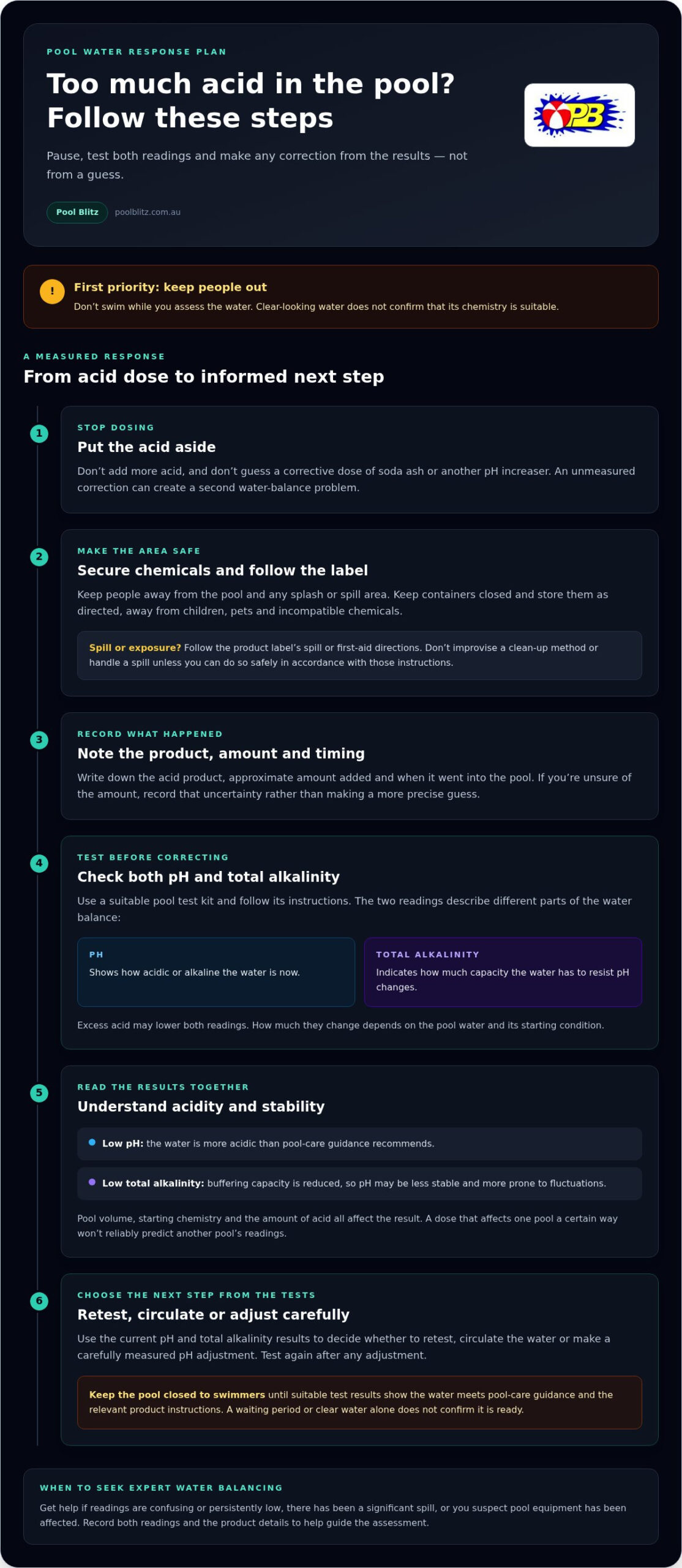
A step-by-step plan to rebalance the pool after an acid overdose
A measured sequence helps you respond without compounding the imbalance. Before choosing a correction, write down the pool’s volume, the acid product and approximate amount used, when it was added, and any available pH and total alkalinity readings. These details provide a clearer starting point than a guessed dose.
The measured correction sequence
- Stop the acid dose. Keep swimmers out while you assess the pool, and secure the chemical container. If there was a spill or exposure, follow the label’s specific instructions.
- Test both readings. Use a suitable pool test method and follow its directions for collecting a sample, timing the test and reading the result. Record pH and total alkalinity separately.
- Review the information. Compare the readings with the guidance for your pool and any relevant product instructions. Check the container label before selecting a corrective chemical, and don’t apply a generic dose from another pool.
- Make only a supported adjustment. If the readings and label indicate a pH-raising product is appropriate, measure and apply it exactly as directed. Avoid adding more than one corrective chemical at a time unless product guidance specifically instructs otherwise.
- Circulate and retest as directed. Follow the chemical label and equipment guidance on circulation and when to test again. Record the new readings before deciding whether any further adjustment is needed.
Take the process one step at a time. If the result doesn’t change as expected, pause rather than increasing the dose. If results remain abnormal, conflict with one another or are difficult to interpret, stop and arrange a professional assessment.
Mistakes that can compound an acid overdose
Don’t add chlorine or another pool chemical close to acid without first following the product labels’ handling and application directions. Never mix concentrated chemicals together. Keep each product in its original container so its identity, directions and safety information remain clear, and store it according to the label.
Large corrective doses can overshoot the target, while repeated additions based on estimates make it harder to understand what has changed. A pool’s appearance isn’t a reliable test either: clear water can still have unsuitable chemistry. Use measured readings and label directions to guide each decision, and keep the pool closed to swimmers until testing and product guidance indicate it’s suitable for use.
If the readings stay low or confusing, arrange expert pool water balancing rather than continuing to guess. A careful assessment can clarify the next step and support a stable return to balanced pool water.
When Brisbane pool owners should get expert water balancing
Some acid overdoses are difficult to resolve confidently with home testing alone. Arrange a professional water assessment if readings remain outside the pool-care guidance after careful, label-led adjustments, if test results are unclear or inconsistent, or if you’re unsure which reading should guide the next step. Adding chemicals without a clear picture can make the water harder to balance.
Signs the pool needs a professional water assessment
Repeated abnormal results deserve attention, especially if pH or total alkalinity doesn’t respond as expected. A significant acid spill, or a spill or exposure that raises a safety concern, is also a reason to stop handling the area and seek appropriate assistance. Follow the product label’s spill and exposure instructions.
Take note if you suspect the imbalance may have affected a pool surface or equipment. That doesn’t prove damage has occurred, but a professional can assess the water and help determine what to do next. Keep swimmers out until the chemistry has been assessed and readings meet the relevant pool-care and product guidance.
Have the product container details and any test results available if you can do so safely. Pool volume, the approximate amount of acid used and the time it was added can also help explain the situation. These details give the assessment a more useful starting point than a series of uncertain chemical adjustments.
How Pool Blitz can help restore confidence in pool care
Brisbane’s climate and how often a pool is used can affect its water conditions, so consistent testing is useful for spotting changes and making informed decisions. That doesn’t mean every pool needs the same chemical routine. Testing and adjustments should respond to the pool’s actual results, rather than a fixed schedule applied to every household.
Pool Blitz’s qualified team provides expert water balancing and pool servicing for Brisbane pool owners. The team can help interpret confusing readings, guide a considered response and support ongoing pool care. If you’re unsure what to do if you put too much acid in the pool, an assessment is a practical alternative to continuing to guess.
Once the immediate issue has been assessed, ongoing servicing can help you keep track of water balance and pool maintenance over time. Regular testing remains useful as conditions and pool use change, while any chemical adjustment should follow current readings and product directions.
If readings remain low, results are difficult to interpret or you’re concerned about a spill or possible equipment effects, arrange pool servicing or expert water-balancing support with Pool Blitz. A measured assessment can help you decide on a safe next step with greater confidence.
Make your next pool-care decision with confidence
A chemical mistake doesn’t have to become an ongoing source of worry. Treat it as a prompt to build a clearer picture of your pool’s water balance, so future adjustments are guided by reliable readings rather than guesswork. If you’re still unsure what to do if you put too much acid in the pool, don’t keep experimenting with corrective chemicals.
Pool Blitz is an independent Brisbane business with more than three decades serving the local community. Its qualified team provides pool servicing and expert water balancing to help you understand the situation and plan a considered next step for your pool.
Arrange expert pool water balancing with Pool Blitz and take the uncertainty out of your next decision. With a measured assessment, you can move forward with greater confidence in your pool care.
Frequently Asked Questions
Can I swim in a pool after adding too much acid?
No. Keep everyone out until pool test results and the chemical product guidance indicate the water is suitable for swimming. Clear water doesn’t establish safety, and there’s no reliable fixed waiting time that applies to every pool. If the pH reading remains outside the recommended range after circulation, don’t reopen the pool based on how long you’ve waited. Retest and follow the product instructions.
How do I raise the pH after adding too much pool acid?
Test the water first, then use a pH-raising product only if the results and its label indicate it’s appropriate. Sodium carbonate, commonly called soda ash, can raise pH, but the amount depends on pool volume, current chemistry and the product directions. Don’t add a second dose simply because the water still looks or feels different. Retest as directed before deciding whether another adjustment is needed.
What happens if pool pH is too low for too long?
Prolonged low pH can increase the risk of corrosion or etching and may affect some metal components, pool surfaces or equipment. It can also make the water uncomfortable for swimmers. The outcome depends on the pool and how long the imbalance lasts, so damage isn’t certain from a low reading alone. If you notice unusual staining, surface changes or equipment concerns, arrange an assessment rather than assuming the cause.
Can baking soda neutralise too much acid in a pool?
Baking soda is sodium bicarbonate, which is generally used to raise total alkalinity. It isn’t interchangeable with sodium carbonate, or soda ash, which may be used to raise pH. Neither should be added automatically as a direct response to excess acid. Test both pH and alkalinity, then follow the selected product’s label. If you’re unsure which reading needs attention, pause before adding anything.
How much soda ash should I add after putting too much acid in the pool?
There isn’t a safe universal amount. The appropriate dose depends on your pool’s volume, current pH and alkalinity readings, and the directions for the particular soda ash product. Base any adjustment on those details, not just the amount of acid added. Follow the label’s measuring instructions, don’t guess at a top-up, and retest as directed.
Should I add chlorine after putting too much acid in the pool?
Don’t add chlorine as a way to correct low pH, and never mix chlorine directly with acid or concentrated pool chemicals. Keep products separate and follow each label’s instructions for handling, application and any required separation between treatments. First establish the water’s condition with appropriate tests and address the imbalance according to product guidance. If the order or timing of treatments is unclear, get expert water-balancing advice before dosing.
What should I do if pool acid splashes on someone?
Act immediately: move the person away from the splash source and follow the acid label’s first-aid instructions. If acid contacts skin or eyes, begin rinsing with clean running water and seek urgent medical advice, particularly for eye exposure, pain or a large splash. Don’t apply another chemical to the affected area. In Australia, call 000 for a medical emergency or the Poisons Information Centre on 13 11 26 for poisoning advice.
No responses yet