
You wake up after a heavy Brisbane storm to find your once-shimmering oasis has turned a disheartening shade of milky grey. It is a common frustration for many local families who expect their salt water system to be a simple solution, only to be met with cloudy water or stubborn calcium scale on the chlorinator cell. We understand that our unique sub-tropical climate demands a more precise approach to salt water pool maintenance brisbane homeowners can trust to keep their water healthy and safe.
By following a structured care routine, you can enjoy the relief of a perfectly balanced pool that remains inviting even during the most humid months of 2026. This guide provides a comprehensive roadmap to mastering your water chemistry, ensuring your salt levels and chlorine output work in harmony to prevent algae blooms before they start. We will walk you through the essential equipment checks that extend the lifespan of your pumps and filtration systems, helping you avoid the high costs of premature equipment failure while maintaining that premium, resort-style clarity year-round.
Key Takeaways
- Understand how Brisbane’s sub-tropical humidity accelerates algae growth and why salt water systems require a climate-specific strategy to stay clear.
- Learn the precise 3000–4000 ppm salt range required for modern chlorinators and how to stabilise the naturally rising pH levels essential for effective salt water pool maintenance brisbane.
- Identify early signs of calcium scaling on your electrolytic cell to prevent expensive hardware failures and ensure your pump maintains optimal flow rates.
- Master proactive storm preparations and post-weather recovery techniques to shield your pool from phosphate spikes and debris during the summer months.
- Evaluate the long-term financial benefits of professional servicing, including access to expert water balancing and early detection of equipment wear.
Why Salt Water Pools in Brisbane Need a Local Maintenance Strategy
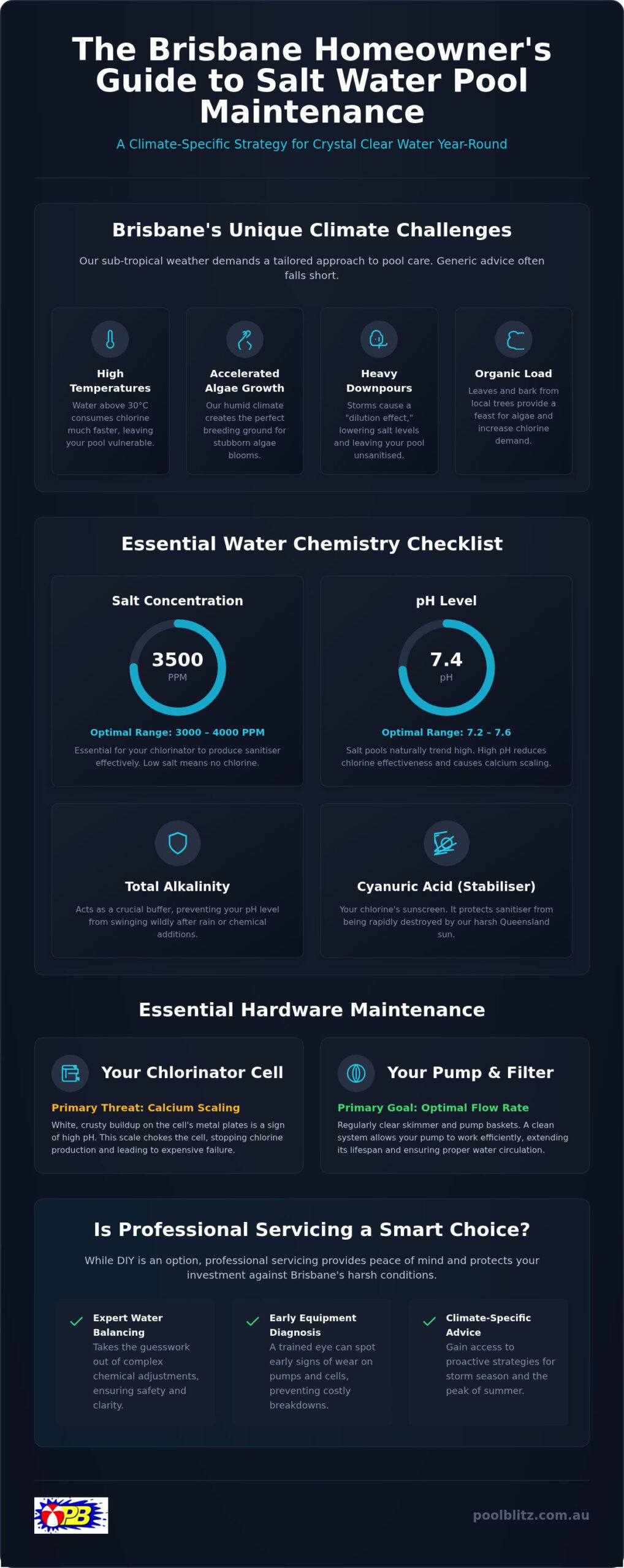
Brisbane weather is legendary for its uncompromising intensity. Our sub-tropical storms and humid afternoons create a specific set of challenges for pool owners that generic advice simply can’t address. Achieving consistent water health requires more than just a passing glance at the pump; it demands a strategy tailored to our unique corner of Queensland. Effective salt water pool maintenance brisbane homeowners rely on is built on understanding how our environment interacts with your pool’s hardware every single day.
The “Salt Water is Maintenance-Free” Myth
Many homeowners choose salt systems because they believe the water is naturally sanitised without effort. It’s a common misconception that can lead to expensive repairs down the road. In reality, your pool still relies on chlorine for safety and hygiene. Understanding how salt water chlorination works is the first step toward long-term water health. An electrolytic cell converts dissolved salt into chlorine gas, which then sanitises the water. If you neglect the chemistry, the cell has to work twice as hard to keep up with bacteria growth. This leads to “chlorine demand” issues where the system simply can’t produce enough sanitiser to keep the water clear. It’s a sophisticated piece of equipment that requires regular human intervention to stay efficient.
Brisbane’s Climate vs. Your Pool Chemistry
Our local climate is the biggest hurdle for any filtration system. When water temperatures climb above 30°C in the peak of summer, chlorine is consumed at a much faster rate than in cooler southern cities. Brisbane’s local vegetation, such as the iconic gum tree, adds a significant organic load. Leaves and bark drop into the water, providing a feast for algae that thrives in our humidity.
The “dilution effect” is another major factor in South East Queensland. A single heavy summer downpour can dump enough fresh water into your pool to significantly lower your salt concentration. When salt levels drop, your chlorinator cannot function properly, leaving your pool vulnerable to a green breakout within hours. A standard Aussie guide might suggest monthly checks, but our local conditions require a more proactive approach. Following a structured local checklist doesn’t just keep the water clear; it provides the peace of mind that comes from knowing your investment is protected against the elements.
The Essential Brisbane Salt Water Chemistry Checklist
Maintaining the perfect balance in a salt water pool requires more than just adding bags of salt when a light flashes on the control panel. It involves a precise management of chemical levels that protect your equipment and your family’s health. For effective salt water pool maintenance brisbane residents should focus on four core pillars: salt concentration, pH levels, total alkalinity, and stabiliser. When these elements are in harmony, your pool remains a clear and inviting sanctuary regardless of the weather.
Testing and Adjusting Salt Levels
Most modern chlorinators in Brisbane operate optimally within a salt range of 3000 to 4000 parts per million (ppm). To add salt correctly, distribute it around the shallow end and use a pool brush to ensure it dissolves completely before it reaches the main drain. Never leave salt sitting on the pool floor as it can cause staining or damage to the interior finish. Over-salting is a significant risk that often forces a partial drain and refill, which places unnecessary stress on your equipment and wastes water.
Managing the pH and Alkalinity Seesaw
Salt water pools naturally tend toward a high pH because the process of electrolysis creates sodium hydroxide as a byproduct. When pH levels climb too high, you will likely see calcium scaling on your tiles and, more critically, on the delicate plates of your chlorinator cell. Total alkalinity acts as a vital buffer that prevents your pH from bouncing wildly after a typical Brisbane storm. We recommend keeping your pH between 7.2 and 7.6 by using small, controlled doses of hydrochloric acid. For those who find this balancing act complex, seeking expert water balancing for healthy Brisbane pools ensures your water remains safe while protecting the longevity of your surfaces. Following official advice on pool safety after a disaster or heavy rainfall is also essential to prevent contamination from runoff.
The Critical Role of Cyanuric Acid
In our harsh Queensland sun, chlorine is incredibly fragile and prone to rapid depletion. Without a stabiliser, also known as cyanuric acid, your chlorine can be lost to UV burn-off in less than two hours during a typical summer afternoon. We recommend maintaining stabiliser levels between 30 and 50 ppm for Brisbane pools to provide a necessary “sunscreen” for your water. You can test for this at home using a standard kit, but a professional check every few months is wise to ensure your levels haven’t drifted. If your chemistry feels out of control, a regular pool service can provide the stability your system needs to thrive.
Hardware Maintenance: Caring for Your Chlorinator and Pump
While balanced chemistry is the soul of your pool, the hardware is its heart. In the context of salt water pool maintenance brisbane weather can be quite taxing on mechanical components. The combination of high humidity and salt air creates an environment where neglect leads to rapid deterioration. Regular inspection of your chlorinator and pump is the most effective way to ensure your system remains reliable for years to come. It’s about protecting your investment through consistent, methodical care.
Your first priority should be the electrolytic cell. Even with “self-cleaning” models, you must manually inspect the plates for calcium “snowing” or white scale buildup. If you notice these deposits, your chlorinator’s efficiency drops significantly. Simultaneously, you should monitor your pump basket and skimmer box. Removing debris daily ensures optimal flow rates, which prevents the “no flow” or “low salt” warnings that often plague neglected systems. These warnings are frequently symptoms of poor flow rather than actual salt deficiency. Finally, check your O-rings and seals. Brisbane’s humid air can cause rubber components to perish faster than in drier climates, leading to air leaks that can eventually burn out your pump motor.
The Art of Cleaning a Salt Cell
If you see stubborn white deposits on your cell plates, it’s time for a safe acid wash. We recommend a dilution ratio of one part hydrochloric acid to ten parts water. Always add acid to water, never the other way around. Submerge the plates until the fizzing stops, then rinse thoroughly with fresh water. Be mindful that most cells have a lifespan of roughly three to five years. If you find yourself cleaning the cell every few weeks, or if the plates appear pitted and worn, it is likely time for a replacement. For professional assistance with these technical tasks, you can rely on expert pool equipment repairs Brisbane homeowners trust to keep their systems running smoothly.
Integrating Your Robotic Pool Cleaner
A robotic cleaner is a brilliant addition to any Brisbane backyard, but it requires specific care in a salt environment. Salt water can be particularly harsh on the internal seals of a robot if the water balance drifts. To protect your investment, always rinse your cleaner with fresh water after each cycle. It’s equally important to clean the robot’s filter canisters regularly. When these filters are clogged, the robot works harder, but it also means the main pool pump has to compensate for the extra debris left in the water. For more advice on choosing and maintaining the right model, see our guide to the best robotic pool cleaner Brisbane has to offer.
Seasonal Adjustments: Summer Storms vs. Winter Care
Brisbane doesn’t follow a traditional four-season cycle; instead, we navigate a pivot between humid storm seasons and mild, dry winters. This shift requires a proactive approach to salt water pool maintenance brisbane families can rely on to prevent water quality from sliding. Adapting your strategy to these seasonal shifts ensures your equipment isn’t overworking during the quiet months and isn’t overwhelmed when the heat returns. It’s about maintaining a steady baseline of health that respects our local climate’s volatility.
Surviving the Brisbane Storm Season
The sudden arrival of a “southerly buster” can dump significant rainfall into your pool in under an hour. This deluge causes an immediate dilution effect, stripping away your carefully balanced salt and stabiliser levels. Before the clouds break, we recommend lowering your water level slightly to accommodate the rain and bumping your chlorinator to its “boost” or “super-chlorinate” mode. This creates a vital sanitiser reserve to combat the organic matter a storm inevitably introduces.
Once the weather clears, prompt debris removal is essential to prevent phosphate spikes. While your salt cell is efficient, it produces chlorine slowly over time. If your water looks dull after a heavy event, a manual “shock” treatment using liquid chlorine provides the immediate sanitisation needed to kill off storm-borne contaminants. It’s much simpler to treat a slightly cloudy pool today than to recover a green one tomorrow. If the post-storm cleanup feels overwhelming, booking a casual pool servicing visit can restore your water balance quickly and professionally.
Wintering Your Salt Pool
A common mistake in South East Queensland is turning the filtration system off entirely during the cooler months. Even when the water temperature drops, algae can still take hold if the sanitiser level hits zero. You should keep your system running, but reduce the chlorinator’s percentage output on your Astral or Zodiac controller to reflect the lower bather load and cooler water. This prevents over-chlorination, which can be just as damaging to your equipment as a lack of sanitiser.
Winter is also the ideal time to check your calcium hardness levels. Without regular swimming to circulate the water, minerals can settle or leach from the pool surfaces if the chemistry isn’t stable. A well-maintained winter pool makes for a seamless “Spring Opening” in September, allowing you to dive straight back in as soon as the first heatwave hits. Maintaining this baseline of care protects your pump and chlorinator from the stress of a heavy startup later in the year.
Professional Servicing vs. DIY: Making the Right Choice
Deciding how to handle your salt water pool maintenance brisbane routine often comes down to a balance of time and technical confidence. While many locals enjoy the ritual of a weekend skim, the underlying chemistry of a salt system can be deceptively complex. A professional service provides more than just clear water; it offers a level of diagnostic precision that prevents small issues from escalating into significant financial burdens. It is about the relief that comes from knowing a seasoned expert has verified every component of your filtration system.
Many homeowners are surprised to find that DIY chemical costs can quickly rival professional fees. When you factor in the premium price of retail chemicals and the risk of over-correcting a water balance issue, the professional route often proves more economical over the long term. Our experts use commercial-grade testing to ensure every gram of acid or bag of salt is strictly necessary, protecting both your wallet and your pool’s delicate surfaces. To maintain a healthy baseline between professional visits, we recommend this simple three-tier approach:
- Daily: Empty the skimmer box and conduct a quick visual check of the water clarity.
- Weekly: Test the pH and chlorine levels; ensure the water level remains halfway up the skimmer opening.
- Monthly: Inspect the chlorinator cell for scale and check your salt levels against the manufacturer’s recommendations.
When to Call in the Experts at Pool Blitz
There are specific moments when a DIY approach reaches its limit. If you are struggling with persistent cloudy water that won’t clear despite adding salt, or if your chlorinator becomes non-responsive, it is time to seek assistance. Strange grinding noises from the pump are another clear signal that a mechanical failure is imminent. These symptoms often point to internal equipment wear that requires a trained eye to diagnose correctly before it leads to a total system shutdown. For a detailed breakdown of service options, you can explore our professional pool service Brisbane guide.
The Pool Blitz Maintenance Philosophy
Our approach is rooted in our history as a seasoned authority established in 1994. We don’t just clean pools; we act as proactive stewards for your property’s most valuable leisure asset. By focusing on long-term water health and equipment integrity, we ensure you never have to deal with the stress and expense of a full green pool recovery. We invite you to book a regular pool servicing plan or a casual visit to experience the total peace of mind that comes from 30 years of local expertise.
Securing Your Shimmering Oasis for the Year Ahead
Mastering salt water pool maintenance brisbane requires a blend of consistent chemistry and proactive hardware care. By understanding how our humid climate and sudden summer storms impact your water balance, you can prevent the common frustrations of cloudy water and equipment scale. It’s a significant investment; protecting its long-term health ensures it remains a source of joy rather than a chore.
We’ve been Brisbane-owned and operated since 1994, bringing over 30 years of local expertise to every backyard we visit. Whether you need expert water balancing or specialised robotic cleaner and pump repairs, our team provides the comprehensive care your system deserves. We invite you to Book a Professional Salt Water Service with Pool Blitz to experience the clarity and peace of mind that only a seasoned partner can provide. We look forward to helping you keep your pool crystal clear through 2026 and beyond.
Frequently Asked Questions
How much salt should I add to my Brisbane pool after heavy rain?
You should only add salt if your pool has overflowed, as rain otherwise just dilutes the existing concentration. For a standard 50,000-litre pool, you might need one or two 20kg bags after a significant storm event to return to the 3000 to 4000 ppm range. It’s vital to test the water with a reliable digital meter first, as over-salting can lead to equipment strain or require you to partially drain the pool.
Why is my salt water pool still turning green in summer?
Algae thrives in Brisbane’s high humidity when your chlorine production cannot keep up with the organic load. This often happens because of a calcified salt cell, low stabiliser levels, or high phosphates from garden runoff. Even if your chlorinator is running, a high pH level can make the chlorine ineffective. Ensuring your salt water pool maintenance brisbane routine includes checking these three factors will keep the water clear and safe.
How often should I clean my salt chlorinator cell?
You should inspect your cell monthly and clean it only when you see visible white calcium buildup on the plates. While many modern units are “self-cleaning” through polarity reversal, they still require a manual acid wash roughly every three to six months in Brisbane’s conditions. Over-cleaning with acid can strip the precious metal coating from the plates, so only wash the cell when performance drops or the “check cell” light stays on.
Can I use liquid chlorine in a salt water pool?
Yes, liquid chlorine is an excellent tool for providing an immediate “shock” treatment after heavy rain or a pool party. Your salt cell produces chlorine slowly over several hours, which isn’t always fast enough to kill a sudden bloom of bacteria or algae. Adding a few litres of liquid chlorine provides an instant sanitiser boost without affecting your salt levels, allowing your chlorinator to maintain the residual level once the water is clear again.
Is a salt water pool cheaper to maintain than a chlorine pool?
Salt water pools generally have lower ongoing chemical costs because you aren’t purchasing expensive chlorine drums every week. However, you must factor in the eventual replacement of the electrolytic cell every three to five years and the electricity required to run the system. When managed with a consistent salt water pool maintenance brisbane plan, the long-term savings on chemicals and the softer water feel usually outweigh the hardware replacement costs over the life of the pool.
What is the ideal pH level for a salt water pool in Brisbane?
The ideal pH range is between 7.2 and 7.6 to ensure both swimmer comfort and chlorine effectiveness. Salt water systems naturally drive pH upwards due to the electrolysis process, so you will need to add small amounts of hydrochloric acid regularly. If your pH climbs above 8.0, your chlorine becomes almost 80% less effective, which is the primary cause of sudden algae growth during a humid and hot Queensland summer.
How do I know if my salt cell is dead or just needs cleaning?
A cell that needs cleaning will have visible white scale, whereas a dead cell often looks clean but produces little to no chlorine gas. Most controllers will display a “low salt” or “check cell” light even when your salt levels are perfect. If you have cleaned the cell and your salt levels are confirmed at 3500 ppm, but the output remains low, the plates have likely lost their conductive coating and require professional replacement.
Do I need to run my salt chlorinator for longer in summer?
You should increase your filtration time to at least 8 to 10 hours a day during a Brisbane summer to combat intense UV depletion. The sun’s rays destroy chlorine rapidly, and a higher bather load introduces more contaminants that need sanitising. Splitting this time between early morning and late afternoon is often the most efficient way to ensure your pool stays healthy and clear without overworking your pump during the hottest part of the day.
No responses yet