
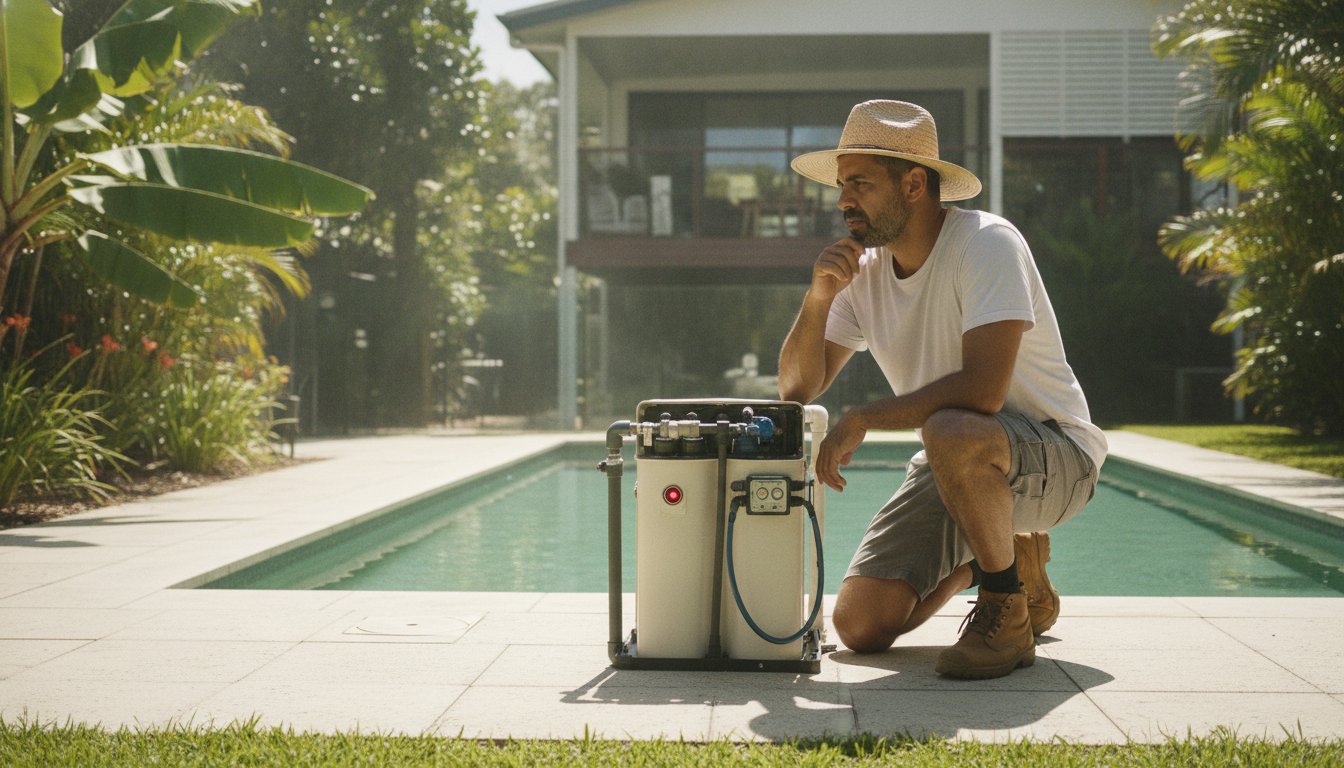
Imagine stepping onto your deck on a humid Brisbane Saturday, expecting a refreshing swim, only to find your water has turned a dull shade of olive. A quick check of the equipment confirms your suspicion of a pool chlorinator not working, leaving you to decipher blinking lights or a completely unresponsive display. It is a stressful discovery for any homeowner, particularly when the Queensland heat is rising and the family is ready for a dip.
We recognise the frustration of watching your investment turn green and the anxiety that often follows regarding the potential cost of a new control box or cell. This guide provides the clarity you need to identify why your salt chlorinator has stopped producing chlorine and outlines the exact steps to get your pool back to its sparkling best. You will learn how to troubleshoot common faults, understand when a simple clean will suffice, and determine when it is time to call in a seasoned professional to ensure a long-term fix. By following these methodical checks, you can often save a system that might otherwise be discarded, ensuring your backyard remains a clear and safe sanctuary for the season ahead.
Key Takeaways
- Learn to recognise the early warning signs of a failing system, such as “No Flow” indicators or cloudy water, before your pool turns green in the summer heat.
- Understand how the unique Brisbane climate and local water conditions can lead to a pool chlorinator not working by accelerating calcium build-up on the electrolytic cell.
- Discover a simple two-step method to test your equipment’s output by ensuring correct water balance and utilising the system’s “Boost” functionality.
- Gain the confidence to distinguish between basic DIY maintenance tasks and complex faults that require a seasoned professional to ensure safety and longevity.
- Identify how regular equipment servicing and expert water balancing can prevent premature burnout and save you from the expense of a total system replacement.
Signs Your Salt Pool Chlorinator Isn’t Working Properly
Your salt chlorinator is the heart of your pool’s sanitisation system. It works by converting dissolved salt into chlorine gas through a process called electrolysis. Understanding How Salt Water Chlorinators Work helps clarify why a pool chlorinator not working isn’t always a sign of a dead unit. Sometimes the control box hums along perfectly while the cell itself has stopped producing sanitiser entirely. Identifying the difference between a total electronic failure and a loss of electrolytic efficiency is the first step toward a functional pool.
Common red flags include “Low Salt” or “No Flow” indicators on the display panel. However, the most deceptive scenario is a system that appears functional but yields zero chlorine. A complete shutdown is obvious; a loss of efficiency is a slow creep toward a green pool that often catches homeowners by surprise. You must look beyond the lights to confirm what is happening inside the water.
The Visual “Eyeball” and Cloudiness Test
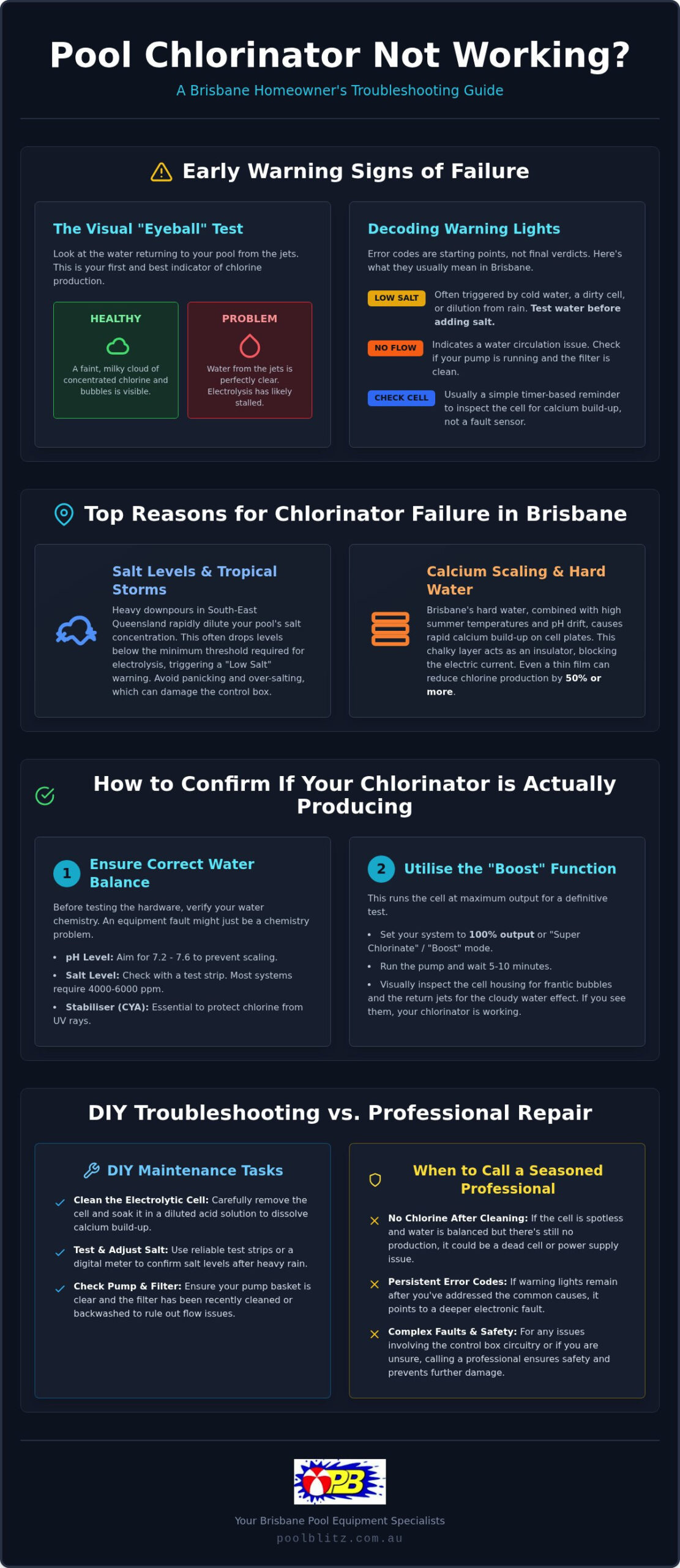
When the system is running at 100 per cent output, look closely at the return jets, often called the “eyeballs.” You should see a faint, milky cloud of water entering the pool. This cloudiness is the concentrated chlorine and hydrogen gas being produced. If you look at the transparent housing of the cell itself, it should be filled with tiny, frantic bubbles during operation. If the water inside the cell remains perfectly clear while the pump is running, the electrolysis process has likely stalled. If the water looks cloudy but your chlorine tests still read zero, you might be facing a high sanitiser demand or a lack of stabiliser rather than a hardware failure.
Decoding Common Warning Lights and Error Messages
Modern chlorinators use display panels to communicate health, yet these messages are often misunderstood. A “Check Cell” or “Inspect Cell” light is usually a timer-based reminder rather than a sensor detecting a specific fault. It suggests it is time for a manual inspection of the plates for calcium build-up. The “Low Salt” light is a common trap for Brisbane homeowners. While it might mean you need more salt, it often triggers because the water is too cold or the cell is too dirty to conduct electricity. Adding more salt to a system that already has enough can lead to high-conductivity issues that eventually damage the internal circuitry. Treat these error codes as diagnostic starting points, not as final verdicts on the health of your equipment.
Top Reasons for Chlorinator Failure in Brisbane Pools
Brisbane’s subtropical climate presents a unique set of challenges for pool equipment that southern counterparts rarely face. The combination of intense ultraviolet radiation, high humidity, and sudden tropical downpours creates an environment where a pool chlorinator not working becomes an almost seasonal occurrence for many residents. Understanding these local stressors is the first step in extending the life of your sanitisation system and avoiding unnecessary replacement costs.
Salt Levels and the Impact of Tropical Storms
South-East Queensland is famous for its afternoon summer storms, which can dump significant volumes of freshwater into your pool in a matter of minutes. This sudden influx dilutes the salt concentration, often dropping it below the minimum threshold required for electrolysis to occur. When your control box flashes a “Low Salt” warning after a heavy downpour, it is often a literal reading of the water chemistry rather than a hardware fault. It’s vital to avoid the common mistake of over-salting in a panic. Excessive salt levels can lead to high-amp errors that strain the internal transformer and shorten the lifespan of the control board. For more detailed advice on managing these cycles, our guides offer seasonal strategies for salt management.
Calcium Scaling and Hard Water Issues
Brisbane’s water mineral content can be quite hard in certain suburbs, leading to rapid calcification of the electrolytic plates. Calcium carbonate naturally gravitates toward the heat generated during the chlorination process, forming a white, chalky crust. This layer creates an insulation effect that physically blocks the electric current from passing through the water. Even a thin, barely visible film of calcium can reduce chlorine production by 50 per cent or more. This process is significantly accelerated if your pool’s pH is allowed to drift above 7.6, which is a frequent issue during the high-use summer months when bather load is at its peak.
High water temperatures also play a critical role in equipment fatigue. When the pool water exceeds 28 degrees, the chemical demand for sanitiser skyrockets. Algae can bloom faster than a struggling chlorinator can produce chlorine, leading to a situation where the equipment is technically working but failing to keep the water clear. If you find yourself constantly battling cloudy water despite your equipment running long hours, a professional water balancing and equipment check can identify whether the fault lies in the hardware or the chemistry. Often, a precise recalibration of your water’s mineral balance is all that is required to restore your system’s efficiency.
DIY Troubleshooting vs. Professional Equipment Repair
Many homeowners feel a surge of pride when they solve a mechanical issue themselves, but with pool electronics, the line between a quick fix and an expensive mistake is thin. If you find your pool chlorinator not working, a methodical approach to troubleshooting can save both time and money. Before you assume the worst, start with a “Five-Minute Check” of the basics. Ensure the power leads are firmly connected and have not been damaged by the sun or local wildlife. Check the fuse in the bottom of the control box and verify that your timer settings haven’t been reset by a recent power surge or storm. These simple oversights are responsible for a surprising number of service calls.
While some maintenance is straightforward, other repairs involve high-voltage components and hazardous chemicals. There is a significant difference between rinsing a cell and opening a control box to probe a circuit board. Knowing when to DIY and when to seek pool equipment repairs in Brisbane is essential for both your safety and the longevity of your hardware. A professional diagnostic check often reveals that a simple component replacement can resurrect a system you thought was dead, saving you the A$800 to A$1500 cost of a total system replacement.
How to Safely Clean Your Chlorinator Cell
If your inspection reveals a white, crusty build-up on the plates, an acid wash is necessary. The correct ratio for this is 1 part hydrochloric acid to 10 parts water; always remember to add the acid to the water, not the other way around, to prevent dangerous splashing. Never use a metal tool like a screwdriver to scrape the plates, as this will permanently damage the precious metal coating required for electrolysis. Instead, use a soft plastic brush or simply let the solution do the work. You can tell a cell is “spent” if the plates appear pitted, or if the dark ruthenium coating has worn away to reveal the dull grey titanium beneath. At this stage, cleaning will no longer restore performance.
Identifying Control Box and PCB Issues
When the problem originates inside the control box, the symptoms are usually more dramatic. Signs of a failing Printed Circuit Board (PCB) include a completely blank display, erratic timer behaviour, or a distinct smell of burnt plastic. However, a “No Flow” error doesn’t always mean the box is dead; it is often caused by a faulty flow sensor, which is a relatively cheap and simple fix. Because the PCB is the “brain” of your system, issues here require technical expertise to diagnose correctly. Professional technicians can often repair a specific fault on the board rather than replacing the entire unit, providing a cost-effective alternative to bining a high-quality system prematurely.
How to Confirm If Your Chlorinator Is Actually Producing
A systematic test is the only way to move beyond guesswork when you suspect your equipment is failing. Before you conclude that you have a pool chlorinator not working, you must ensure the environment is ready for an accurate diagnostic. Start by balancing your water; your pH must be between 7.2 and 7.6 for chlorine to be effective and for the cell to operate at peak efficiency. Once the water is balanced, turn the control box to its maximum “Boost” or 100 per cent output mode to force the system into full production.
After five minutes, capture a water sample directly in front of one of the return jets where the water re-enters the pool. Simultaneously, take a second sample from the deep end or the centre of the pool, far away from any returns. Using a high-quality liquid DPD test kit, compare the two samples. If the return jet water shows a significantly higher chlorine level than the pool centre, your cell is successfully producing sanitiser. If both samples read identical or zero, the system is likely failing to generate, and you may need to investigate deeper hardware issues.
The Eyeball Sample Test
Patience is vital during this diagnostic process. You must wait at least five minutes after activation to allow the electrolytic process to reach full capacity. If you receive a “Nil” reading at the return jet, it typically confirms the cell is spent or the power supply has failed to deliver the necessary current. Be aware of the “Bleach Out” effect; if your chlorine levels are extremely high, they can actually bleach the reagents in your test kit, making the water appear clear. If the sample turns pink for a split second before turning clear, your chlorine levels are actually too high for the test kit to measure.
Equipment Failure vs. Chlorine Demand
A common point of confusion for Brisbane pool owners is “Combined Chlorine.” This occurs when chlorine has reacted with organic matter and is no longer an effective sanitiser; it is what creates that distinct, unpleasant chemical smell and causes stinging eyes. Understanding why you have a pool chlorinator not working requires distinguishing between hardware failure and high sanitiser demand. Even if your equipment is functional, a heavy bather load or organic debris from a storm can consume chlorine faster than it is made. In these instances, you may need to manually shock the water to reset the chemistry. If your diagnostic tests remain inconclusive, we recommend booking expert pool equipment repairs to restore your water’s clarity and safety.
Restoring Your Pool’s Sanitisation System
Once you have identified the cause of your pool chlorinator not working, the focus shifts from immediate troubleshooting to long-term stability. Restoring your system to its peak performance ensures that your Brisbane backyard remains a clear and safe sanctuary for your family. While a temporary fix might clear the water for a weekend, a professional approach to equipment health prevents the recurring cycle of green water and equipment fatigue. Investing in a structured pool maintenance programme is the most effective way to prevent premature chlorinator burnout, as it ensures that the chemistry and the hardware are working in harmony rather than in conflict.
When a component like the electrolytic cell eventually reaches the end of its lifespan, you face the choice between a genuine manufacturer replacement and a high-quality after-market alternative. While after-market cells can offer significant savings, they must be selected with precision to ensure they match the output specifications of your control box. A mismatched cell can lead to erratic readings or electronic strain. Additionally, maintaining a modern pool filtration system plays a vital role in equipment longevity. When your filter is clean and efficient, the chlorinator doesn’t have to work as hard to maintain sanitiser levels, significantly reducing the daily wear on the plates.
Professional Servicing and Peace of Mind
At Pool Blitz, an equipment health check involves more than a simple visual inspection. Our technicians draw on over 30 years of experience to calibrate your system specifically for your pool’s volume and the unique demands of the Brisbane climate. We examine the internal electronics of the control box, test the conductivity of the cell, and verify that the sensors are providing accurate data. Having a seasoned authority handle these technical components provides a level of safety and reliability that DIY methods simply cannot match. We often find that a professional calibration can save a unit that a homeowner was ready to bin, extending its functional life by several seasons.
Long-Term Prevention and Maintenance
Developing a “Monthly Cell Check” is a two-minute habit that can save you hundreds of dollars in repair costs. By simply inspecting the plates for the first signs of calcium, you can perform a light rinse before the scale becomes thick enough to cause electronic damage. Supporting your chlorinator with a well-maintained robotic pool cleaner also reduces the organic load the system must process, allowing the chlorine to focus on sanitisation rather than fighting debris. For an extra layer of protection, consider using a sacrificial anode. This simple device attracts corrosive currents that would otherwise attack your chlorinator plates, acting as a protective steward for your pool’s most expensive hardware.
Restoring Your Pool’s Sparkling Clarity
Navigating the complexities of a pool chlorinator not working doesn’t have to be a source of ongoing stress. By understanding the visual cues of your equipment and the specific demands of the Brisbane climate, you can move from frustration to a clear plan of action. Whether you have resolved a simple calcium build-up through a careful acid wash or identified a more complex electronic fault, the goal remains the same: a safe, healthy, and inviting pool for your family to enjoy.
If your troubleshooting efforts have reached their limit or you simply want the peace of mind that comes from a seasoned authority, our team is here to help. With over 30 years of local expertise, we specialise in all major chlorinator brands and pride ourselves on providing honest advice on whether a repair or a replacement is your most cost-effective path forward. You don’t have to tackle technical electrical components alone when reliable assistance is just a click away. Book a Professional Chlorinator Diagnostic with Pool Blitz today and ensure your sanitisation system is ready for the next Queensland summer.
Frequently Asked Questions
How can I tell if my salt chlorinator cell is dead?
A dead cell usually shows visible physical deterioration, such as pitting on the titanium plates or the complete loss of the dark ruthenium coating. If your control box is set to 100 per cent output but you see no gaseous activity inside the transparent housing, the cell has likely reached the end of its functional life. You can confirm this by testing a water sample directly from the return jet; a zero reading despite balanced water is a definitive sign of failure.
Why is my salt chlorinator saying “Low Salt” when I just added some?
A “Low Salt” warning is often a diagnostic error caused by factors other than the actual salt concentration in your water. If your water temperature has dropped or your cell is heavily calcified, the system cannot conduct electricity efficiently, which the control box interprets as a lack of salt. It is vital to have your salt levels professionally tested before adding more, as over-salting can lead to high-conductivity errors that strain the internal electronics of your pool chlorinator not working correctly.
Is it safe to swim if the chlorinator is not working?
Swimming in a pool without a functional chlorinator is generally not recommended, as the water quickly becomes a breeding ground for bacteria and algae in the Brisbane heat. Without a consistent level of sanitiser, the water can become unsafe for bathers within hours of the system failing. If you must use the pool before a repair is completed, you should manually add liquid chlorine to maintain a safe sanitisation level, though professional equipment repair remains the only long-term solution.
How often should I clean my salt chlorinator cell in Brisbane?
You should perform a visual inspection of your chlorinator cell at least once a month to check for calcium build-up. In Brisbane, the combination of hard water and high summer temperatures means that most cells require a thorough acid wash every three to four months. Maintaining a stable pH between 7.2 and 7.6 will significantly reduce the frequency of cleaning, as high alkalinity is the primary driver of rapid calcification on the electrolytic plates.
Can I fix a chlorinator control box myself?
Homeowners can safely perform basic checks such as verifying power leads, replacing external fuses, or resetting digital timers. However, internal repairs involving the Printed Circuit Board (PCB) or high-voltage transformers should always be handled by a qualified technician. Attempting to repair complex electrical components yourself can lead to further damage or safety hazards. A professional diagnostic check is often the most cost-effective way to identify if a specific component can be repaired rather than replacing the entire unit.
Why does my chlorinator stop working when the water is cold?
Salt chlorinators rely on the conductivity of the water to produce chlorine, and this process becomes less efficient as water temperatures drop during the Brisbane winter. Most modern systems include sensors that reduce output or shut down entirely when the water falls below 15 degrees to protect the plates from premature wear. If your system stops producing during a cold snap, it is often a built-in safety feature rather than a mechanical fault, though you may need to manually supplement your sanitiser.
How long does a typical salt chlorinator cell last in Australia?
In the harsh Australian climate, a high-quality salt chlorinator cell typically lasts between three and seven years. The exact lifespan depends heavily on your daily run times and how diligently you maintain your water balance. Cells that are frequently operated at 100 per cent output or subjected to heavy calcium scaling will fail much sooner than those in well-balanced pools. Regular equipment servicing and keeping your salt levels within the manufacturer’s recommended range are the best ways to maximise this investment.
What is the best way to shock a salt pool when the chlorinator fails?
The most effective way to shock your pool while waiting for a repair is to use liquid chlorine or a pre-dissolved granular pool shock. You should calculate the dose based on your pool’s volume and add it directly to the water, ensuring the pump is running to circulate the sanitiser. This provides an immediate boost to your free chlorine levels, preventing a green pool while your pool chlorinator not working is being professionally diagnosed and restored to its sparkling best.
No responses yet