
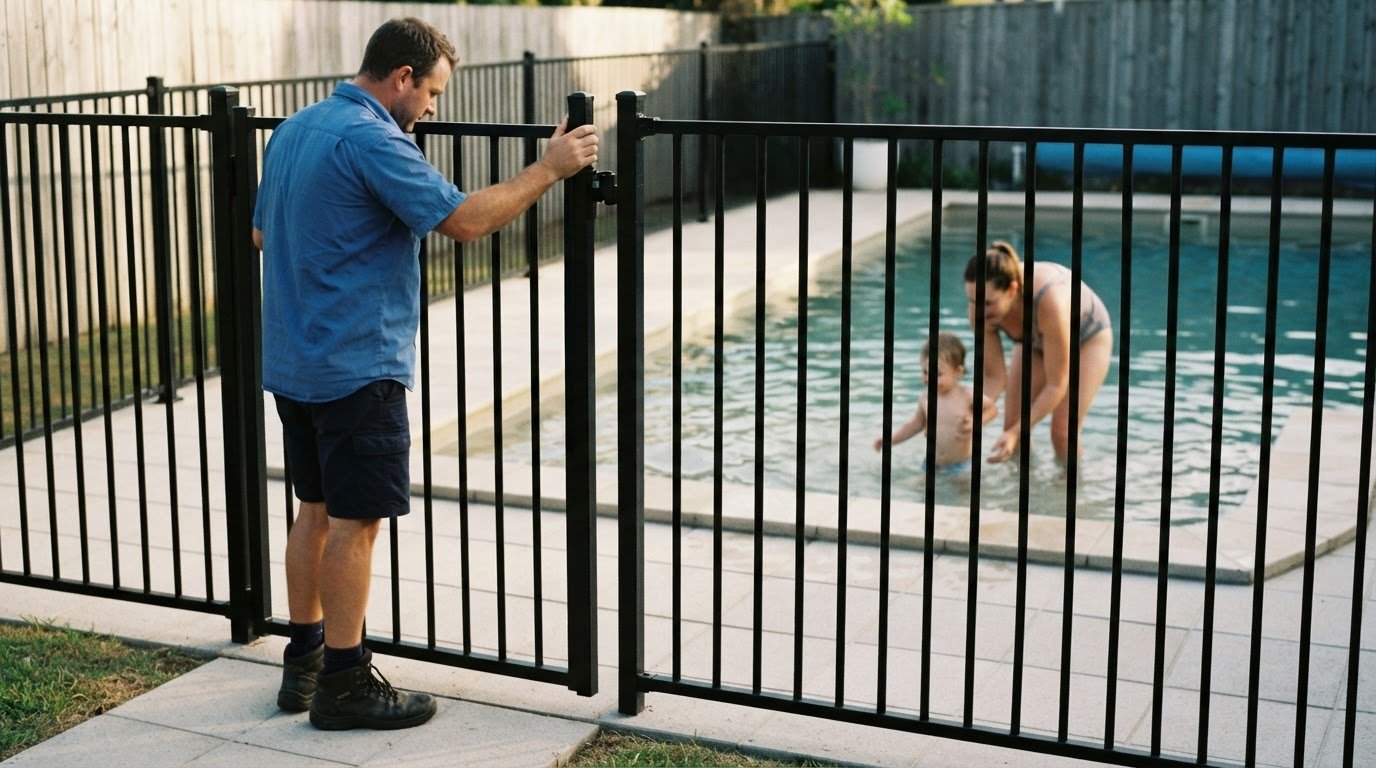
A pool is not safe for children just because an adult is nearby. In Australia, private pools and spas 30 cm deep or deeper must have a safety fence, and whether your pool is safe for your kids to swim in also depends on secure access and active supervision. A fence is a vital barrier, but it can’t replace an adult watching children in the water.
It’s understandable to want clear, practical checks before the next swim. This guide explains how to assess whether your pool is safe for your kids, including the role of barriers, water quality and close supervision. You’ll also find steps to reduce children’s access when the pool isn’t in use.
Key Takeaways
- Know which pools, spas and portable or inflatable pools need a safety barrier, and why even temporary water needs care.
- Learn how close, active supervision changes with a child’s age and keeps attention on the water.
- Spot the key fence and gate features that help prevent children from reaching the pool unsupervised.
- Build simple fence-maintenance and access checks into your routine, and see where pool servicing can support ongoing care.
1. Which swimming pools need fences?
In Australia, private swimming pools or spas 30 cm deep or deeper must have a safety fence. This includes spa baths and water-holding structures, not only in-ground family pools. Treat portable and inflatable pools with the same care: temporary water can still pose a drowning risk to children.
After children finish swimming in an inflatable pool, empty it rather than leaving water accessible. Even a small amount of water can be deep enough for a young child to drown. Put pool toys away, too, as they can tempt children back towards the water.
Before swimming, use a suitable pool water test kit to check chlorine and pH. Follow the kit instructions and compare the readings with the recommended ranges on your pool chemical product labels. If readings are outside those ranges, keep children out until the water is correctly balanced.
If a child is missing near a pool, check the water immediately and call Triple Zero (000) if there’s an emergency. If a child is drowning, get them out of the water if you can do so safely, then follow the emergency operator’s instructions and give CPR if you’re trained.
At a party or public pool, don’t assume another adult is watching your child. Agree clearly on who is supervising, and keep children in sight and within arm’s reach around water. If children visit a neighbour’s pool, treat it as a water hazard and arrange active adult supervision before they enter the pool area.
Pool safety doesn’t stop at your own fence. Empty inflatable pools after use, put toys away and make sure children can’t wander into a neighbouring pool area without an adult. These steps reduce access risks, but they don’t replace close supervision while swimming.
2. Active adult supervision
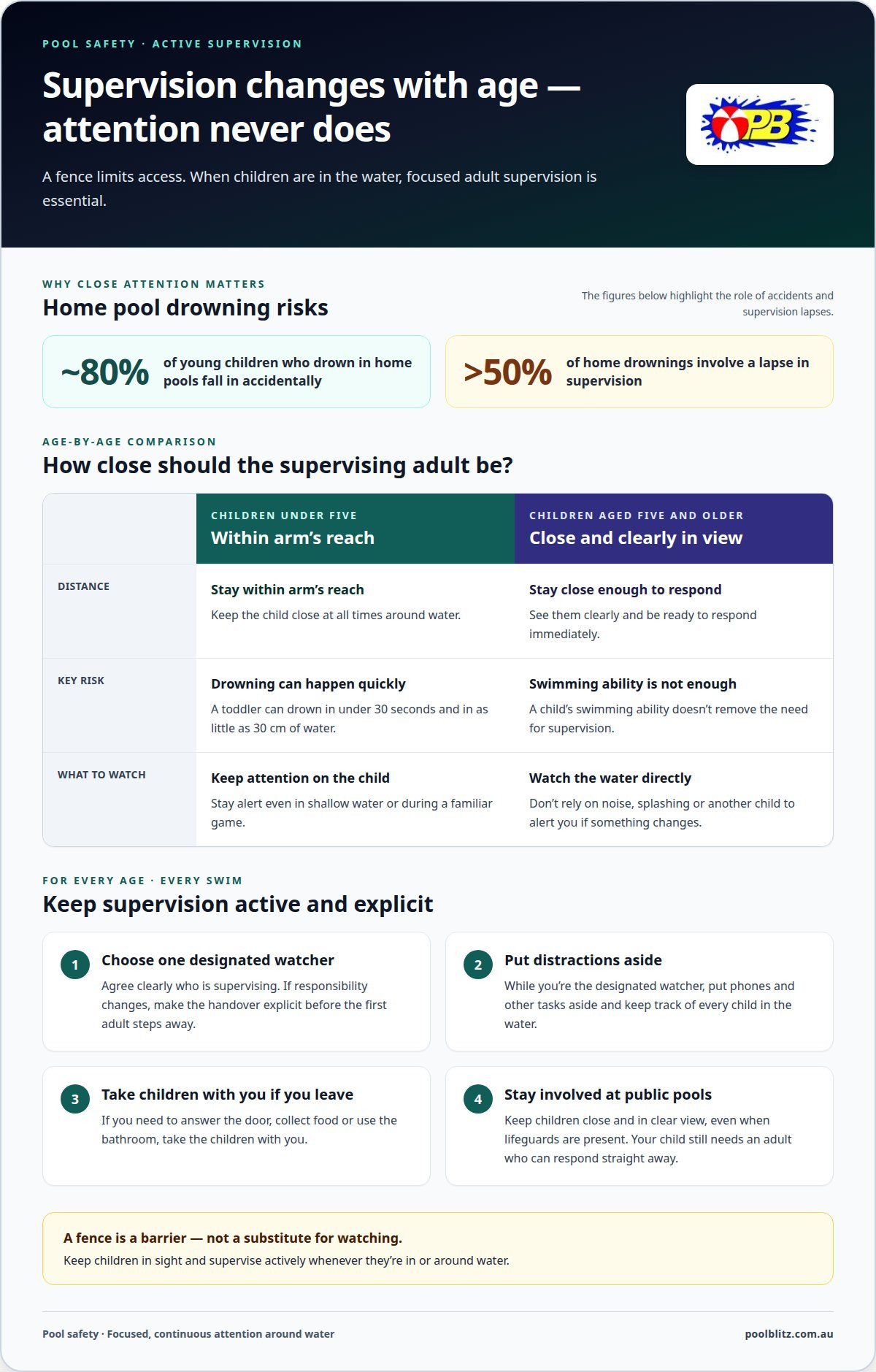
A fence limits access, but supervision matters whenever children are in the water. Around 80% of young children who drown in home pools fall in accidentally. More than 50% of home drownings involve a lapse in supervision, so watching must remain an active task, not an assumption.
For children under five, stay within arm’s reach at all times around water. A toddler can drown in under 30 seconds and in as little as 30 cm of water. Keep your attention on the child, even in shallow water or during a familiar game.
For children aged five and older, stay close enough to see them clearly and respond immediately. Swimming ability doesn’t remove the need for supervision. Watch the water directly rather than relying on noise, splashing or another child to alert you if something changes.
Choose one adult to supervise, and make any handover explicit. The incoming adult should agree to take responsibility before the first steps away. If you need to answer the door, collect food or use the bathroom, take the children with you.
At a pool gathering, distractions can make supervision harder. Put phones and other tasks aside while you’re the designated watcher, and keep track of every child in the water. If responsibility changes, say so clearly rather than assuming someone else has taken over.
At a public pool, stay close and keep children in clear view, even when lifeguards are present. Lifeguards oversee the pool environment, but your child still needs an adult who knows where they are and can respond straight away. Water safety depends on focused, continuous attention.
3. What are the features of a safe pool fence?
A pool barrier should prevent children reaching the water when an adult isn’t watching. In Australia, pool fences must meet Australian Standard 1926 (AS 1926) safety requirements. A fence that looks sturdy may still have gaps, climbable features or a gate that fails to close securely, so assess the whole barrier rather than its appearance alone.
Use these measurements as key checks:
- The fence should be at least 1.2 m high.
- Vertical gaps should be no more than 100 mm apart.
- Horizontal bars should be at least 900 mm apart.
These limits help reduce the chance of a child passing through or climbing the barrier. Check the full fence line, including joins and sections beside structures. A gap under a panel or a foothold near the fence can weaken the barrier, even if the other panels appear secure.
The gate is a critical part of the pool barrier. It should close and latch by itself, with a child-resistant latch higher than 1.5 m above the ground. Watch the gate close from different positions, then check that the latch engages each time. Keep the gate closed rather than relying on children to remember to shut it.
Before installing a pool fence, check the approval requirements that apply to your project. Swimming lessons can help children develop skills, but they don’t replace a compliant barrier or adult supervision. A fence restricts access; it doesn’t make unsupervised swimming safe.
A pool safety inspection or fence repair has no single standard price. Costs depend on the fence’s size, material, access and repair scope, and are provided after a quote request. Damage, loose fittings or a gate that doesn’t latch can affect the work needed, so assess each issue as part of the complete barrier.
4. Pool fence maintenance and access prevention
A compliant fence can lose its protective function if a gate jams or a panel shifts. Walk the full boundary and look for loose sections, damaged mesh, gaps beneath panels and objects that could serve as climbing footholds. Check the gate’s self-closing action and child-resistant latch after any adjustment or repair.
Make this a routine visual check, especially after storms, gardening or work near the fence. A fallen branch, moved pot plant or newly stored ladder can create a route over the barrier. Keep outdoor furniture, bins, toys and pool equipment away from the fence rather than relying on children to leave them untouched.
Test the gate from different open positions. It should swing shut and latch without someone pulling it closed. If it sticks, doesn’t latch or can be held open easily, keep children away from the pool and arrange repairs promptly. Don’t wedge the gate open for convenience, even while carrying towels or supervising a gathering.
Check the boundary after landscaping changes. Raised soil, a new retaining edge or a garden structure beside the fence can change how children might reach or climb it. Look for openings around pipes, equipment and joins, and address any damage that compromises the barrier. Keep the pool gate closed whenever the pool isn’t in active use.
Parents can also reduce temptation and access beyond the fence. Put away pool toys after swimming, secure chemicals and equipment, and empty portable pools after use. If a child could enter through a side gate or open door, include that route in your access check. A missing child near water is an emergency, so prevention must cover every approach, not just the pool perimeter.
For a pool-care routine that complements these access checks, arrange regular pool servicing. Keep fence and gate checks focused on the barrier itself, and act promptly when a defect appears.
Pool Blitz
Pool Blitz can help keep your pool well maintained and ready for family swims. If you’re concerned about water balance, equipment performance or ongoing upkeep, its regular and casual pool servicing can address those needs. Pool Blitz also offers pool chemicals, robotic pool cleaners and repairs, and pool equipment repairs.
These services complement, but don’t replace, a compliant pool fence, secure access controls or active adult supervision. A well-maintained pool still needs a closed, functioning gate and an adult watching children in the water. Pool Blitz is a practical next step for questions about water care or pool equipment, rather than fence installation or emergency response.
For help with pool care, contact Pool Blitz.
Make pool safety part of your routine
A child’s confidence, household routines and pool area can change over time. Review who watches the children and how they move around the pool, especially when visitors or new activities change the usual pattern. Ask, “Is my pool safe for my kids to swim in?” as part of that regular review, and make sure every supervising adult understands their role.
If you’re still asking, “Is my pool safe for my kids to swim in?”, assess the whole pool environment, not just the water. Maintenance supports a well-kept pool, while barriers and attentive supervision remain essential to protecting children.
For help with pool-care questions, contact Pool Blitz about pool safety. A considered next step can help you feel more prepared for the swims ahead.
Frequently Asked Questions
What are the features of a safe pool fence?
A safe pool fence forms a continuous barrier that children can’t easily climb through or over. Australian requirements include a minimum height of 1.2 m, vertical gaps no wider than 100 mm, and horizontal bars at least 900 mm apart. The gate should close and latch by itself, with a child-resistant latch higher than 1.5 m above ground. Check the entire boundary, not just the gate.
Which swimming pools need fences?
In Australia, private pools and spas 30 cm deep or deeper need safety fences. This includes spa baths and portable or inflatable pools, so a temporary pool can still require a barrier. After children finish using an inflatable pool, empty it rather than leaving water available. Even a small amount can be dangerous for a young child.
What are the current pool safety rules for children in Australia?
Children need active adult supervision around water, alongside a barrier that restricts unsupervised access to the pool. Keep children under five within arm’s reach; for children aged five and older, stay close enough to see them clearly and respond instantly. Take children with you whenever you leave the pool area, even briefly, and make supervision handovers explicit.
What fencing and gate requirements apply to home swimming pools in Australia?
Home pool fences must meet Australian Standard 1926 (AS 1926) safety requirements. The fence should be at least 1.2 m high, with vertical gaps no more than 100 mm apart. Horizontal bars should be at least 900 mm apart. The gate needs to self-close and self-latch, with a child-resistant latch higher than 1.5 m above ground.
How can I check whether a pool fence and gate are safe for children?
Walk the complete fence line and look for damage, openings, loose sections or objects a child could use to climb. Open the gate and watch it close and latch without assistance, then repeat from different positions. Check that nothing is holding it open. If a fault leaves access possible, keep children away from the pool until the barrier is repaired.
What is the recommended level of adult supervision for children swimming?
Keep children under five within arm’s reach whenever they’re around water. For older children, stay close enough to see them clearly and respond immediately. Give one adult clear responsibility for watching, without phone use or other distractions. If that adult needs to leave, take the children along or arrange a direct handover before stepping away.
No responses yet