
Is that subtle screeching sound from your filter box actually the first warning sign of an expensive, avoidable replacement? For many Brisbane homeowners, a silent pump in the peak of a humid January is a source of genuine anxiety; it usually signals a rapidly approaching “green pool” crisis. Understanding how to fix pool pump issues before they escalate is about more than just mechanical repair, it’s about preserving the clarity and safety of your family’s backyard sanctuary. We recognise that the confusion between a simple capacitor failure and a complex motor burn-out can be overwhelming, especially when you’re trying to balance the household budget.
We agree that maintaining a pristine pool should be a source of relaxation rather than a technical chore. This 2026 troubleshooting guide provides the professional clarity you need to diagnose faults with precision and implement safe, effective DIY solutions. You’ll learn to identify common mechanical and electrical symptoms, understand the impact of new energy efficiency standards on your equipment, and recognise exactly when a seasoned expert should take over the heavy lifting. By the end of this article, you’ll have a comprehensive plan to restore your filtration system and keep your Brisbane pool crystal clear all year round.
Key Takeaways
- Recognise the specific “cries for help” your equipment makes, from mechanical rattles to electrical hums, before a minor fault becomes a total failure.
- Learn a methodical approach to fix pool pump priming issues by identifying air leaks in the suction side and clearing pressure side blockages.
- Establish a clear safety boundary for DIY repairs, ensuring you only tackle tasks that don’t require specialised electrical licensing or complex tools.
- Discover how maintaining precise water alkalinity acts as a protective measure for your pump seals, preventing the leaks that lead to motor damage.
- Gain insights into the latest 2026 energy standards and Brisbane-specific tariffs to optimise your pump’s running costs and overall efficiency.
Common Signs Your Pool Pump Needs Fixing
Your pool pump often communicates its distress long before the system shuts down entirely. Recognising these early “cries for help” is the most effective way to avoid the steep costs associated with a total equipment replacement. In Brisbane’s intense humidity, even a minor mechanical rattle can quickly escalate into a seized motor if moisture penetrates the internal components. When you attempt to fix pool pump issues at the first sign of trouble, you are prioritising the longevity of your entire filtration system.
A failing pump doesn’t just affect your energy bill; it directly impacts your water health. Decreased water flow means your salt chlorinator cannot produce sanitiser effectively, which leads to a “green pool” crisis in the Queensland heat. Maintaining a vigilant ear and eye for these symptoms ensures your backyard remains a sanctuary rather than a source of technical anxiety.
Unusual Noises: Screeching, Grinding, and Humming
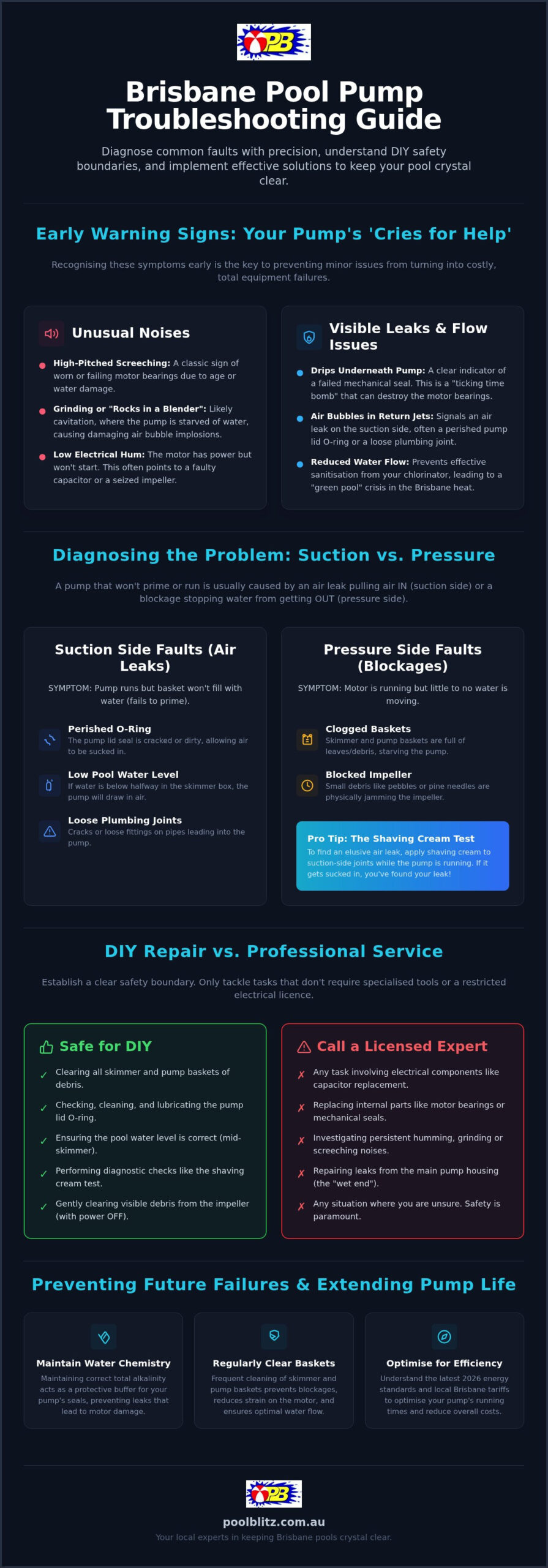
A high-pitched screeching sound is a classic indicator that your motor bearings are failing. These bearings are designed to provide smooth, silent rotation, but they eventually wear down due to age or water ingress. If you hear a sound akin to “rocks in a blender,” you’re likely dealing with cavitation. This occurs when the pump is starved of water, often because of a clogged skimmer basket or a blockage in the suction line, causing air bubbles to implode against the impeller with violent force.
A low electrical hum without any water movement usually points to a faulty capacitor or a seized impeller. The motor is receiving power but lacks the “kick” required to start the rotation. It’s often possible to fix pool pump humming by clearing debris from the impeller, but a failed capacitor requires professional attention to ensure the electrical system remains safe and compliant with QLD regulations.
Visible Leaks and Water Loss
Dripping water directly beneath the pump housing is a tell-tale sign of a failed mechanical seal. This is a ticking time bomb for your motor; if the leak persists, water will eventually travel along the shaft and destroy the internal bearings. While a small puddle might seem insignificant, the moisture levels in Brisbane can accelerate corrosion within the motor casing, turning a simple seal replacement into a much larger repair job.
Suction-side leaks are often identified by a steady stream of air bubbles appearing in the return jets. This usually happens when the pump lid O-ring has perished or the plumbing joints have expanded and contracted during our seasonal temperature shifts. During Brisbane’s storm season, it’s also vital to ensure that water isn’t “puddling” around the base of your equipment. Excessive standing water near electrical pool components is a significant safety hazard that can lead to short circuits and permanent motor damage.
Diagnosing the Problem: Why Your Pump Won’t Prime or Run
A pool pump that refuses to prime is a common frustration for many local residents. To effectively fix pool pump issues, you first need to understand the “Anatomy of Failure.” The system is divided into two distinct halves: the suction side, which pulls water from the pool, and the pressure side, which pushes it back through the filter and chlorinator. When your pump basket fails to fill with water, the culprit is almost always an air leak on the suction side or a severe blockage preventing flow.
Brisbane’s lush environment presents a unique challenge. Our heavy leaf-load, particularly during the windy months or jacaranda season, can overwhelm skimmer and pump baskets in a matter of days. If the motor is running but no water is moving, it’s essential to determine if the motor is simply humming, which indicates it’s seized, or if it’s spinning freely without catching water. Understanding this distinction is the first step toward a successful diagnosis.
Air Leaks and Priming Issues
The most frequent cause of priming failure is a compromised pump lid O-ring. Over time, these rubber seals can crack or become coated in grit, allowing air to bypass the seal. A practical way to find elusive air leaks is the “shaving cream test.” Apply a thick layer of shaving cream around the pipe joints and lid while the pump is running; if the cream is sucked into a gap, you’ve found your leak. Additionally, ensure your pool’s water level is at the halfway mark of the skimmer box. If it’s too low, the pump will draw in air, preventing it from ever reaching full prime.
Mechanical Blockages in the Impeller
Small debris, such as pine needles or tiny pebbles, can occasionally bypass the pump basket and jam the impeller. This prevents the motor from spinning even when it’s receiving full power. While you can attempt to fix pool pump clogs yourself, always ensure the power is disconnected at the mains before reaching into the pump housing through the basket opening. If the impeller feels rigid or stuck, a physical blockage is the likely cause.
However, if the impeller spins freely but the pump still lacks pressure, it may be worn out rather than just blocked. Erosion from sand or salt can eventually “smooth” the impeller vanes, reducing its ability to move water efficiently. If you’re unsure whether the issue is a simple clog or a more complex mechanical failure, our team can provide professional pool equipment servicing to restore your system’s performance and give you peace of mind.
DIY Repair vs. Professional Pool Equipment Servicing
Choosing the right moment to intervene is the hallmark of a responsible pool owner. While the desire to fix pool pump issues personally is understandable, establishing a “Safety First” framework is essential for protecting both your equipment and your family. In the context of Brisbane’s regulatory environment, this means drawing a clear line between external plumbing adjustments and internal mechanical or electrical repairs. A well-intentioned DIY attempt on a complex internal component can often lead to a total motor burnout, turning a manageable service into an expensive replacement.
We believe in empowering homeowners with the knowledge to maintain their systems safely. Many minor performance issues stem from simple environmental factors that don’t require a trade qualification to resolve. By focusing your efforts on the “suction and pressure” external components, you can often restore clarity to your water without ever opening the motor casing or risking your manufacturer’s warranty.
The “Safe for DIY” Checklist
You can safely perform several maintenance tasks on a Saturday morning to improve your pump’s efficiency. Replacing perished O-rings and lubricating them with a quality silicone-based grease is a foundational skill that prevents air leaks. Similarly, clearing stubborn debris from the pump basket and skimmer box ensures the motor doesn’t have to work harder than necessary to move water. If you notice a small drip from a plumbing joint, tightening the loose PVC unions by hand is often enough to resolve the issue. These proactive steps are the most effective ways to fix pool pump priming problems before they cause permanent damage.
When to Call a Professional Repairer
Internal repairs demand a higher level of technical precision and, in many cases, specific legal certifications. In Queensland, any task involving internal motor wiring or the replacement of a faulty capacitor must be handled by a licensed professional to ensure safety and compliance with electrical standards. Attempting to bypass these regulations not only poses a significant physical risk but can also void your home insurance or equipment warranties.
Mechanical seals are another area where professional intervention is vital. Replacing these seals requires the complete disassembly of the pump housing, a process where even a millimetre of misalignment can lead to catastrophic failure. For these complex tasks, seeking pool equipment repairs Brisbane ensures that your system is restored to factory standards. Entrusting the “heavy lifting” to a seasoned authority allows you to enjoy your weekend with the peace of mind that your pool’s longevity is being professionally managed.
Step-by-Step Guide to Basic Pool Pump Repairs
Before you begin any hands-on work to fix pool pump issues, safety must be your absolute priority. Always switch off the power at the main isolator and unplug the unit from the chlorinator or power point to prevent accidental activation. You’ll generally only need a few basic tools: a garden hose, a bucket of pool water, some silicone-based lubricant, and perhaps a small mirror or a torch to inspect the deeper recesses of the housing. Taking these precautions ensures the repair process is as smooth and stress-free as the results we aim to provide.
The “Systematic Reset” is your first line of defence. Before dismantling anything, check that your pool’s water level is correct and ensure the circuit breaker hasn’t tripped. Sometimes, a pump stops simply because a power surge or a brief outage has reset the timer settings. Once you’ve confirmed power is available and the water level is sufficient, you can move on to more specific mechanical troubleshooting with confidence.
How to Clear a Blocked Impeller
Isolate the power completely before removing the pump basket to access the intake. Use a small mirror to look into the impeller’s opening or carefully use your fingers to feel for debris like jacaranda seeds or small twigs that often bypass the basket. A “hook tool” made from a bent coat hanger can be incredibly effective for snagging stubborn blockages. Before closing the lid, try to rotate the impeller manually; it should move freely without any grinding or resistance before you restore power.
Fixing a Pump That Won’t Prime
Check your skimmer box first to ensure the weir door isn’t stuck in the upright position, as this will starve the pump of water during the suction phase. To assist the priming process, fill the pump housing manually with a bucket of pool water until it overflows. Replace the lid quickly and start the pump. If air remains trapped in the lines, use the air bleed valve on top of your filter or temporarily set your pool multiport valve settings to the “waste” position to help expel the air lock through the system.
Replacing a Perished O-Ring
When you fix pool pump air leaks, the lid O-ring is the most frequent culprit. Identify the correct size for your specific brand and ensure the seating channel is completely free of grit or old lubricant. Never use petroleum jelly, such as Vaseline, on your seals; the petroleum base will cause the rubber to swell and perish prematurely. Instead, apply a generous layer of silicone-based grease to create a supple, airtight seal that can withstand the intense Brisbane heat and humidity.
If these steps don’t restore your system’s pressure and flow, it’s often a sign of a deeper mechanical fault. We offer comprehensive pool equipment repairs to handle the technical complexities, ensuring your pool remains a clear and inviting retreat for your family.
Preventing Future Failures and Extending Pump Life
Many homeowners fall into the “set and forget” trap once their filtration system is running smoothly. This hands-off approach is the primary enemy of equipment longevity, particularly in Brisbane where intense summer UV rays and sudden tropical storms can stress even the most robust systems. While you’ve learned how to fix pool pump issues when they arise, the most cost-effective strategy is to prevent them through proactive stewardship. A well-maintained pump shouldn’t just survive the season; it should provide reliable service for a decade or more.
Protecting your investment involves more than just mechanical checks. It requires a holistic understanding of how your pool’s environment interacts with its machinery. From the corrosive nature of salt spray to the impact of high-intensity sunlight on PVC pipework, your equipment is constantly under siege. A professional annual “health check” serves as a vital safeguard, identifying microscopic wear and tear that the untrained eye might miss during a standard Saturday morning clean.
The Role of Water Balance in Equipment Health
It’s a common misconception that water chemistry only affects the clarity of the pool. In reality, low pH levels create an acidic environment that literally “eats” through copper heat exchangers and degrades the internal rubber of your pump seals. When your alkalinity is out of range, the water becomes aggressive, seeking out minerals from your equipment to balance itself. This is why expert water balancing is the most effective insurance policy you can hold for your filtration system.
Managing calcium hardness is equally critical for preventing scale buildup within the impeller’s narrow vanes. If calcium levels are too high, white deposits can form inside the pump housing, creating friction that forces the motor to draw more current and run hotter. This heat is the silent killer of motor windings, often leading to a premature failure that no amount of cleaning can resolve.
Routine Maintenance Schedule
Consistency is the foundation of a trouble-free pool. Emptying your skimmer and pump baskets weekly is a non-negotiable task that prevents motor strain and the destructive forces of cavitation. You should also develop the habit of checking for “salt creep” around the motor shaft. This white, crusty buildup is a clear indicator that a seal is weeping, allowing corrosive saltwater to travel toward the front bearing where it can cause the screeching sounds discussed in earlier sections.
Catching these issues early is the key to maintaining a budget-friendly maintenance routine. If you notice even a slight dampness under the pump housing, scheduling pool pump repairs near me at the first sign of a leak can save you from a complete motor burnout. By combining your new ability to fix pool pump basics with a disciplined maintenance schedule, you ensure your Brisbane pool remains a source of pride and relaxation for years to come.
Restoring Your Pool’s Peace and Clarity
A reliable filtration system is the heartbeat of any Brisbane backyard, and identifying the early warning signs of failure ensures your water remains inviting year-round. By understanding the difference between a simple air leak and a complex electrical fault, you can confidently decide when to manage a Saturday morning repair yourself and when to call for specialised support. Remember that maintaining precise water chemistry and clearing debris regularly are the most effective ways to avoid the need to fix pool pump components prematurely. These proactive habits protect your equipment from our intense local climate while preserving your household budget.
If you’re facing a stubborn mechanical issue or simply want the peace of mind that comes with a professional inspection, our team is here to help. Founded in 1994, Pool Blitz brings over three decades of local Brisbane experience to every service, specialising in all major pump brands and robotic cleaners. We take pride in being an independent local business that handles the heavy lifting so you can focus on enjoying your pool. Get your pool pump fixed by Brisbane’s experts at Pool Blitz and ensure your system is ready for the seasons ahead. Your crystal-clear sanctuary is just a professional service away.
Frequently Asked Questions
Why is my pool pump making a loud screeching noise?
A loud screeching noise is typically the result of worn or corroded motor bearings. These bearings fail when the internal mechanical seal perishes, allowing chlorinated water to seep into the motor housing. In our humid Brisbane climate, this corrosion can accelerate quickly. While it might be tempting to ignore the sound, continuing to run the unit will eventually cause the motor to seize entirely, leading to a much more expensive replacement.
Can I run my pool pump if it is leaking water?
You should avoid running a leaking pump as it poses a direct threat to the motor’s internal components. Water dripping from the underside of the housing indicates a failed mechanical seal, which acts as the only barrier between the wet end and the electrical motor. If moisture reaches the bearings, it causes permanent damage. It is always safer to address the leak immediately to protect the longevity of your equipment.
How much does it cost to fix a pool pump in Brisbane?
The cost to fix pool pump issues in Brisbane depends on the complexity of the fault and the specific parts required for your model. Minor repairs such as replacing a mechanical seal or a start capacitor are generally more economical than a full motor overhaul. To get a clear understanding of the investment required, a professional assessment is necessary to diagnose whether the issue is a simple external leak or a more involved internal mechanical failure.
Why is my pool pump humming but not starting?
A humming pump that refuses to start is usually caused by a failed start capacitor or a physical blockage in the impeller. The capacitor provides the necessary electrical “kick” to begin rotation; without it, the motor simply vibrates. Alternatively, debris like small stones or seeds may have bypassed the basket. Because capacitor replacement involves internal wiring, it’s important to ensure a qualified professional handles this to remain compliant with Queensland electrical safety regulations.
How often should I lubricate my pool pump O-rings?
You should lubricate your pool pump O-rings every three to six months to maintain a supple, airtight seal. Brisbane’s intense summer heat can cause rubber components to dry out and crack prematurely if they aren’t protected. Always use a high-quality silicone-based lubricant rather than petroleum-based products. Applying a thin, even layer during your regular maintenance routine is a simple way to prevent the air leaks that often lead to priming failures.
Is it worth repairing an old pool pump or should I replace it?
Choosing between a repair and a replacement usually comes down to the age of your equipment and its energy efficiency. If your pump is over eight years old, the cost of a major overhaul might be better directed toward a modern variable-speed model. These newer units comply with current Australian energy standards and offer significant savings, using up to 55% less energy than older single-speed models. This often makes replacement the more sustainable long-term choice.
What causes a pool pump to lose its prime?
A pool pump loses its prime when air enters the system, breaking the vacuum required to pull water from the pool. This is frequently caused by a perished lid O-ring, a low water level in the skimmer box, or a loose plumbing union on the suction side. To fix pool pump priming issues, ensure the water level is at the halfway mark of the skimmer and check that the pump lid is seated correctly without any debris.
Can a blocked filter cause my pump to overheat?
A blocked filter can certainly cause your pump to overheat by creating excessive backpressure within the system. When the filter media is clogged with debris or scale, the motor must work significantly harder to push water through the resistance. This increased workload generates internal heat, which can damage the motor windings over time. Regularly cleaning your filter and monitoring the pressure gauge is essential for maintaining a cool, efficient filtration system.
No responses yet