
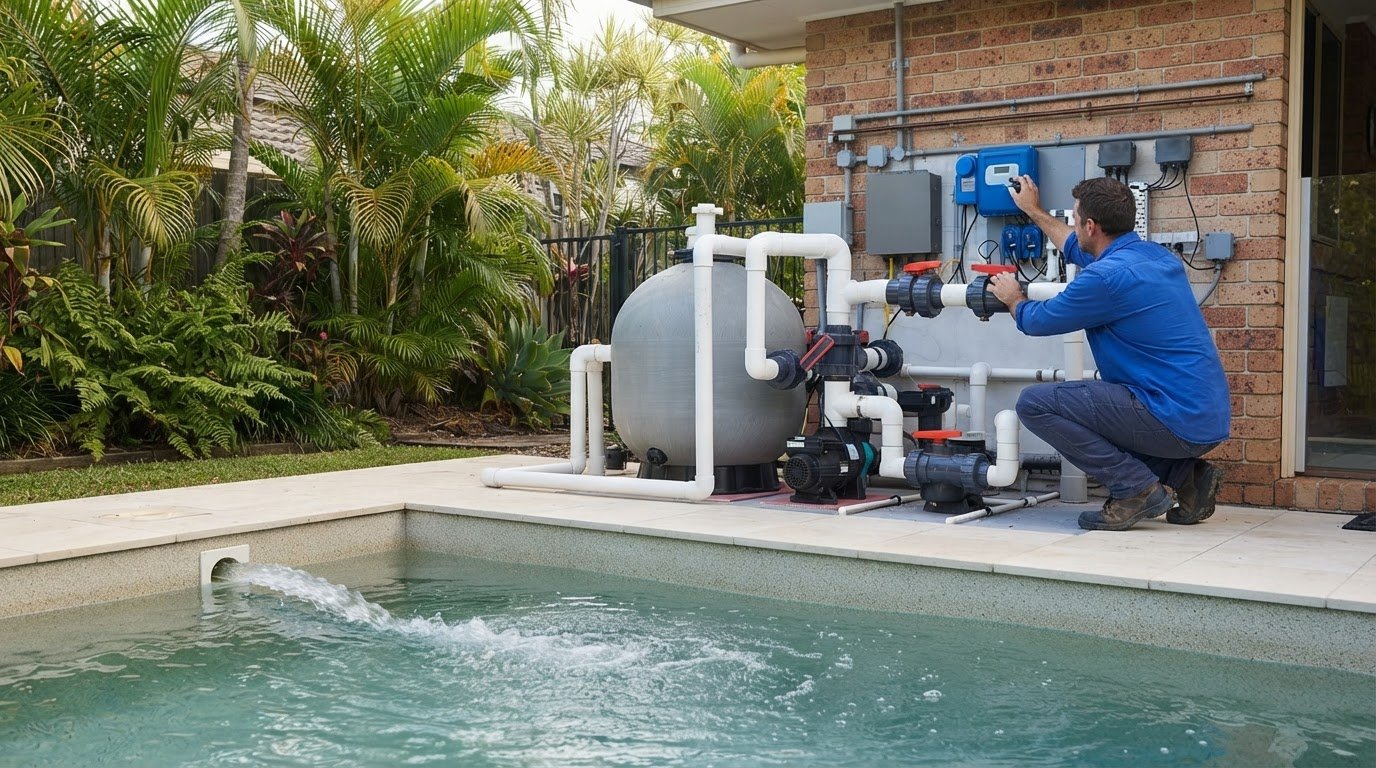
Running your pool pump for longer isn’t automatically better. For many Australian pools, a useful starting point for optimising pool pump running times is 6–10 hours a day in summer and 3–6 hours a day in winter, with enough circulation to filter the pool’s water at least once daily. The right schedule depends on your pool, pump and equipment.
It’s sensible to want clear, inviting water without running the pump longer than necessary. This guide explains how to set a practical schedule, adjust it for the season and energy efficiency, and spot signs that circulation may be inadequate. It also covers equipment requirements, including how a salt chlorinator, filter or heat pump can affect how long the system needs to run.
Key Takeaways
- Estimate the time needed for a full water turnover using your pool’s volume and pump flow rate, rather than relying on a single schedule for every pool.
- Use a timer and consider splitting the pump cycle to align circulation with your household’s energy tariff and pool-use patterns.
- Cloudy water, poor circulation or a filter that needs frequent attention can signal that the current schedule or filtration setup needs a closer look.
- Factor in equipment requirements, as a salt chlorinator or heat pump may need a particular flow rate and operating schedule.
1. How Long Should You Run a Pool Pump?
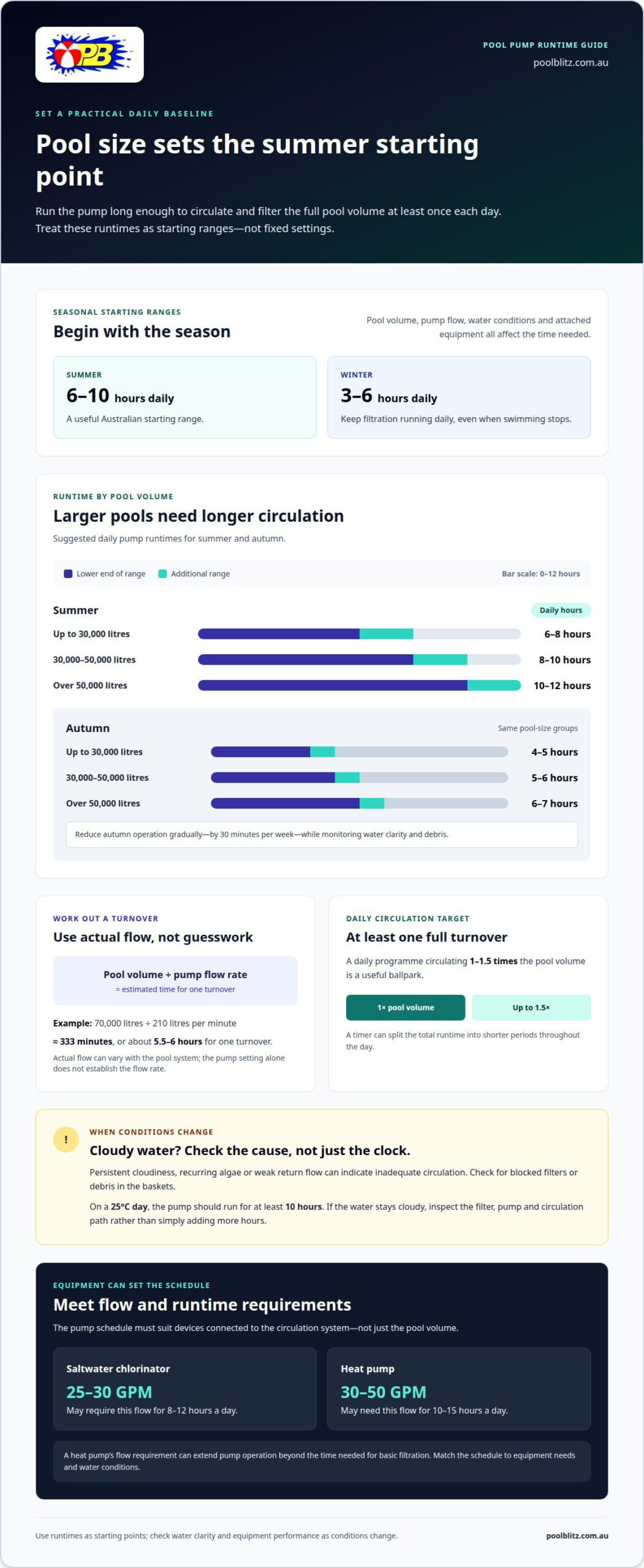
Run the pump long enough to circulate and filter the pool’s full water volume at least once each day. In Australia, a common starting point is 6–10 hours daily in summer and 3–6 hours in winter. Treat these as starting ranges, not fixed settings: pool volume, pump flow, water conditions and attached equipment all affect the time required.
Estimate a turnover by dividing pool volume by the pump’s actual flow rate. For example, a 70,000-litre pool with a flow rate of 210 litres per minute needs about 333 minutes, or 5.5–6 hours, for one turnover. Flow can vary with the pool system, so the pump’s setting alone won’t establish the actual rate. A daily program circulating 1–1.5 times the pool volume is a useful ballpark.
Pool size offers another practical guide for summer: a pool up to 30,000 litres may need 6–8 hours daily; one from 30,000–50,000 litres, 8–10 hours; and one over 50,000 litres, 10–12 hours. In autumn, suggested daily runtimes are 4–5, 5–6 and 6–7 hours for those same size groups. Reduce autumn operation gradually, by 30 minutes per week, while monitoring water clarity and debris.
Keep filtration running daily in winter, even when swimming stops, to help limit algae growth and circulate chlorine. A timer can split the total run time into shorter periods throughout the day. Scheduling operation around pool use and conditions can avoid unnecessary hours while maintaining circulation and saving energy.
2. Adjusting schedules to improve energy efficiency
A timer helps match pump operation to your electricity plan and pool routine. In Australia, early-morning operation around 5am–9am is one option. Late-evening operation around 8pm–12am may suit plans with off-peak tariffs. A split cycle can run part of the schedule in the morning and the rest at night, rather than running continuously.
Electricity tariffs can affect pump running costs, and off-peak periods may make overnight operation cheaper. Local noise requirements can also determine whether running the pump at night is suitable. Check your electricity plan and council guidance before setting an overnight schedule, and consider whether pump noise could disturb neighbours.
Daytime operation can help circulate chemicals when ultraviolet rays are strongest. If swimming, hot weather or heavy debris increases the pool’s demands, adjust the schedule to maintain effective filtration. Lower pool use in winter may allow a shorter schedule, but keep the pump running enough to limit algae growth and circulate water.
A variable-speed pump may support longer operation at lower cost because it can run more efficiently at reduced speeds. The key is maintaining acceptable flow for the pool system, rather than choosing a speed based only on the display. If acceptable flow is achieved at 50% motor speed, power consumption may be reduced by as much as 80–90% compared with high-speed operation.
Use the timer to test a practical schedule, then observe water clarity and equipment performance as conditions change. Avoid cutting operation simply to reduce electricity use if the filter or other equipment needs more circulation. For a system whose flow or filtration needs make scheduling difficult, a correctly matched pool filtration system can support efficient, dependable operation.
3. Signs of insufficient circulation and filtration
Summer places extra demand on filtration. Heavy swimming, rainstorms and extreme heat are reasons to increase pump operation, then assess water clarity and debris levels. On a 25°C day, the pump should run for at least 10 hours. If the water remains cloudy after that period, simply adding more hours may not resolve the cause; the filter, pump and circulation path may need inspection.
Backwash the filter when needed to clear trapped debris and help it work effectively. Follow the filter’s operating guidance rather than backwashing on an arbitrary daily schedule. A blocked filter can reduce flow, while unnecessary backwashing interrupts filtration. If the water remains cloudy afterwards, check the pump and filter for other restrictions instead of extending run time without identifying the cause.
Pool size and filter type both affect the flow the system can handle. Filtration-rate guidelines include below 15–20 gallons per minute (GPM) per square foot for sand filters, below 1.5–2.0 GPM per square foot for diatomaceous earth filters, and below 0.35–0.4 GPM per square foot for cartridge filters. These figures help explain why one runtime won’t suit every residential pool. A larger pool needs more water circulated, while the filter’s capacity constrains suitable flow. Even a pump running at high speed may not maintain clarity if a filter is blocked or poorly matched to the system.
4. Planning pump schedules around pool equipment requirements
A pump schedule must suit every device connected to the circulation system, not just the pool’s volume. A salt chlorinator, heat pump and filter each have operating requirements that may set a minimum flow rate or runtime. The practical aim is to keep the pool clean while avoiding unnecessary electricity use. The right balance depends on the equipment and water conditions.
A saltwater chlorinator may require at least 25–30 GPM for 8–12 hours a day. Run the pump for the chlorinator’s required period, then match its output setting to chlorine demand and measured water balance. If testing shows chlorine is consistently too low or high, adjust output rather than assuming that changing pump hours alone will solve it.
A heat pump may need 30–50 GPM for 10–15 hours a day. Its flow requirement can therefore extend pump operation beyond the time needed for basic filtration. Schedule the pump during periods when heating is needed, while ensuring the heat pump receives its required flow. A reduced schedule that interrupts heating or chlorination may undermine overall system efficiency.
Filter capacity also shapes a suitable schedule. For example, a cartridge filter with 150 square feet of area has an ideal filtration rate at or below 52.5–60 GPM. A pump that pushes water through the filter too quickly may not support effective filtration, while insufficient flow can affect connected equipment. Match pump flow to the lowest relevant equipment requirement, then set the operating period around the devices that need circulation.
When running your pool system, consider the pump, filter, chlorinator and heat pump as one connected setup. If water balance, flow or equipment operation remains difficult to manage, arrange pool equipment repairs to address performance issues and help establish a practical schedule.
Pool Blitz: Pool Pumps
Pool Blitz can help when your pump’s performance, schedule or condition makes consistent pool care difficult. The pump needs to work with your pool’s filtration and other equipment, while its daily operation supports clear water without unnecessary running time.
If the pump is noisy, struggles to circulate water or doesn’t keep the pool clean, Pool Blitz offers pool pumps and pool equipment repairs. Regular or casual pool servicing can also help with ongoing maintenance, while robotic pool cleaner sales and repairs offer another way to manage debris.
For pump repairs, a replacement or support with routine pool care in Brisbane, contact Pool Blitz to discuss the next step.
Keep your pool routine working well
A pump schedule works best as part of an ongoing pool-care routine, not as a setting you choose once and forget. Changes in swimming habits, weather and equipment can alter what your pool needs. Review the system’s performance when conditions change, rather than simply adding hours without considering the cause.
Include water clarity and circulation in that review. If conditions change, adjust the schedule thoughtfully and observe how the pool responds. This helps balance day-to-day care with electricity use while keeping the filtration system suited to the pool and its equipment.
For help with optimising pool pump running times or choosing a practical next step for your pool, contact Pool Blitz for pool pump advice. A considered schedule can make pool care easier to manage, and the right support can help you move forward with confidence.
Frequently Asked Questions
How Long Should You Run a Pool Pump?
A useful starting point for optimising pool pump running times is enough daily operation to circulate the pool’s full water volume once. The actual duration depends on the pump’s flow rate, not just its speed setting. Consider connected equipment too, as a chlorinator or heat pump may require the system to run longer than basic circulation alone would need.
What’s the General Rule for Pool Pumps in Autumn?
For optimising pool pump running times in autumn, reduce the schedule gradually and monitor how the water responds. A practical guide is to cut runtime by 30 minutes per week, keeping an eye on clarity and debris. Pool size helps determine a starting schedule, while worsening water conditions are a reason to review the reduction rather than continue automatically.
How many hours a day should a pool pump run in Australia?
A common general recommendation for residential pools in Australia is 8–12 hours daily, though the suitable duration varies. Summer heat, swimming, debris, water conditions and connected equipment can all increase filtration needs. A pool used heavily during a hot spell may need more circulation than the same pool during a cooler, quieter period, so treat the range as a guide rather than a fixed setting.
How do you calculate pool pump run time from pool volume and flow rate?
Divide the pool volume in litres by the pump’s flow rate in litres per minute to estimate the minutes needed for one turnover. Divide that result by 60 to convert minutes into hours. For example, a result of 360 minutes equals six hours. This estimates circulation time; equipment requirements and actual system conditions can change the schedule needed.
What is the best time of day to run a pool pump in summer and winter?
There isn’t one best time for every pool. Early morning operation around 5am–9am or late evening around 8pm–12am may suit different electricity tariffs. Daytime circulation can help move chemicals through the pool when ultraviolet rays are strongest. Choose periods that meet equipment needs and suit your tariff, while considering pump noise if scheduling overnight.
How do variable-speed and single-speed pool pumps affect optimal run times and electricity costs?
A variable-speed pump can run more slowly for longer, often using less electricity than high-speed operation. If acceptable flow is achieved at 50% motor speed, consumption may be reduced by as much as 80–90% compared with high-speed operation. A single-speed pump offers less flexibility in operating speed, so its schedule relies more on choosing suitable run periods and duration.
No responses yet