
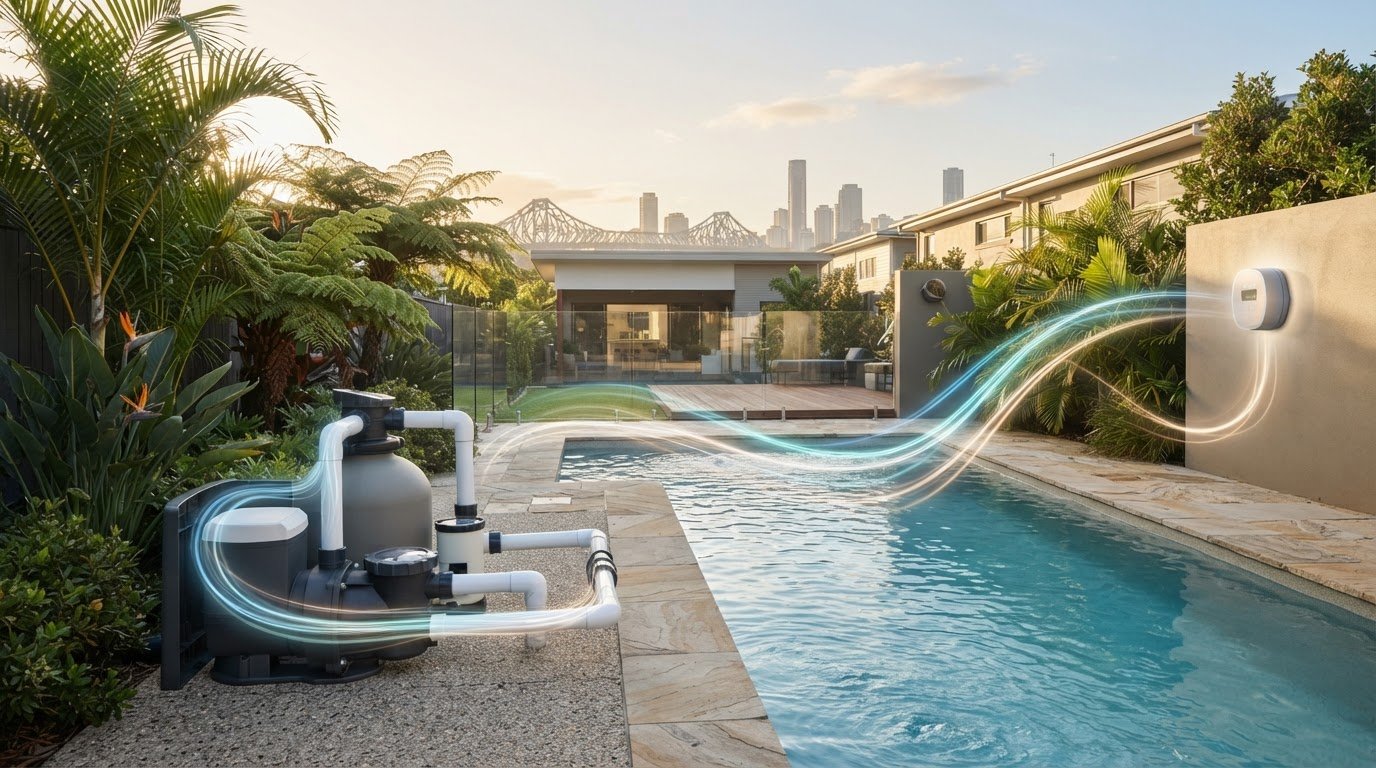
The cost of running a pool pump in Queensland depends on its power use, daily run time and electricity tariff. Your bill will vary with your location and electricity plan.
Pump run time is only part of the picture: pump type and energy use also affect the total. This guide explains how tariffs, pump speed and operating hours shape costs, then shows how to estimate a monthly figure for your pool. Use the calculation to understand what drives your electricity use and which details to check first.
Key Takeaways
- Use the usage rate on your electricity plan to estimate pump costs, as tariffs vary by location and plan.
- Compare pump power use and speed settings to understand how equipment affects electricity consumption.
- Time-of-use plans may offer cheaper periods for filtration, so check when off-peak rates apply to your supply.
- Balance daily run time with your pool’s filtration needs; longer operation isn’t automatically more efficient.
- Apply the monthly calculation to your pump’s wattage, run time and tariff for a more useful estimate of your bill.
Pool pump electricity tariffs and hourly costs
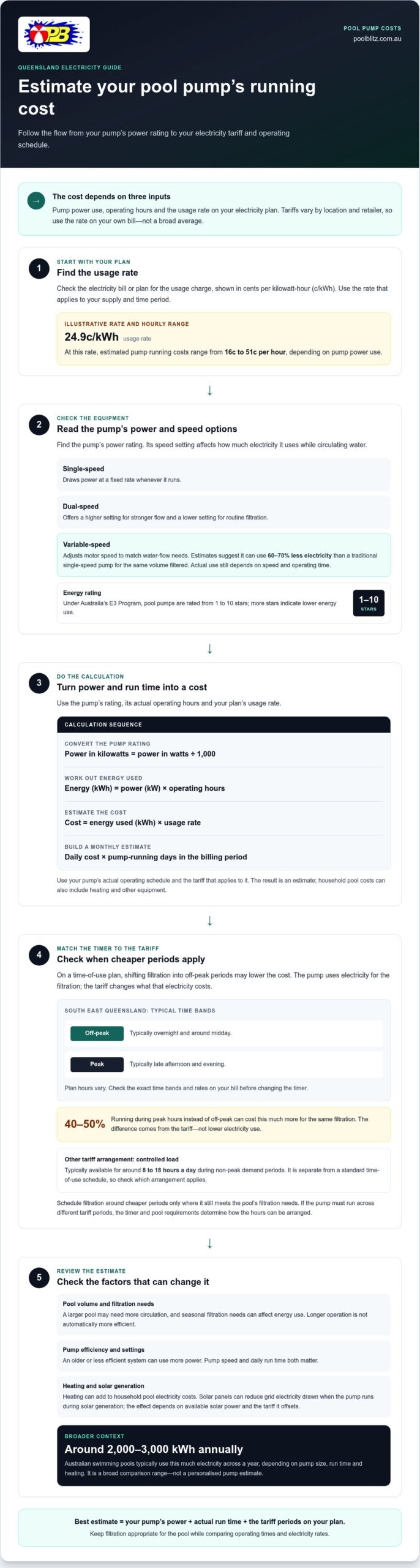
The cost of running a pool pump in Queensland depends on the electricity tariff, pump wattage and operating hours. Start with the pump’s power rating and the usage rate on your electricity plan to estimate the cost.
Electricity tariffs vary across Australia and between retail plans, so use your actual usage rate rather than a broad average.
At a 24.9c/kWh usage rate, estimated pump running costs range from 16c to 51c per hour. The range reflects differences in pump power use, rather than one standard charge for every Queensland pool. Pool heating can add to household electricity costs, so distinguish pump use from total pool expenses.
Annual electricity use and running costs
Annual pool electricity use is the energy consumed by equipment across a year, measured in kilowatt-hours. Australian swimming pools typically use around 2,000-3,000 kWh annually, depending on pump size, run time and heating. For households seeking ways to offset this substantial consumption, clean energy solutions from Redefining Solar can help reduce reliance on the grid. This estimate helps you compare your household’s pool-related usage with a broad national range.
Calculating daily and annual costs
To estimate running costs, multiply the pump’s power in kilowatts by its operating hours, then multiply by your tariff. Use the pump’s rating and your plan’s usage rate to make the calculation relevant to your home.
Factors affecting electricity costs
Pool volume, pump efficiency, daily run time, electricity tariff and heating all affect electricity costs. A larger pool may need more circulation, while an older or less efficient system can use more power. Can solar panels reduce the cost of running a pool pump in Queensland? Yes. When the pump runs during solar generation, solar power can reduce the electricity drawn from the grid. For homeowners seeking to offset daytime equipment loads, solar installers like Sky High Solar and Electrical can help design a suitable system. The saving depends on how much solar power is available while the pump is operating and the tariff it offsets. Pool use and seasonal filtration needs also affect energy consumption.
Single-, dual- and variable-speed pumps
Pump speed affects the electricity needed to circulate pool water. Variable-speed and single-speed pumps can have notably different estimated running costs, while dual-speed models provide an intermediate operating option.
Variable-speed pump consumption
A variable-speed pump adjusts its motor speed to match the required water flow, rather than running at one fixed speed. This matters because lower-speed operation can use less energy while filtering the same volume of water. Estimates suggest variable-speed pumps use 60-70% less electricity than traditional single-speed pumps for the same volume filtered. Their consumption still depends on the selected speed and daily operating time.
Running a pump for longer at low speed can use less power than running it for a shorter time at high speed. This illustrates how the operating setting can affect household pool electricity use.
Savings and payback from variable-speed pumps
Potential savings compare a new pump’s electricity use with the existing pump’s consumption. The result depends on how the pump is operated and the electricity rate, so treat it as a comparison rather than a guaranteed saving.
How do variable-speed and single-speed pool pump running costs compare? Estimates rely on different assumptions, so compare your pump’s actual power use and tariff before making a like-for-like assessment.
A single-speed pump draws power at a fixed rate whenever it runs. A dual-speed pump has a higher setting for tasks requiring stronger flow and a lower setting for routine filtration. A variable-speed model offers more adjustment, helping match circulation to the pool’s needs.
These examples show why wattage matters alongside run time.
Energy ratings offer another comparison point. Under Australia’s E3 Program, pool pumps are rated from 1 to 10 stars, with more stars indicating lower energy use. Check the pump’s rating alongside its power specification and the way it will operate in your pool. A more adjustable pump is not automatically the right choice for every setup; the required flow and filtration routine matter too.
If your current pump’s consumption is difficult to assess, reviewing suitable pool pump options can help you compare equipment with your pool’s operating needs.
Off-peak pump operation
On time-of-use electricity plans, off-peak operation shifts filtration to lower-priced periods. In South East Queensland, off-peak periods are typically overnight and around midday, while peak rates apply in the late afternoon and evening.
That timing can matter: running a pump during peak hours instead of off-peak can cost 40% to 50% more for the same filtration. The saving comes from the tariff difference, not from the pump using less electricity. Retailers set plan rates and time bands, so the hours that count as off-peak depend on the specific plan.
Controlled load supply is another tariff arrangement, typically available for around eight to 18 hours a day during non-peak demand periods. It is separate from a standard time-of-use schedule. Pool owners should understand which arrangement applies before assuming a particular operating window or rate.
For a practical comparison, use the tariff periods shown on your electricity bill and match them against the pump timer. If your plan has an overnight off-peak window, a timer can schedule filtration within it. A pump running after 10 pm can cost less because off-peak power usually starts around then in most areas, but South East Queensland plan periods vary.
Changing the schedule can lower costs only if filtration fits within the cheaper periods. If the pump needs to run across peak and off-peak times, split the operating hours where the timer and pool requirements allow. Keep filtration appropriate for the pool rather than cutting necessary run time to chase a lower tariff.
Consider your daily routine, too. An overnight schedule may fall within the typical off-peak period, while a daytime schedule could overlap with midday off-peak hours on some South East Queensland plans. Check the exact time bands: even part of the pump’s run time during peak pricing affects the bill.
Retailers publish each plan’s tariff structure, and your electricity bill shows the rates charged for usage. Compare these with the pump’s daily run time to estimate whether changing its schedule could reduce costs. Recording timer settings alongside bill periods can show whether the pump regularly runs during higher-priced hours.
Off-peak scheduling does not replace equipment maintenance. A clogged filter or restricted flow can affect circulation, whatever the tariff timing. Consider the pump schedule alongside the filtration system’s condition: lower-priced electricity helps only if the pool still gets the circulation it needs.
Recommended daily pump run times
A pool pump must circulate enough water for filtration and cleaning, while avoiding unnecessary operating hours. Across Australia, pumps are generally run for 6 to 8 hours each day, but Queensland conditions and pool use affect the practical schedule.
Recommended daily filtration times
Daily filtration time is the number of hours the pump circulates pool water each day. It matters because a schedule that meets the pool’s needs can limit unnecessary electricity use. Australian pools are generally filtered for 6 to 8 hours daily; heavier use or warmer conditions can increase filtration needs.
Are there Queensland rules or local requirements for pool filtration and pump operating times? No single daily schedule suits every pool. Operating time should account for filtration performance and water conditions; a generic schedule is not a legal rule.
In summer, warmer water and more frequent swimming can increase filtration needs. Debris, cloudy water or restricted flow can also affect how effectively the system cleans. Instead of cutting the timer to reduce costs, check whether the current run time keeps water clear and circulating properly.
Assess the schedule using the pump’s rating and the pool’s condition. A lower-powered pump may need to run longer to move the required volume, while a higher-powered model can use more electricity each hour. Running costs depend on both power consumption and operating hours.
Pump sizing and run times by pool size
Pump sizing matches the equipment’s flow capacity to the pool’s volume and filtration needs. A poorly matched pump may circulate water inefficiently or use more electricity than necessary. What size pool pump and daily run time are recommended for different pool sizes? Pool volume matters, but size alone does not determine the right pump rating or operating hours.
Pool pumps in Australia commonly have power ratings between 500 and 1,500 watts. Pool size and volume affect the electricity required for circulation, while pump efficiency and run time also influence consumption. Match those considerations with the filtration system’s needs, rather than selecting a pump solely by pool dimensions.
For example, a larger pool generally needs more water circulated than a smaller one, but the required flow also depends on the filter and plumbing setup. A single daily-hours recommendation cannot account for every combination. The usual 6 to 8 hours provides a starting point, not a fixed setting for every Queensland pool.
Australia’s E3 Program rates pool pumps from 1 to 10 stars, with more stars indicating lower energy use. Consider that rating alongside the pump’s wattage, pool volume and actual filtration performance. Evaporation can also affect water levels, especially during warm weather, so keep the pool’s condition in view when reviewing its operating routine.
Example monthly cost calculation
A monthly estimate turns the pump’s power rating, operating time and electricity tariff into a practical budget figure. The calculation below uses an illustrative South East Queensland tariff and separates pump consumption from other pool expenses, so you can compare the estimate with your electricity bill.
For a 1,000-watt pump running eight hours daily, convert the rating to kilowatts: 1,000 watts equals 1 kW. Multiply 1 kW by eight hours to get 8 kWh each day.
Use the same calculation with your own details:
- Convert the pump’s wattage to kilowatts by dividing by 1,000.
- Multiply kilowatts by the hours it runs each day to find daily kWh.
- Multiply daily kWh by your tariff, then by the days in your billing period.
For example, a 750 W pump running six hours uses 4.5 kWh daily. The result represents pump electricity only. Actual usage can change with the pump’s operating time, rating and tariff.
A chlorinator can add to the combined equipment load. One common setup draws 1.1 kW for its pump and chlorinator together. The annual figure includes both devices, so don’t treat it as the pump-only cost.
Brisbane pool estimates also show how tariff type affects a seasonal total. These are 90-day totals, not monthly charges.
Keep other pool expenses separate from the pump calculation. Filters affect circulation, while chemical treatment is a separate part of pool care. Heating can also add to total pool electricity use, but it is not included in the pump-only example. Compare the same equipment and billing period for a more useful estimate.
For help with water treatment alongside your electricity budgeting, explore pool chemical options.
Pool Blitz: Regular Pool Servicing
Pool Blitz provides regular pool servicing to help maintain balanced water and keep routine care on track. If you have estimated your pump’s electricity use and want support with pool maintenance alongside its filtration schedule, servicing is a practical next step.
Regular servicing helps you consider water quality and equipment care together. For occasional help instead of an ongoing routine, Pool Blitz also provides casual pool servicing. Other services include pool chemicals, robotic pool cleaners and repairs, and pool equipment repairs.
For support with regular pool care, contact Pool Blitz.
Make your next pool-care decision with confidence
Understanding the cost of running a pool pump in Queensland is a useful starting point. The next step is keeping the whole pool operating well. A consistent water-care routine can help you notice changes in filtration, water balance or equipment performance before they become ongoing problems.
Pool Blitz provides regular pool servicing for ongoing care, casual pool servicing for occasional support, and robotic pool cleaners and repairs. Choose the help that suits your pool-care routine, whether you need regular attention or support with a specific cleaning issue.
For friendly guidance with your pool, contact Pool Blitz about your pool. A considered next step can make pool care feel more manageable, so you can focus on enjoying your backyard.
Frequently Asked Questions
How Much Does It Cost To Run My Pool?
The cost depends on the pump’s wattage, operating hours and electricity tariff. That figure concerns pool electricity overall, not necessarily the pump alone. To narrow it down, separate pump consumption from heating and other equipment, then apply your own usage rate.
Is it cheaper to run a pool pump at night?
Running the pump at night may cost less if your electricity plan has lower overnight rates. South East Queensland time-of-use plans typically offer off-peak electricity overnight and around midday, with peak rates in the late afternoon and evening. Any saving depends on your plan’s time bands and whether filtration can fit within cheaper periods. A flat-rate plan does not necessarily charge less for overnight use.
Do pool running costs change between summer and winter?
Yes, seasonal pool use can change how much electricity the equipment consumes. Warmer weather and more frequent swimming may increase filtration needs, and pool heating can add electricity use. In cooler months, a pool may need less filtration, depending on use and water conditions. Rather than changing the schedule based on the season alone, consider cleanliness, circulation needs and whether heating is operating.
Does time of day matter?
Yes. On a time-of-use electricity plan, the time of day matters because rates vary across peak and off-peak periods. For example, a South East Queensland plan may have lower-priced periods overnight and around midday, while late afternoon and evening fall within peak times. The pump’s consumption depends on its operation, but the tariff charged for that usage varies with the plan’s schedule.
How much are you actually spending?
Use your electricity bill to identify the usage rate and billing period, then compare these with the pump’s operating pattern. If the bill combines household appliances, pool equipment and heating, it will not show the pump’s cost separately. A plug-in energy monitor may not suit permanently connected pool equipment, so estimate cost from the pump’s power rating and run time, then compare the estimate with changes in your bill over time.
How much energy does a swimming pool use?
Australian swimming pools typically use around 2,000-3,000 kWh of electricity per year, depending on pump type, size, daily run time and heating. This is a broad pool-energy estimate, rather than a figure for the pump alone. Pool equipment and heating can contribute different amounts, so the total varies between households. For a clearer view, distinguish pump use from other electrical equipment and heating in your household assessment.
How much electricity does a pool pump use per hour in Queensland?
Pool pumps in Australia commonly have power ratings between 500 and 1,500 watts, so hourly consumption varies with the particular pump. At an illustrative usage rate of 24.9c per kWh, estimated running costs range from 16c to 51c per hour. For a closer estimate, convert the pump’s wattage to kilowatts and multiply by your plan’s usage rate. The actual tariff and equipment rating determine the result.
How much does it cost to run a pool pump for 6, 8, or 12 hours a day?
Pump-only costs differ if the chlorinator isn’t included. Assuming an average 1,000-watt pump on a standard Queensland tariff of roughly 25c per kWh, running the pump for 6 hours a day uses about 6 kWh, costing around $1.50 daily. Extending this to 8 hours uses 8 kWh at about $2.00 a day, while a 12-hour schedule consumes 12 kWh, amounting to roughly $3.00 daily. Variable-speed pumps operated on eco-modes can reduce these daily totals significantly.
No responses yet