
Dumping a heavy dose of chlorine into your Brisbane pool only to wake up to a milky, opaque mess isn’t just frustrating; it’s a sign that your chemical treatment has hit a metaphorical brick wall. You’ve likely spent your Saturday morning measuring and pouring, yet the nagging question remains: why is my pool still cloudy after shocking? It’s a common headache that often leads to the exhausting “pool-store-loop,” where you’re sold more additives without ever addressing the underlying cause of the murkiness.
We understand the embarrassment of a dull-looking pool when you’ve planned a backyard barbecue, and the feeling of wasted money is something no homeowner should have to endure. This guide will help you break that cycle by identifying the exact mechanical and chemical hurdles preventing your water from reaching that crisp, inviting brilliance you expect. We’ll walk through the critical role of filtration efficiency, the impact of high pH levels, and the professional steps required to restore your swimming spot to its former glory. By the end, you’ll have a clear roadmap to crystal-clear water and the knowledge to ensure your pool remains a source of pride rather than a chore.
Key Takeaways
- The milky appearance following a treatment usually indicates that the shock successfully killed organic matter, but your filter now needs assistance to remove these microscopic particles.
- Imbalanced pH levels act as a barrier to chemical efficiency; ensuring your water is correctly balanced is vital to prevent wasting money on ineffective treatments.
- Discover exactly why is my pool still cloudy after shocking by checking for “Chlorine Lock,” a condition where excessive stabiliser prevents your chlorine from sanitising the water.
- Learn the strategic difference between using a clarifier for minor cloudiness and a flocculant for rapid, heavy-duty debris removal to save time and effort.
- Persistent cloudiness often signals a mechanical issue within your filtration system, making a professional equipment inspection the most reliable path to lasting clarity.
Understanding the ‘Dead Algae’ Phenomenon: Why Shocking Isn’t the Final Step
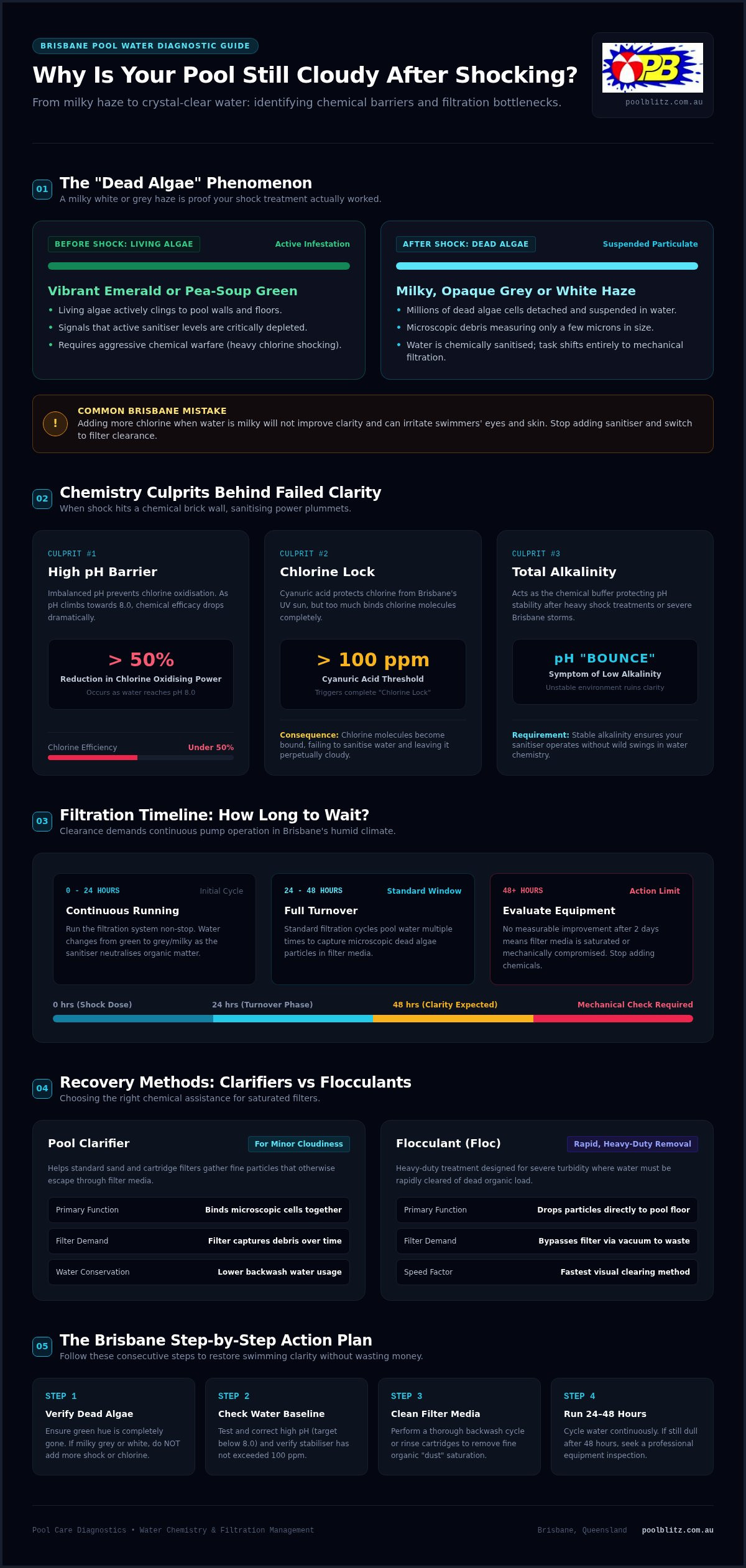
When you add a heavy dose of chlorine to a green pool, you’re initiating a chemical battle. If you wake up the next morning to find the green has vanished but has been replaced by a milky, opaque haze, take heart. This transition is actually a positive sign that your shock treatment has been successful. The reason why is my pool still cloudy after shocking is often simpler than you think; you’re looking at the remains of millions of dead algae cells suspended in the water.
These organic particles are incredibly fine, often measuring just a few microns in size. Most standard sand or cartridge filters struggle to capture such tiny debris in a single pass. This creates a bottleneck where your water chemistry is technically “clean” from a sanitisation standpoint, but visually murky. To understand the complex relationship between these chemicals and your equipment, it’s helpful to review the basics of swimming pool sanitation and water chemistry. Once the algae is dead, your pool’s filtration system must take over the heavy lifting to physically remove the debris from the environment.
Your filter media will quickly become saturated with this fine “dust” as it works through the volume of the pool. Performing a thorough backwash cycle or cleaning your cartridges is essential during this recovery phase. In Brisbane, it’s vital to monitor your water usage during this process. Ensure you’re clearing the filter efficiently to stay within local water conservation guidelines while still providing the flow rate needed for recovery.
The Difference Between Green Algae and Cloudy Water
Living algae is vibrant and clings to surfaces. It gives the water a distinct emerald or pea-soup hue, indicating that your sanitiser levels are far too low. Conversely, a grey or white haze suggests that the chlorine has done its job. Adding more chlorine at this stage is a common mistake that can actually irritate swimmers’ eyes and skin without improving clarity. If the water has shifted from green to grey, your focus must move from chemical warfare to mechanical filtration.
How Long Should You Wait After Shocking?
Patience is a required ingredient for a clear pool. In our humid Brisbane climate, a standard filtration system typically requires 24 to 48 hours of continuous operation to cycle the water enough times to catch the dead organic load. If you don’t see a measurable improvement after two days of constant running, your filter media might be compromised. This is the moment to stop adding chemicals and start evaluating whether your equipment is performing at its peak capacity.
Chemistry Culprits: Why Your Shock Treatment Might Have Failed
While dead algae is a physical reality, chemical imbalances are often the silent reason why is my pool still cloudy after shocking. If your water’s chemical foundation isn’t correctly aligned, even the highest quality chlorine will struggle to perform its intended function. High pH levels are perhaps the most frequent culprit in these scenarios. When your pH climbs toward 8.0, your chlorine’s ability to oxidise organic matter drops by more than half, turning a necessary maintenance task into an expensive exercise in futility.
Total Alkalinity also plays a pivotal role in this delicate balance. It acts as a buffer, preventing your pH from swinging wildly after a heavy treatment or a typical Brisbane storm. If your alkalinity is too low, your pH will “bounce,” making it nearly impossible to maintain the stable environment required for clear water. If you find yourself constantly adjusting chemicals without seeing results, it may be time to consider a professional casual pool servicing to reset your water’s baseline.
The Cyanuric Acid (Stabiliser) Trap
Brisbane’s harsh subtropical sun makes stabiliser a necessity for protecting your chlorine from rapid UV degradation. However, there is a fine line between protection and prevention. When Cyanuric Acid levels exceed 100 parts per million, you may experience a phenomenon known as “Chlorine Lock.” Chlorine lock occurs when excessively high levels of cyanuric acid bind to chlorine molecules, preventing them from sanitising the water and leaving it perpetually murky. This is a common reason why is my pool still cloudy after shocking, as no amount of additional chlorine can break through that chemical bond without significant water dilution.
Water Alkalinity and pH Balancing
Maintaining proper water alkalinity is vital because it protects your pool’s health from the acidic impact of heavy rainfall. After a classic Brisbane downpour, your alkalinity can drop sharply, which destabilises your pool’s chemistry and leads to persistent, stubborn cloudiness. For the best results, your pH should sit strictly between 7.2 and 7.6. This specific range ensures your shock treatment can actually oxidise organic matter rather than simply floating ineffectively in the water. We also recommend monitoring calcium hardness, as excessively hard water can lead to mineral scaling that creates a fine, cloudy haze across your pool’s surface.
Filtration vs. Clarifiers vs. Flocculants: Choosing the Right Recovery Method
Once you’ve balanced your chemistry and addressed the dead algae, you must decide how to physically extract the remaining particles from your water. This stage of the process is often why is my pool still cloudy after shocking; the suspended debris is simply too fine for your filter to capture on its own. To achieve that signature Brisbane sparkle, you need to choose between a clarifier and a flocculant based on your specific equipment and timeframes.
Your choice of filter media-whether it’s traditional sand, modern glass, or a pleated cartridge-dictates which chemicals are safe to use. Sand and glass filters are generally more robust and can handle a wider range of additives. Cartridge filters, however, are significantly more delicate. Using the wrong type of clarifier or any form of flocculant in a cartridge system can lead to “gumming up” the fine pleats, which often necessitates an expensive replacement rather than a simple clean.
When to Use a Pool Clarifier
Clarifiers are the ideal choice for mild cloudiness where you have a few days to let the system work. These chemicals act as a coagulant, carrying a positive charge that attracts negatively charged microscopic dust and dead algae cells. By binding these tiny particles into larger clumps, the clarifier allows your filter to finally grip and remove them from the water column. This is the safest, most “set and forget” option for busy homeowners who prefer to let their equipment handle the recovery gradually.
The ‘Floc and Vac’ Method for Emergency Clearing
If you have guests arriving in 24 hours and your water is still milky, a flocculant is your heavy-duty solution. Unlike clarifiers, which keep particles moving through the filter, flocculants bind everything together and sink the heavy mass directly to the pool floor. It effectively “clears” the water in hours by settling the debris into a thick, grey cloud at the bottom of the pool.
The success of this method hinges on a critical step: you must vacuum the settled debris directly to “waste.” Sending this heavy sludge through your filter media will cause an immediate and severe blockage. If you’ve accidentally cycled flocculant through your system, a pool filtration system repair Brisbane specialist may be required to deep-clean or replace the compromised media. This method is effective but carries a higher risk of mechanical strain if the proper vacuuming procedure isn’t followed precisely.
The Step-by-Step Recovery Plan for Brisbane Pool Owners
Restoring clarity requires a disciplined sequence of actions rather than a scattergun approach of adding more chemicals. If you are still wondering why is my pool still cloudy after shocking, it is time to stop guessing and start a structured recovery. Following these professional steps ensures you aren’t fighting against your own pool’s chemistry or equipment limitations.
- Step 1: Re-balance. Test your pH and Total Alkalinity immediately. Your pH must sit between 7.2 and 7.6 for any secondary treatments to be effective.
- Step 2: Clean the Filter. Perform a thorough backwash or clean your cartridge. The dead organic matter you’ve already killed is likely restricting your flow rate.
- Step 3: Constant Circulation. Switch your pump from ‘Auto’ to ‘Manual’ and run it 24/7. Continuous filtration is the only way to cycle the entire volume of water through the media enough times to catch fine particles.
- Step 4: Chemical Assist. Add a high-quality clarifier to help those microscopic particles group together. This makes it easier for your filter to trap them on the next pass.
Optimising Your Filtration Run-Time
A standard 8-hour cycle is sufficient for daily maintenance, but it is woefully inadequate for a recovery event. During a ‘green to clean’ transition, your water needs constant movement to prevent dead algae from settling in dead spots. We often see ‘channelling’ in older sand filters, where water carves a path through the sand and bypasses the filtration process entirely. A best robotic pool cleaner Brisbane owners can invest in provides an added advantage by scrubbing surfaces and keeping water circulating in the corners where the main pump might struggle.
Brisbane Weather Adjustments
South East Queensland weather presents unique challenges for pool owners. A sudden afternoon storm can dump nitrogen and debris into your water, instantly increasing the demand for sanitiser. When water temperatures remain consistently above 28 degrees, algae can bloom at an accelerated rate, often requiring you to maintain a higher chlorine residual than usual. Brisbane’s high humidity can cause opened bags of shock to clump or lose their oxidising potency within just a few months. If your DIY efforts aren’t yielding a crystal-clear result, our team can provide casual pool servicing to professionally diagnose and resolve the issue for you.
When to Call in the Brisbane Pool Experts
Sometimes, even after you’ve balanced the pH and run the pump for 48 hours, the water refuses to clear. If you’ve spent hundreds on chemicals and are still asking why is my pool still cloudy after shocking, you’ve likely reached the limits of DIY troubleshooting. There’s a tipping point where the ongoing cost of shock treatments and clarifiers exceeds the price of a professional intervention. At this stage, the issue is rarely about adding more chlorine and more about the fundamental health of your equipment.
Mechanical failures can be deceptive. Your pump might sound perfectly healthy while failing to move water through the filter media effectively. If your pressure gauge hasn’t moved despite a backwash, or if the water flow from your returns feels weak, your system isn’t performing the necessary cycles to achieve clarity. Our team specialises in expert pool equipment repairs Brisbane homeowners can rely on to salvage a “lost” swimming season before the next heatwave hits.
The Pool Blitz Diagnostic Approach
We pride ourselves on being seasoned authorities who look beyond the surface of the water. Our diagnostic process involves checking the integrity of your multi-port valves, internal spider gaskets, and suction-side seals. A common reason why is my pool still cloudy after shocking is actually a tiny air leak in your plumbing. This intake of air creates millions of microscopic bubbles that remain suspended in the water, mimicking the appearance of chemical cloudiness. Unlike many generalists, we focus exclusively on maintenance and equipment longevity; we don’t build pools or install fences, which allows us to dedicate our full expertise to the “why” behind your water issues.
Organise a Casual Service for a Fresh Start
If your chemistry has become a tangled mess of high stabiliser and bouncing pH, a one-off pool service provides the necessary reset. We conduct a comprehensive water balancing audit to identify the precise chemical roadblocks holding your pool back from brilliance. Having a professional check your filtration system once a year is a proactive way to ensure small issues don’t turn into expensive mid-summer failures. It’s about more than just clear water; it’s about the long-term stability and safety of your family’s swimming environment.
Ready for a crystal-clear swim? Contact Pool Blitz for expert water balancing today and let us restore your peace of mind with a pool that’s ready for guests at a moment’s notice.
Enjoying a Sparkling Pool All Year Round
Achieving a pristine swimming environment requires more than just a heavy dose of chlorine. It involves a delicate synergy between water chemistry and mechanical filtration. We’ve explored how dead algae particles can bypass your filter and how imbalanced pH levels often render expensive chemicals ineffective. If you are still struggling to understand why is my pool still cloudy after shocking, the answer often lies in the precise calibration of your filtration system or a hidden mechanical fault that requires a seasoned eye.
As a Brisbane owned and operated specialist since 1994, Pool Blitz focuses on the technical “why” behind water issues. We provide expert water balancing tailored specifically to the unique Queensland climate and offer specialised equipment repairs that go far beyond the scope of a standard chemical retailer. Our team acts as a dependable partner to ensure your pool remains a source of pride and relaxation. Book a professional Brisbane pool service and clear your water for good. Your backyard oasis should be a place of joy; with the right professional care, you’ll be back to enjoying crystal-clear water in no time.
Frequently Asked Questions
Is it safe to swim in a pool that is still cloudy after shocking?
It is generally not safe to swim in a cloudy pool. Murky water significantly reduces visibility, which creates a safety risk for swimmers who may become distressed underwater. Additionally, cloudiness often indicates that the chemical sanitisation process is incomplete or that your pH is imbalanced. Swimming in water that is still reacting to a shock treatment can lead to skin irritation and red, stinging eyes until the levels stabilise.
How many bags of shock does it take to clear a cloudy pool?
The amount of shock required depends entirely on your pool’s volume and the severity of the algae bloom. A standard 50,000-litre pool typically needs two or three bags of quality shock to reach breakpoint chlorination. However, adding too much without testing your levels is a mistake. Excessive calcium from some shock types is a common reason why is my pool still cloudy after shocking, as it leads to mineral precipitation.
Can I use my robotic pool cleaner to clear cloudy water?
A robotic cleaner is excellent for scrubbing the floors and walls, but it won’t clear cloudy water on its own. These machines are designed to trap larger debris and silt rather than the microscopic particles that cause a milky haze. While the robot helps by circulating the water and preventing dead spots, you still need to run your main filtration system 24/7 and potentially use a clarifier to remove the finest debris.
What happens if I put too much clarifier in the pool?
Adding too much clarifier can actually make your pool cloudier for a longer period. Clarifiers work by giving tiny particles a charge so they clump together, but an overdose can cause those same particles to repel each other again. This creates a stubborn, milky suspension that is very difficult for your filter to catch. Always follow the specific dosage instructions on the label to avoid this common “over-coagulation” problem.
Why does my pool turn cloudy as soon as I turn on the salt chlorinator?
This usually happens because your pH or calcium hardness levels are too high. As the salt cell generates chlorine, it creates a high-pH environment inside the cell housing. If your water is already out of balance, this spike causes calcium to drop out of the solution and form a visible white cloud. Regular water balancing is the best way to prevent this mineral cloudiness from occurring every time the system starts.
Will baking soda clear a cloudy pool faster than shock?
Baking soda is used to raise Total Alkalinity, but it won’t clear a cloudy pool as effectively as shock. While it is a vital part of the balancing process, it has no sanitising properties to kill algae or bacteria. If your alkalinity is low, adding baking soda will help stabilise your pH, which allows your shock to work more efficiently. It is a supportive chemical rather than a primary clearing agent.
How do I know if my sand filter needs the sand replaced?
You should generally replace your filter sand every five to seven years to maintain peak performance. Signs of aging media include persistent cloudiness despite correct chemistry, or sand appearing on the pool floor near the return jets. Over time, the sand grains become smooth and lose their ability to trap fine debris. If your pressure remains high even after a thorough backwash, your sand has likely become calcified and requires professional replacement.
Does heavy rain in Brisbane affect my pool’s cloudiness after a shock?
Significant rainfall in Brisbane introduces nitrogen and organic contaminants that rapidly consume your chlorine. Heavy storms also dilute your existing chemicals and often cause your Total Alkalinity to drop, leading to unstable pH levels. This chemical instability is a primary reason why is my pool still cloudy after shocking, as the filtration system becomes overwhelmed by the sudden influx of new debris while still trying to process the old dead algae.
No responses yet