
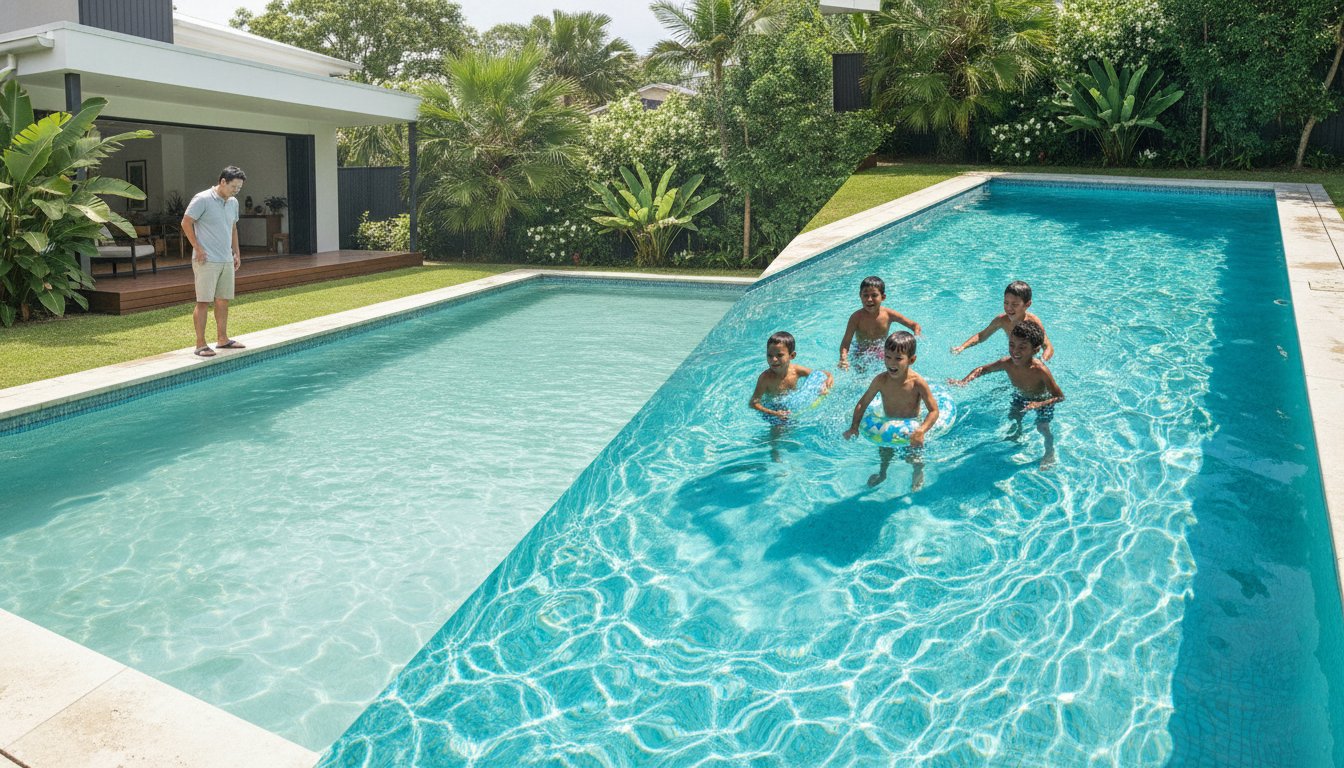
You have planned the perfect Saturday afternoon barbecue, but as you look out at the backyard, the pool water looks more like a thick, milky soup than an inviting oasis. It is a frustrating sight that often leads to a frantic dash for expensive chemicals that rarely seem to solve the underlying issue. Learning how to fix cloudy pool water requires more than just a bucket of chlorine; it demands an understanding of how your system interacts with the unique, humid Brisbane climate.
We understand the quiet anxiety of wondering if the water is actually safe for the kids to swim in or the embarrassment of having to explain the haze to your arriving guests. Most local pool owners have experienced the frustration of spending hundreds on treatments only to see the same dull results. This guide provides the professional clarity you need by revealing exactly how to transform your hazy pool back into a crystal-clear sanctuary using techniques refined over thirty years in South East Queensland. We will walk you through the essential steps to synchronise your filtration cycle, verify your water safety, and protect your pool’s brilliance against the next heavy summer storm.
Key Takeaways
- Understand how Brisbane’s unique subtropical humidity and sudden summer downpours impact your water clarity and chemical demand.
- Master the professional 5-step recovery plan to learn how to fix cloudy pool water by prioritising filtration health and precise water balancing.
- Learn to distinguish between clarifiers and flocculants so you can select the most efficient treatment for your specific level of cloudiness.
- Discover why maintaining a consistent pump schedule and using robotic cleaners is the most reliable way to prevent sediment build-up.
- Gain the confidence to verify your water safety through expert balancing techniques tailored for South East Queensland conditions.
Understanding Why Your Brisbane Pool Has Turned Cloudy
Cloudy water is an accumulation of microscopic particles too small for a standard filter to catch immediately. These suspended solids scatter light rather than allowing it to pass through, creating that uninviting, hazy appearance. While it might look like a single problem, cloudiness is usually a symptom of several environmental or chemical factors working against your water’s clarity. Understanding the root cause is the first step in learning how to fix cloudy pool water effectively.
Our unique subtropical climate introduces specific environmental challenges that many generic pool guides overlook. Brisbane’s intense summer humidity and sudden afternoon downpours act as a delivery system for organic matter, dumping dust, debris, and pollutants into the water. This sudden influx can overwhelm your sanitiser levels in a matter of hours, leaving the water vulnerable to the microscopic growth that causes cloudiness.
A lively weekend pool party is another common trigger for a hazy Monday morning. High bather loads introduce oils, sunscreens, and nitrogenous waste that consume chlorine at an accelerated rate. When combined with local environmental factors like fine dust from the “Ekka winds” or garden fertilisers carried by the breeze, your pool’s chemistry can quickly fall below established water quality standards.
Common Causes of Hazy Water in South East Queensland
Low sanitiser levels are frequently the primary culprit. When chlorine cannot keep pace with the introduction of bacteria and algae spores, the water loses its sparkle. Poor circulation also plays a major role. Stagnant “dead spots” in the pool prevent filtered water from reaching every corner, allowing particles to settle and cloud the water. Additionally, heavy rain often carries soil and phosphate-rich runoff from nearby garden beds directly into the pool, which provides a nutrient source for the organisms that cause haze.
Is it Safe to Swim in a Cloudy Pool?
Swimming in hazy water presents more than just aesthetic concerns for your family. If the water is cloudy, it often indicates a lack of effective sanitisation, which increases the risk of bacterial infections in the ears, eyes, or skin. Physical safety is a significant concern that requires your attention. If you cannot clearly see the bottom of the deep end, the pool is a hazard because a struggling swimmer might not be visible from the surface. We recommend a simple visibility test for Brisbane families: if you cannot see the main drain or a coin on the floor of the deep end, the pool should remain off-limits until the water is restored.
Knowing these triggers helps you decide how to fix cloudy pool water before the issue becomes a costly green pool cleanup.
The Critical Role of Filtration and Water Balance
Effective filtration is your primary line of defence against dull water. Without a robust circulation system, even the most expensive chemicals will fail to keep your pool clear. When homeowners ask how to fix cloudy pool water, the answer often begins with the mechanical health of their equipment. If your pump isn’t running for enough hours each day, the water cannot be properly turned over and filtered, which allows microscopic particles to accumulate.
Circulation is just as vital as the filtration itself. Your pump acts as the heart of the pool, pushing water through the filter and distributing sanitisers evenly. During the peak of a Brisbane summer, the increased heat and bather load mean your system must work harder than usual. If your water looks hazy despite regular chemical additions, it is likely that your filtration cycle is simply too short to keep up with the environmental demands of South East Queensland.
Checking Your Filtration System’s Health
Sand and glass media play a vital role in trapping microscopic debris. Over time, sand particles lose their sharp edges and become rounded; this significantly reduces their ability to catch fine silt. Glass media is a modern alternative that provides superior filtration and a longer lifespan due to its jagged surface area. For those using cartridge filters, a simple hose down isn’t always enough to restore performance. You may need to chemically clean the elements or replace them entirely if the fabric has become saturated with oils and minerals. If you suspect your equipment is struggling, a professional pool equipment repair assessment can identify issues before they lead to a total system failure.
Essential Chemistry for Crystal Clarity
Water balance is a delicate science that directly impacts aesthetic clarity. High pH is a common culprit because it renders your chlorine significantly less effective. When the pH rises above 7.8, your sanitiser’s ability to kill bacteria and algae spores drops drastically. We recommend following the CDC guidelines on pool disinfection to ensure your water remains safe and clear for your family. Total Alkalinity acts as a buffer for your pH; without it, your levels will swing wildly and cause persistent cloudiness.
Calcium hardness is another factor to watch, particularly with the local water supply in Brisbane. If your calcium levels are too high, the water can take on a distinct milky appearance as the minerals fall out of suspension. Finally, manage your stabiliser (cyanuric acid) levels carefully. While it protects chlorine from the harsh Australian sun, excessive amounts can lead to “chlorine lock”, where your sanitiser is present but unable to work. Mastering these chemical relationships is the most reliable way to understand how to fix cloudy pool water and maintain that brilliant blue look all year round.
Choosing the Right Treatment: Clarifiers vs. Flocculants
Selecting the correct chemical treatment is essential when deciding how to fix cloudy pool water without wasting time or resources. While both products aim to restore clarity, they operate through very different mechanical processes. Clarifiers are designed to assist your existing filtration system by gathering microscopic particles into larger clumps that the filter can finally catch. Flocculants act like a powerful magnet, binding contaminants together and forcing them to sink to the pool floor for manual removal.
Choosing the right approach depends entirely on the severity of the cloudiness. A clarifier is generally sufficient for “hazy” water where you can still see the bottom but the water lacks its usual brilliance. If the water has become “milky” or opaque, a flocculant is often the only way to achieve a rapid recovery. This distinction is vital for Brisbane pool owners who need to balance effective results with the time they have available for maintenance. For those who prefer to leave the complex chemical decisions to the experts, engaging professional pool cleaning services in Brisbane can take the guesswork out of treatment selection entirely.
When to Use a Pool Clarifier
A clarifier is the ideal solution for minor cloudiness or for maintaining that enviable diamond-like sparkle in your water. It is widely considered the “low effort” option because it allows your filter to do the heavy lifting over a period of several days. You simply add the dose to your skimmer box and let the system circulate. For the best results, you must run your filter continuously for 24 to 48 hours to ensure every clumped particle is successfully trapped within the media.
When a Flocculant is the Only Answer
Flocculants are the “nuclear option” for severe cases, such as when your pool has turned a milky white or is filled with fine debris after a heavy Brisbane storm. This treatment provides rapid results, making it the preferred choice for emergency clearing before a weekend event. However, this speed comes with a requirement for manual labour. Once the particles have settled on the floor, you must vacuum the sediment directly to “waste” to prevent it from re-entering the water column. This ensures the contaminants are removed from the system entirely rather than being recirculated through the filter.
You must verify your filter type before choosing a treatment. Never use flocculant with a cartridge filter unless you are prepared to destroy the expensive internal element. The heavy, sticky sediment created by flocculants will clog the fine pleats of a cartridge beyond repair; sand or glass media filters are much better suited to this process as they can be cleared through a standard backwash. Understanding these technical nuances ensures you know how to fix cloudy pool water safely while protecting the longevity of your equipment.
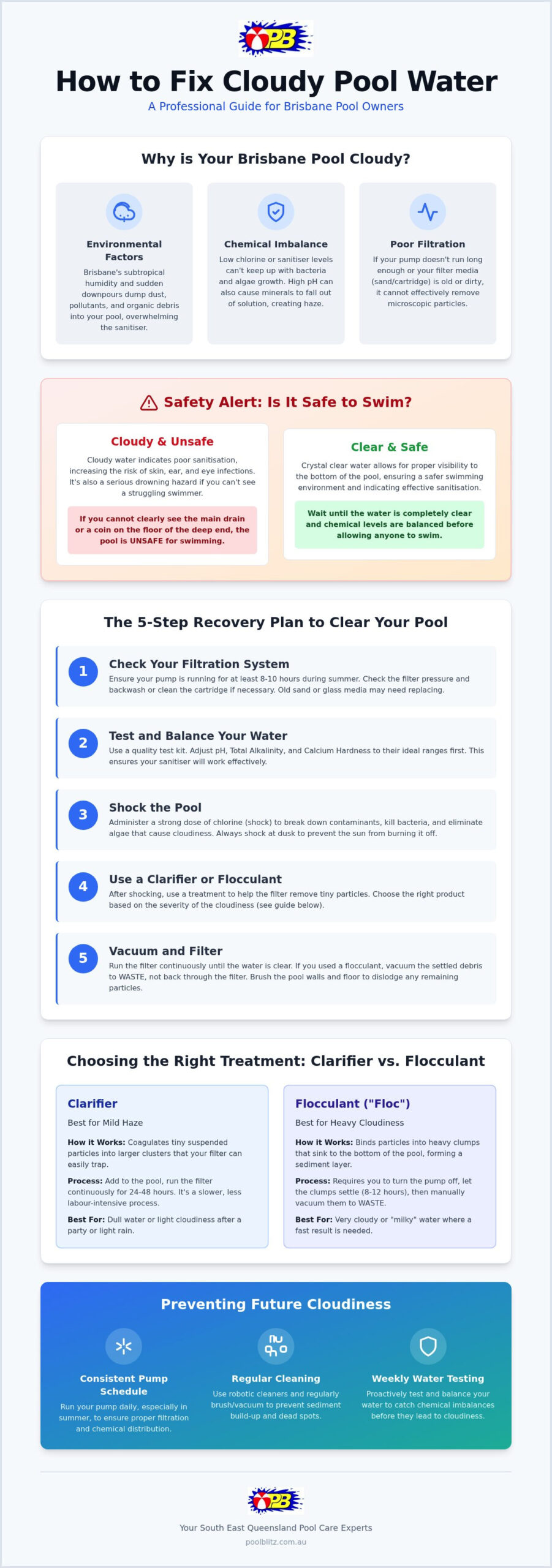
The 5-Step Recovery Plan to Clear Your Pool Fast
Once you have diagnosed the cause and selected your preferred treatment, it is time to execute a systematic restoration. This structured approach is the professional standard for how to fix cloudy pool water without wasting chemicals or effort. By following these steps in order, you ensure that contaminants are not just neutralized but physically removed from your swimming environment.
- Step 1: Deep clean your filter. Your recovery will fail if your filter is already saturated with debris. Backwash your sand or glass media until the sight glass runs clear, or thoroughly hose out your cartridge elements to restore maximum flow.
- Step 2: Balance the water chemistry. Focus on your pH and Total Alkalinity first. Achieving a pH between 7.2 and 7.6 creates the ideal environment for your shock treatment and clarifiers to work at peak efficiency.
- Step 3: Shock the pool. Add a concentrated dose of chlorine to oxidise organic matter and kill lingering algae spores. This “resets” the water and prepares it for the final clearing stage.
- Step 4: Add your chosen treatment. Introduce your clarifier or flocculant according to the specific label instructions. Ensure you have calculated your pool’s volume correctly to avoid under-dosing.
- Step 5: Final removal. If using a clarifier, run the filter continuously until the haze disappears. If using a flocculant, allow the particles to settle completely before vacuuming the sediment off the floor.
If you find that your water remains stubborn or you are unsure about the specific chemical demands of your system, our Expert Water Balancing service can provide the professional precision needed to restore your pool’s brilliance.
Shocking the Pool Correctly
Effective shocking requires more than just pouring chemicals into the water. You must calculate the correct dose of chlorine shock based on your pool’s total litreage to ensure you reach the “breakpoint” needed to clear the haze. We strongly recommend shocking your pool at night. The intense Brisbane UV light quickly degrades unstabilised chlorine, so applying it after sunset allows the sanitiser to work undisturbed for several hours. Brushing the walls and floor immediately after application is also vital; this agitates the water and ensures the shock reaches every corner where bacteria might be hiding.
Vacuuming the Debris
When using a flocculant, the “Vacuum to Waste” technique is the only way to ensure the sediment is removed permanently. This setting on your multiport valve bypasses the filter media and sends the dirty water directly out of the system. Move the vacuum head with a slow and steady rhythm to avoid stirring the “cloud” back up into the water column. Since this process removes water from the pool, you will need to keep a hose running to maintain the correct water level. This prevents the pump from drawing air and ensures you have enough time to finish the job without interruption.
Mastering this recovery plan is the most effective way to learn how to fix cloudy pool water and return your backyard to a crystal-clear sanctuary for your family.
Preventing Future Cloudiness with Expert Maintenance
Consistency is the cornerstone of a crystal-clear pool. While knowing how to fix cloudy pool water is essential for managing unexpected events, preventing the haze from occurring in the first place is far more cost-effective and less stressful. This proactive approach protects your equipment from the strain of heavy-duty recovery cycles and provides you with year-round peace of mind. Much like maintaining your pool, staying on top of your fitness requires a dedicated routine; if you’re ready to commit to your health goals, check out 6X Training for expert personal training.
Modern technology has revolutionised preventative care through the use of robotic pool cleaners. These devices do more than just scrub the floor; they act as a secondary, fine-particle filtration system that operates independently of your main pump. By capturing dust and organic matter before it has a chance to break down and dissolve into the water column, they significantly reduce the sediment load on your sand or cartridge filter. This is particularly valuable in Brisbane, where fine dust and pollen can quickly overwhelm traditional systems.
Longevity and clarity are directly linked to the health of your filtration system. Ensuring your pump and filter are operating at peak efficiency prevents the stagnant conditions where cloudiness begins. Regular professional water balancing provides a vital second opinion on your chemistry, especially during the volatile summer months when Brisbane’s environmental loads are at their highest. It is a methodical way to ensure your sanitiser remains active and your water remains inviting. If you are weighing up your options, understanding the difference between casual and regular professional pool service in Brisbane can help you choose the right level of support for your pool’s specific needs.
The Role of Robotic Cleaners in Clarity
A high-quality robotic cleaner equipped with a fine-mesh canister can trap particles as small as 2 microns. This removes the microscopic debris that serves as a nutrient source for algae and bacteria, keeping your water sparkling even after a busy weekend. If your current unit is struggling to climb walls or seems to be leaving debris behind, our specialist robotic pool cleaner repairs service can restore its performance to factory standards. By maintaining this equipment, you ensure your pool has a constant, automated guardian against sediment build-up.
When to Call in the Brisbane Pros
There are times when DIY methods reach their limit. If your water remains stubbornly cloudy after 72 hours of continuous filtration and chemical adjustment, there may be a deeper issue at play that requires professional diagnostic tools. Partnering with a reputable swimming pool maintenance service in Brisbane ensures you have access to seasoned experts who understand the unique demands of the local climate and can identify problems that DIY methods simply cannot resolve. You should also seek assistance if you suspect a mechanical failure in your pump or if your multi-port valve is leaking water during normal operation. You can Book a casual pool service to have our seasoned experts diagnose the issue and clear the cloud for you. We take pride in being a dependable partner for local families, ensuring your pool is safe, healthy, and ready for use. Mastering how to fix cloudy pool water is easier when you have a trusted advisor to guide you through the more complex technical challenges.
Enjoy a Brilliant Blue Pool Year-Round
Restoring clarity to your backyard sanctuary is a methodical process that rewards patience and precision. By prioritising filtration health and mastering the balance between pH and alkalinity, you can successfully manage the environmental challenges unique to South East Queensland. Understanding how to fix cloudy pool water is just the beginning; the ultimate goal is achieving a stable, sparkling environment that’s always safe for your family to enjoy. Consistency in your maintenance routine will ensure your water remains inviting even after the heaviest summer storms. For those who also manage a business and value professional consistency, you can learn more about ASAP Solutions for expert guidance on small business tax and accounting.
If you find that stubborn haze persists or your equipment needs a professional touch, we are here to help. With over three decades of Brisbane pool experience, our team acts as a dependable partner for your property’s care. As an authorised robotic cleaner repair centre with qualified technicians for all equipment repairs, we provide the seasoned expertise needed for long-term stability. Get your pool water professionally balanced by the Brisbane experts at Pool Blitz and reclaim your crystal-clear oasis today. Your pool should be a source of pride and relaxation, and with the right approach, it will stay that way through every season.
Frequently Asked Questions
How long does it take for a cloudy pool to clear?
It generally takes between 24 and 48 hours for a cloudy pool to clear when using a professional-grade clarifier and continuous filtration. If you opt for a flocculant, the process can be faster, often settling overnight, though it requires manual vacuuming to finish the job. The exact timeframe depends on your filter’s efficiency and the volume of debris currently in the water.
Can I put too much clarifier in my pool?
Yes, you can certainly add too much clarifier, and doing so often has the opposite effect of what you intended. Excessive amounts of clarifier can act as a dispersant, which keeps particles separated rather than clumping them together. Always follow the specific dosage instructions on the label to avoid making the water even cloudier than when you started.
Why is my pool still cloudy after shocking it?
It is quite common for water to remain hazy immediately after shocking because the process of killing algae and bacteria creates a large amount of microscopic organic debris. If the cloudiness persists for more than 24 hours, it may indicate that your pH is too high or your filter media is saturated. This is a critical stage in learning how to fix cloudy pool water, as it often requires a follow-up clarifier to help the filter remove the dead matter.
Does baking soda clear a cloudy pool?
Baking soda is not a clearing agent, although it is useful for raising Total Alkalinity and stabilising your pH levels. While it won’t directly remove the particles causing a haze, it creates the balanced chemical environment necessary for your sanitiser and filter to work effectively. It’s a foundational tool for water health rather than a quick fix for clarity.
Will running my filter 24/7 fix the cloudiness?
Running your filter 24/7 is one of the most effective ways to resolve cloudiness, especially when combined with the right chemical balance. Continuous circulation ensures that every litre of water passes through your filter media multiple times, which is essential for trapping the fine silt that causes a dull appearance. In many cases, increasing filtration time is the simplest answer to how to fix cloudy pool water during the humid Brisbane summer.
Is it okay to swim in a pool that is slightly hazy?
We advise against swimming in a pool that is even slightly hazy. Lack of clarity is a strong indicator that your sanitiser levels are insufficient, which increases the risk of ear and eye infections for your family. There is also a significant safety concern; if a swimmer is in distress at the bottom of the pool, they may not be visible from the surface.
What is the difference between a pool clarifier and a flocculant?
A clarifier is a coagulant that gathers small particles into clumps for your filter to trap over several days. In contrast, a flocculant is a more aggressive chemical that binds particles into heavy masses that sink to the floor for manual vacuuming. Clarifiers are better for mild haze, while flocculants are the preferred choice for severe, milky cloudiness.
How often should I backwash my filter to prevent cloudy water?
You should backwash your sand or glass filter whenever the pressure gauge reads 8 to 10 PSI above its normal clean operating pressure. In a typical Brisbane summer with high bather loads and storm activity, this usually occurs every two to four weeks. Backwashing too frequently can actually reduce filtration efficiency, as a lightly seasoned filter bed often traps finer particles better than a perfectly clean one.
No responses yet