
What if the most expensive mistake you’re making with your pool isn’t the chemicals you’re buying, but the invisible chemistry you’re ignoring? For many local residents, swimming pool water testing brisbane feels like a relentless battle against the subtropical elements, particularly when a sudden summer downpour turns a pristine oasis into a cloudy frustration. You’ve likely spent weekend hours scrubbing surfaces and adding treatments, only to find the water remains stubborn or the algae returns with a vengeance. It’s exhausting to navigate conflicting advice that fails to account for our specific Queensland humidity and intense UV levels.
We believe that maintaining a healthy pool should be a source of relaxation rather than a cause for anxiety about equipment damage or rising costs. This guide will help you master the nuances of professional water balancing, offering a steady, expert hand to ensure your water remains crystal clear and safe for your family. We’ll walk you through the essential testing steps tailored for 2026, explain how to interpret your results with precision, and demonstrate how proactive care safeguards your expensive filtration systems and robotic cleaners for the long term.
Key Takeaways
- Understand how Brisbane’s unique UV index accelerates chlorine degradation and why our local climate requires a specialised approach to water chemistry.
- Master the critical relationship between pH levels and Total Alkalinity to create a stable environment that prevents frustrating chemical fluctuations.
- Learn why professional laboratory analysis provides the precision needed for swimming pool water testing brisbane, offering far more accuracy than standard home test strips.
- Follow the “Elbow Deep” sampling technique to ensure you collect a representative water sample that yields reliable and actionable data.
- Discover how expert water balancing acts as a protective shield for your pool pump and filtration system, significantly reducing the need for costly equipment repairs.
Why Brisbane Weather Makes Regular Pool Water Testing Essential
Maintaining a pristine pool in South East Queensland requires more than just a passing glance at a test strip. True water balance is the delicate equilibrium of pH, alkalinity, and calcium hardness, and in our climate, this balance is under constant siege. While generic online guides offer broad advice, they often fail to account for the specific environmental pressures we face here. Professional swimming pool water testing brisbane is a technical preservation strategy that ensures your water remains inviting while protecting your high-value equipment from the corrosive effects of chemical fluctuations.
The “Storm Season” Effect on Your Pool
Brisbane’s summer storms are legendary for their intensity, and they can transform your pool chemistry in a single afternoon. Heavy rainfall doesn’t just raise the water level; it dilutes your salt and stabiliser concentrations, which directly weakens your pool’s sanitising power. High winds also introduce organic debris and phosphates into the water, providing a feast for algae spores that thrive in our humidity. We recommend testing your water within 24 hours of a significant weather event to catch these shifts before they escalate. Prompt action allows you to rebalance your alkalinity and pH levels, preventing the cloudy water and slippery surfaces that often follow a tropical downpour.
UV Exposure and Chlorine Longevity
The intense Queensland sun is perhaps the greatest challenge to maintaining a healthy swimming environment. Our extreme UV index acts as a catalyst for rapid chlorine degradation, often “burning off” unprotected sanitiser at an alarming rate during a January heatwave. Without the correct level of Cyanuric Acid, which acts as a chemical sunscreen for your chlorine, you might find your pool is completely unprotected by mid-afternoon.
Precise swimming pool water testing brisbane identifies the exact concentration of stabiliser needed to shield your chlorine from these harsh rays. By maintaining this protective layer, you ensure that your sanitiser remains active for longer, which provides consistent protection against bacteria. This proactive approach doesn’t just keep the water clear; it also reduces the overall workload on your pool pump and chlorinator, extending the lifespan of your entire filtration system through stable, predictable chemistry.
Understanding the Science: The Core Parameters of Your Pool Health
Achieving crystal clear water is less about luck and more about mastering a precise chemical balancing act. While many owners focus solely on chlorine, true water health relies on a synergy of several key parameters that work together to protect your swimmers and your investment. Regular swimming pool water testing brisbane provides the data you need to manage these invisible variables effectively, ensuring your pool remains a safe sanctuary rather than a chemical experiment.
The pH and Chlorine Synergy
The relationship between pH and chlorine is the most critical factor in pool sanitation. When your pH levels climb too high, your chlorine becomes “lazy” and loses its ability to kill bacteria and algae effectively. In Brisbane’s warm climate, we aim for a pH range of 7.2 to 7.6; this is the sweet spot where chlorine remains active and the water is comfortable for eyes and skin.
You might also encounter “Chlorine Lock,” a frustrating scenario where your test shows plenty of chlorine, but it isn’t working. This is often caused by over-stabilisation from too much Cyanuric Acid. Without professional analysis, you might keep adding chemicals to a pool that is already chemically “locked,” leading to wasted money and persistent algae blooms. If you’re struggling to keep these levels steady, our expert water balancing service can help restore your pool’s natural equilibrium.
Alkalinity and Calcium Hardness
Total Alkalinity acts as the “anchor” for your pH, providing a buffer that prevents sudden spikes or drops. If your alkalinity is too low, you’ll experience “pH bounce,” where your levels swing wildly after every rain shower or heavy swim session. This instability doesn’t just annoy the chemist in you; it causes significant equipment corrosion over time.
Calcium hardness is equally vital, especially for the longevity of your pool’s interior surface. Brisbane’s local water supply can vary in mineral content, and if your calcium levels are too low, the water will actually “leach” minerals from your pool’s concrete or grout. Conversely, high calcium leads to unsightly scale build-up, potentially clogging your pool filtration system and reducing its efficiency.
Finally, we must monitor phosphate levels. Phosphates are essentially “algae food” introduced by wind-blown dust and organic debris. Even a perfectly balanced pool can turn green if phosphate levels are high enough to fuel rapid growth. By identifying these hidden triggers through precise testing, you can treat the root cause of algae rather than just the symptoms, resulting in lower maintenance costs and total peace of mind.
Home Testing Kits vs. Professional Laboratory Analysis
Choosing between a quick home test and a professional lab analysis is often a matter of context. While a basic kit is helpful for a routine mid-week check, it rarely provides the granular detail needed to solve complex water issues or prevent long-term equipment damage. Professional swimming pool water testing brisbane residents rely on goes beyond simple colour changes; it offers a scientific breakdown that home equipment simply cannot replicate. We’ve seen many well-meaning owners spend hundreds of dollars on “corrective” chemicals based on a vague test strip reading, only to find the problem persists because the underlying cause was never identified.
Limitations of DIY Test Strips
DIY test strips are a convenient starting point, but they possess inherent weaknesses that can lead to costly mistakes. The reagents on these strips are highly sensitive to the very things we have in abundance in Queensland: heat and humidity. If your kit has been sitting in a warm garden shed, the results are likely to be compromised before you even dip the strip into the water. There is also the significant challenge of “colour matching” under different lighting conditions. What looks like a healthy pink in the bright afternoon sun might actually be a dangerously low reading when viewed in the shade. For those serious about north brisbane pool care, this margin of error is simply too high. High chlorine levels can even “bleach” the test pads, leading you to believe your sanitiser is low when it’s actually at a corrosive peak.
The Pool Blitz Professional Advantage
We believe that accuracy shouldn’t be a guessing game. At Pool Blitz, we utilise advanced digital photometers that eliminate the subjectivity of human sight. These laboratory-grade devices pass a light beam through the water sample to provide an exact digital readout, ensuring your chemical levels are pinpointed with absolute precision. This level of swimming pool water testing brisbane allows us to identify underlying issues like high phosphate levels or rising total dissolved solids that basic kits completely ignore.
Instead of a generic suggestion to just “add more chlorine,” we provide a tailored chemical prescription based on your pool’s specific volume and equipment type. This methodical approach prevents the expensive cycle of chemical trial and error. When you consider the cost of a single bucket of unnecessary shock treatment or the price of replacing a corroded heater, the investment in a professional analysis pays for itself through longevity and peace of mind. It’s the difference between merely maintaining your pool and truly protecting your investment for the seasons ahead.
How to Collect and Prepare a Pool Water Sample for Testing
A professional analysis is only as reliable as the sample you provide. If the water you bring in isn’t representative of the entire pool, your swimming pool water testing brisbane results will be skewed, potentially leading to incorrect chemical additions. To ensure precision, you must follow a methodical collection process that accounts for both the physical location of the draw and the environmental conditions at the time of sampling.
The Step-by-Step Collection Process
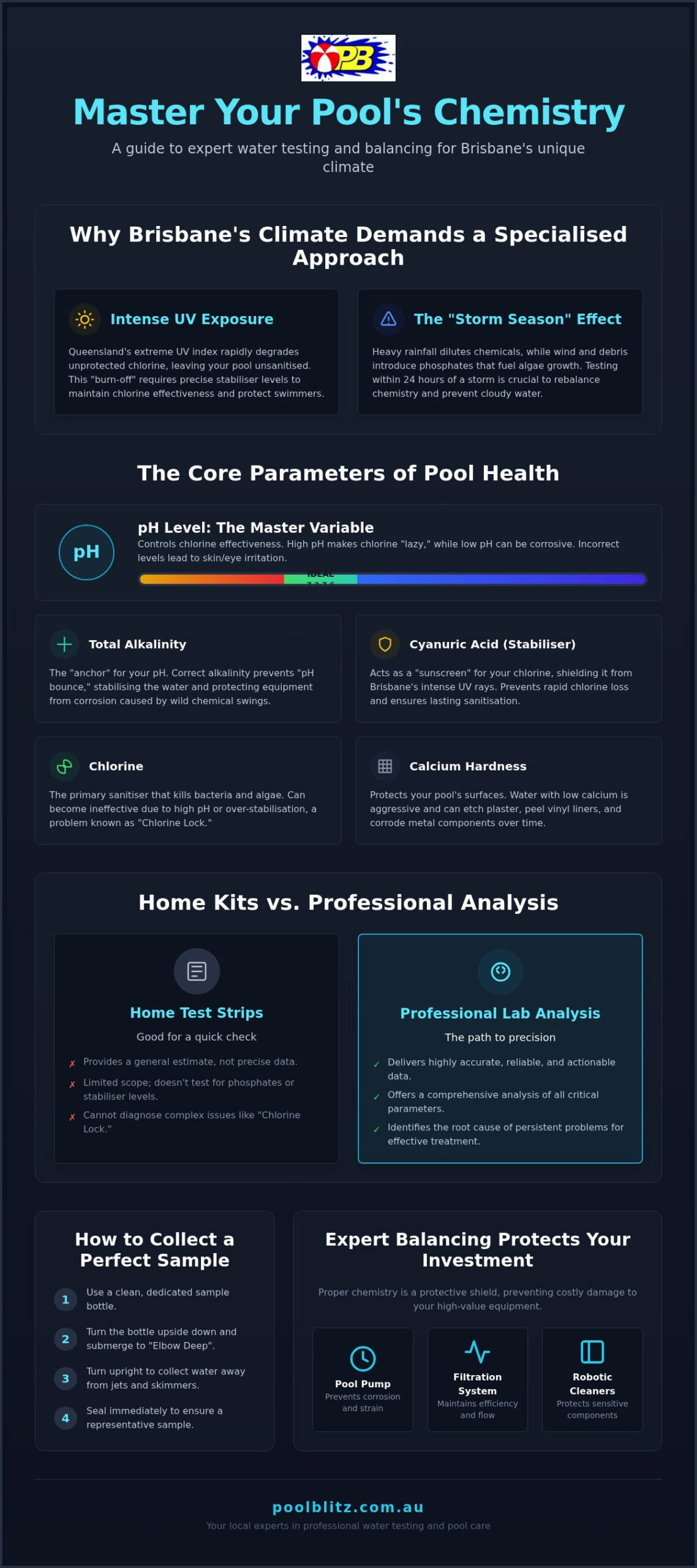
Before you even dip a bottle into the water, ensure your filtration system has been running for at least 8 hours. This circulation is vital because it ensures the chemicals are evenly distributed throughout the pool, preventing “pockets” of high or low concentration. Use a clean, dedicated water sample bottle rather than a recycled food or drink container, as even trace residues can significantly alter your readings.
- Rinse the bottle: Triple-rinse your container with pool water before taking the final sample.
- Choose your spot: Draw the water from the deep end, ideally at a midpoint between the return jets and the skimmer box.
- The Elbow Deep rule: Turn the bottle upside down, submerge it until your elbow is underwater, approximately 30cm deep, and then turn it upright to fill. This avoids collecting surface water, which is often diluted by rain or influenced by higher temperatures and debris.
Preserving Sample Integrity
Water chemistry is dynamic and begins to change the moment it leaves your pool. In our subtropical climate, the swimming pool water testing brisbane process is highly sensitive to temperature fluctuations. You should aim to have your sample analysed within 2 hours of collection. If you leave the bottle in a hot car while running other errands, the rising temperature will cause the pH to shift and the chlorine to dissipate, rendering the eventual test results inaccurate.
When you arrive, provide your technician with the essential context they need for a tailored report. Knowing your pool’s approximate volume, the interior surface type, and the specific equipment you use allows for a much more sophisticated balancing plan. If you’ve recently added chemicals or experienced heavy rain, mention this as well. For those who prefer the certainty of a professional at their doorstep, our regular pool servicing takes the guesswork out of collection and ensures your water is always in expert hands.
Beyond the Test: Professional Water Balancing with Pool Blitz
A precise water analysis is a powerful diagnostic tool, but the real value lies in how you apply those results to your pool’s environment. Professional swimming pool water testing brisbane serves as the foundation for a comprehensive maintenance strategy that prioritises the health of your water and the integrity of your hardware. At Pool Blitz, we’ve spent over three decades helping local families transition from the frustration of a “greenish” pool to the effortless enjoyment of a year-round blue oasis. Our approach isn’t just about adding chemicals; it’s about understanding the unique interplay between our local climate and your specific pool setup.
Safeguarding Your Pool Equipment
Poorly balanced water is a silent predator that can cause thousands of dollars in damage long before the water looks “dirty.” When pH levels remain low, the water becomes acidic and aggressive, often leading to the premature failure of pump seals and the internal components of your heater. This corrosive environment can necessitate unexpected pool equipment repairs that are entirely preventable through consistent monitoring.
Your cleaning technology is equally vulnerable. Imbalanced chemistry can cause the rubber tracks and delicate brushes on your cleaner to harden or perish prematurely, leading to a need for robotic pool cleaner repairs. By ensuring your water remains in the ideal range for calcium hardness and alkalinity, you’re acting as a protective steward for your investment, ensuring every component operates at peak efficiency for its full intended lifespan.
Booking Your Brisbane Water Analysis
We understand that modern Brisbane families are busy, and finding the time for precise swimming pool water testing brisbane can be a challenge. That’s why we offer flexible mobile servicing options designed to fit your schedule. Whether you need a one-off casual service to recover a neglected pool or a structured regular maintenance plan to provide total peace of mind, our seasoned technicians are here to help.
The difference between a generic test and our professional intervention is the depth of our local expertise. We don’t just hand you a list of chemicals; we provide a clear, methodical path to a healthier pool. Let our qualified team handle the complex chemistry so you can focus on what matters most: enjoying your pool with the confidence that it’s safe, clear, and expertly maintained. Contact us today to arrange your professional water analysis and experience the relief of true expert care.
Securing Your Pool’s Future for the Seasons Ahead
Mastering your pool’s chemistry is the most effective way to ensure your backyard remains a sanctuary rather than a source of stress. We’ve explored how Brisbane’s intense UV rays and unpredictable storm seasons demand a more rigorous approach than generic guides suggest. By moving beyond basic home kits and prioritising precise swimming pool water testing brisbane, you aren’t just achieving clear water; you’re actively extending the life of your expensive pumps and robotic cleaners.
As a local family-owned and operated business with over 30 years of Brisbane pool expertise, we take pride in acting as protective stewards for your property. We specialise in the technical nuances of water health and equipment longevity, providing the stable care your investment deserves. Don’t let chemical fluctuations dictate your weekend plans or lead to avoidable repair costs.
Book your expert Brisbane water test and balance today and experience the peace of mind that comes from professional precision. Your pool is ready for a summer of effortless, crystal-clear swimming.
Frequently Asked Questions
How often should I have my pool water professionally tested in Brisbane?
You should have your pool water professionally tested at least once a month during the peak swimming season. In Brisbane’s milder winter months, extending this to every six to eight weeks is generally sufficient unless you experience heavy unseasonal rain. Professional testing provides a level of detail that home kits miss, ensuring your water remains safe and your equipment stays protected from the long-term effects of minor chemical imbalances.
Can I use a plastic bottle from home to bring in a water sample?
We recommend using a dedicated, sterile pool water sample bottle rather than a recycled container from your kitchen. Household bottles, such as those used for milk or juice, often contain trace residues that can significantly alter your pH and phosphate readings. Most professional technicians provide these bottles free of charge to ensure the integrity of your sample. Using a clean, purpose-made container is the first step toward achieving an accurate chemical profile.
Why does my pool water turn green so quickly after a Brisbane storm?
Storms introduce a surge of organic matter and nitrogen-rich rainwater that rapidly consumes your available chlorine. High winds also blow in dust and garden debris, which act as a direct food source for algae spores. Because Brisbane storms are often followed by intense humidity and heat, the remaining sanitiser is quickly overwhelmed. Testing your water immediately after a storm helps you replenish these levels before the algae has a chance to take hold.
Is it safe to swim in the pool immediately after water balancing chemicals are added?
You should generally wait at least four hours after adding balancing chemicals before entering the water. For more aggressive treatments like hydrochloric acid or large doses of dry acid, waiting for a full turnover of your pool’s water through the filtration system is a safer practice. This ensures the chemicals are thoroughly diluted and evenly distributed. Always check the specific instructions on the chemical packaging or consult your technician for guidance on specific treatments.
What is the ideal chlorine level for a Brisbane pool during summer?
The ideal free chlorine level for most Brisbane pools during the summer months is between 2.0 and 4.0 parts per million (ppm). Because our UV index is exceptionally high, maintaining a level at the higher end of this range provides a necessary buffer against rapid sun-induced degradation. This ensures there is always enough active sanitiser to combat bacteria and algae, even during the hottest parts of a typical Queensland January afternoon.
Does a salt water pool still need regular water testing and balancing?
Yes, salt water pools require the same level of consistent testing and balancing as traditional chlorine pools. A salt chlorinator simply produces chlorine from the salt in the water, but it doesn’t manage other critical factors like pH, alkalinity, or calcium hardness. In fact, salt pools often experience a natural rise in pH levels over time, which requires regular monitoring and adjustment to prevent scale build-up and maintain sanitiser efficiency.
Why is my pool water cloudy even though the chlorine levels are fine?
Cloudy water is often a sign of high pH levels or an accumulation of fine particles that your filter is struggling to capture. Even if your chlorine is adequate, imbalanced pH can cause minerals to “fall out” of the water, creating a hazy appearance. Comprehensive swimming pool water testing brisbane can identify if high phosphate levels or rising total dissolved solids are the underlying cause. Addressing these specific issues will restore clarity far more effectively than simply adding more chlorine.
How much does a professional pool water test and balance cost in Brisbane?
The investment for a professional water test and balance in Brisbane varies depending on your pool’s volume and the specific chemicals required to restore equilibrium. While some providers offer basic testing, a full professional service typically includes a detailed laboratory analysis and a tailored treatment plan. It’s best to contact a local service provider for a quote that reflects your pool’s unique needs. Investing in professional care often reduces long-term costs by preventing expensive equipment damage.
No responses yet