
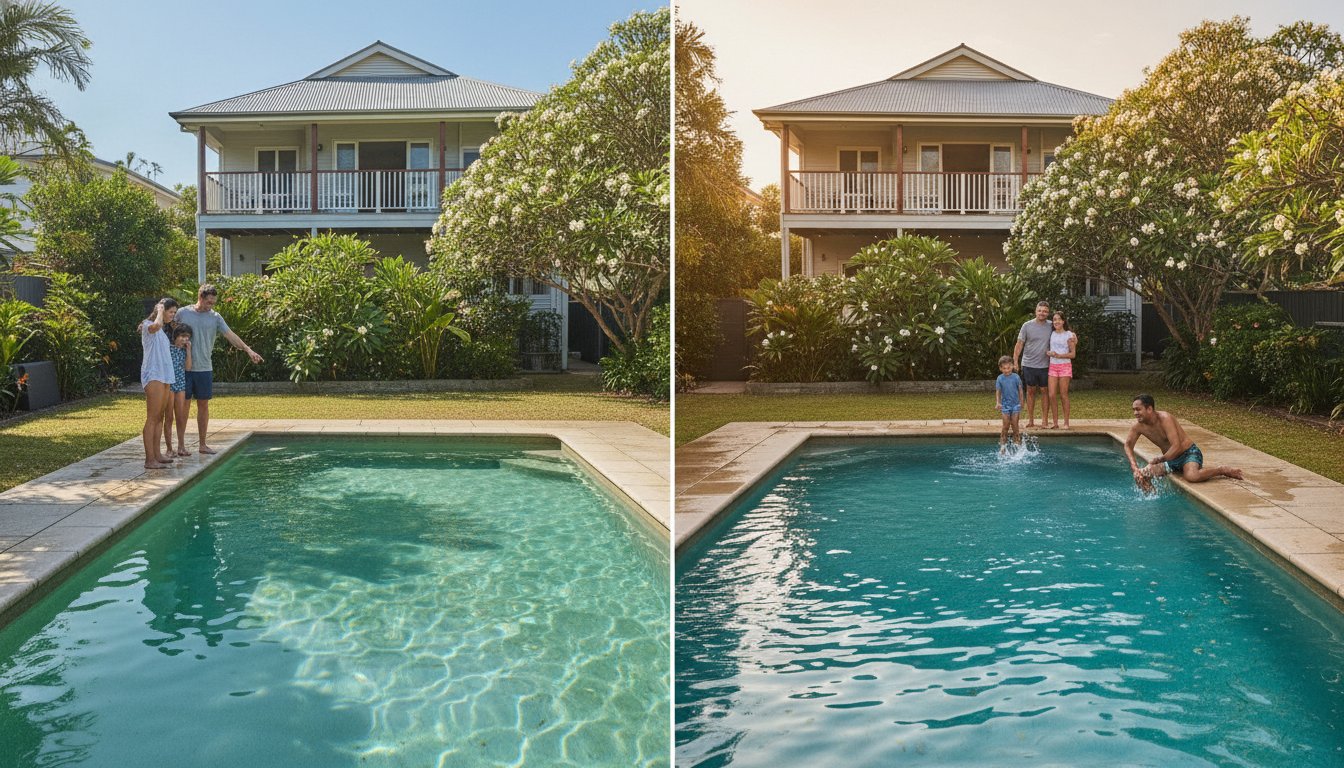
You have organised the perfect Saturday afternoon barbecue, the sun is shining over the Gabba, and your guests are due to arrive in just two hours. However, as you look out at the backyard, you realise the water looks more like a hazy Brisbane river than a refreshing private retreat. Dealing with cloudy pool water in Brisbane is a common frustration, especially when the subtropical humidity and sudden storms throw your chemistry out of balance.
It is incredibly draining to spend your hard-earned money on “miracle” chemicals that simply don’t work, leaving you worried about whether the water is actually safe for the kids. We understand that you want more than just a quick fix; you want the peace of mind that comes with a crystal-clear oasis. This 2026 recovery guide provides the exact steps to transform your hazy pool into a sparkling sanctuary, tailored specifically for our South East Queensland environment. We will explore why a “filtration-first” method beats aggressive chemical dumping, and how a simple, professional maintenance routine can ensure your water remains inviting and safe for your family all year round.
Key Takeaways
- Understand how Brisbane’s unique subtropical humidity and sudden summer storms introduce the contaminants that lead to hazy water.
- Discover why precise water balancing is the foundation of clarity; chlorine becomes 80% less effective when your pH levels are too high.
- Determine if the cloudy pool water brisbane owners experience is caused by chemical imbalances or a filtration system struggling with summer heat.
- Follow a professional 5-step recovery plan that focuses on deep cleaning and methodical adjustments to restore your pool to a sparkling oasis.
- Evaluate how a structured maintenance routine provides a more cost-effective solution than frequent, high-stress green pool recoveries.
Understanding Why Your Brisbane Pool Turns Cloudy
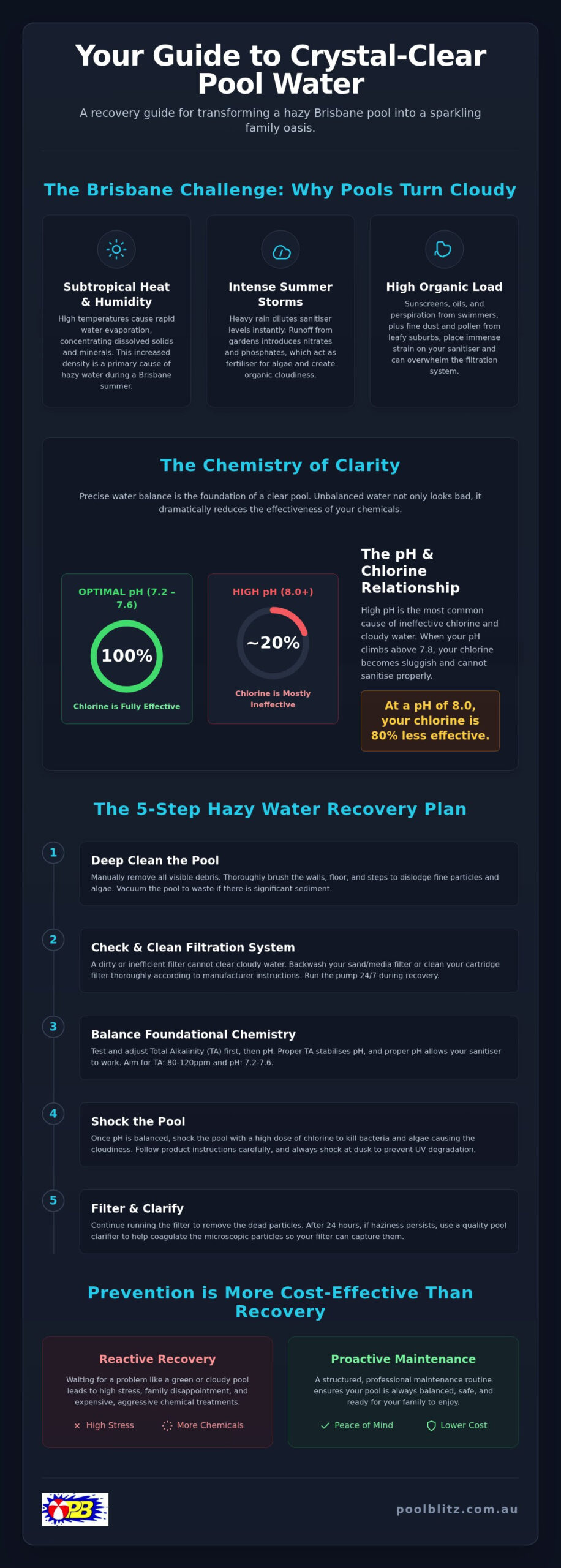
Brisbane’s climate is beautiful, but it presents unique challenges for maintaining water clarity. The high humidity levels we experience across South East Queensland don’t just affect our comfort; they fundamentally alter the concentration of chemicals in your pool. When temperatures soar, rapid evaporation leaves behind a higher density of dissolved solids and minerals. This concentration can quickly lead to cloudy pool water brisbane families often struggle with during the peak of summer.
High bather load is another significant factor during our long school holidays and humid weekends. As more people enjoy the water, they introduce organic contaminants like sunscreen, perspiration, and skin oils. These substances put an immense strain on your sanitiser. Understanding the science behind swimming pool sanitation methods is vital for any homeowner facing a persistent haze; it helps identify when the demand for chlorine has simply outstripped the supply.
The Storm Season Effect in South East Queensland
Brisbane’s summer storms are legendary for their intensity and their ability to ruin a pool’s chemistry in minutes. Heavy rainfall acts as a double blow to your water balance. First, the sheer volume of water dilutes your sanitiser levels almost instantly, leaving the pool vulnerable to microscopic growth. Second, the wind and rain carry nitrates and phosphates from garden beds directly into the water.
Runoff from nearby soil or mulch acts as a fertiliser for microscopic organisms. This influx of nutrients creates a sudden bloom of organic cloudiness that a standard filter may struggle to clear. Checking your water balance immediately after a storm is non-negotiable. It’s the only way to ensure you can neutralise these contaminants before they settle and cause long-term issues for your equipment health.
Organic Load in Brisbane’s Leafy Suburbs
Residents in leafy Western Suburbs like Kenmore or The Gap face a specific set of environmental hurdles. While the established trees provide wonderful shade, they also drop a constant stream of fine dust and pollen. This micro-debris is often so small that it bypasses standard skimmer baskets and settles deep within the water column. It creates a persistent haze that resists standard chemical treatments.
Native vegetation produces oily resins that can coat the surface of your filter media, reducing its efficiency over time. If you live in these areas, you might find that your standard cleaning routine isn’t quite enough during high-pollen months. Engaging in Casual Pool Servicing during these peak periods can provide the deep clean necessary to remove these stubborn particles. A professional technician can identify if your filtration system is actually capturing this fine debris or simply circulating it back into the pool.
The Chemistry of Clarity: Balancing Brisbane Water
Water balancing represents the precise alignment of pH, Total Alkalinity, and Calcium Hardness to create a stable environment where your sanitiser can perform its job effectively. In South East Queensland, we often face what we call “Brisbane Chlorine Demand.” When the thermometer hits 35 degrees, the intense UV radiation and heat work together to strip sanitiser from your pool faster than most standard systems can replace it. Without a structured approach to chemistry, your water can lose its clarity in a single afternoon.
Achieving this balance requires a methodical mindset. It isn’t just about pouring in more chlorine; it’s about ensuring the water’s environment allows that chlorine to stay active. Following established pool chemical safety guidelines is essential when you’re managing these powerful concentrates to keep your family safe while you work. If your chemical levels aren’t precisely calibrated, you’re likely wasting money on products that simply cannot function in the current conditions.
The pH and Chlorine Relationship
The ideal pH range for Brisbane pools is 7.2 to 7.6 for maximum sanitiser efficiency. If your pH climbs above this range, your chlorine becomes sluggish and ineffective. At a pH of 8.0, your chlorine is approximately 80% less effective than it is at 7.2. This imbalance often leads to calcium precipitation, which creates the “milky” or cloudy pool water brisbane locals frequently notice after a hot spell. To combat the fierce Queensland sun, the use of a high-quality pool stabiliser, or Cyanuric Acid, is mandatory to prevent UV degradation from destroying your chlorine residual before it can kill bacteria.
Total Alkalinity: The Foundation of Clarity
Total Alkalinity acts as a buffer for your pool’s chemical stability, protecting the pH from wild fluctuations. When alkalinity is too low, you’ll experience “pH bounce,” where the levels swing rapidly and cause unpredictable cloudiness. Brisbane’s local water sources can vary in their natural mineral content, meaning the water coming out of your garden hose might have a different initial alkalinity depending on your specific suburb.
Maintaining this foundation is about more than just looks; it’s about protecting your investment. Ensuring your Expert Water Balancing is handled correctly prevents long-term equipment corrosion and scale build-up on your pool surfaces. If you’re finding it difficult to keep your levels steady during the humid months, our team can provide the Pool Chemicals and professional advice needed to lock in that crystal-clear finish.
Evaluating Your Filtration and Equipment Health
A cloudy pool is often a filtration issue rather than a chemical one. While it’s tempting to simply add more sanitiser, your filter is the primary tool for removing the physical particles that cause a persistent haze. If your equipment isn’t functioning at its peak, even the most expensive treatments will fail to deliver a sparkling result. For those struggling with cloudy pool water brisbane humidity often exacerbates, a thorough check of the filtration system is the first step toward a permanent solution.
Determining if your pump run-time is sufficient is critical during our intense summer months. In 35-degree heat, your pool requires significantly more circulation to prevent algae spores from taking hold in stagnant pockets of water. Beyond just running the pump longer, you must ensure the filter media hasn’t reached the end of its functional life. Over time, sand becomes smooth and cartridges become clogged with oils, losing their ability to trap fine debris. Gaining a deeper perspective on understanding pool chemicals helps you see how sanitisation and filtration must work in tandem to maintain a safe swimming environment.
Sand vs. Glass vs. Cartridge Filtration
Choosing the right media can make a dramatic difference in water clarity. Standard sand filters typically capture particles down to 20 or 40 microns, while glass media is superior for capturing Brisbane’s fine dust, filtering down to approximately 5 or 10 microns. This finer filtration is essential for residents in leafy suburbs where micro-debris is a constant challenge. Cartridge filters offer excellent clarity but require more frequent manual cleaning in high-debris areas to prevent pressure build-up. If your water remains hazy despite perfect chemistry, it may be time for a pool filtration system repair in Brisbane to restore your equipment’s efficiency.
The Importance of Pump Circulation
Water turnover is the foundation of a healthy pool. You should aim for a turnover rate that circulates the entire volume of your water at least twice daily during the peak of summer. Poor circulation creates “dead spots,” often behind steps or in deep corners, where contaminants can accumulate and cause localised cloudiness. Robotic pool cleaners play a vital role here by acting as a secondary circulation system. These machines move along the floor and walls, mixing the water and removing heavy sediment before it has a chance to suspend and cloud the entire pool. This mechanical intervention ensures that your Pool Pumps aren’t doing all the heavy lifting alone, leading to a more consistent and inviting result.
The 5-Step Recovery Plan to Clear Hazy Water
Restoring clarity to your pool is a methodical process that requires patience and a strict adherence to the correct order of operations. If you rush to add sanitisers before the water is properly balanced, you’re essentially wasting resources on a temporary fix. This 5-step recovery plan is designed to address the root causes of cloudy pool water brisbane owners face after heavy use or sudden storm activity.
- Step 1: Deep clean the filter and skimmer baskets. Maximising water flow is the first priority; ensure you backwash your sand filter or thoroughly rinse your cartridge to remove existing debris.
- Step 2: Test and adjust pH and Alkalinity. As discussed previously, your sanitiser cannot function if these levels are outside the ideal range.
- Step 3: Apply a “Shock” treatment. This process oxidises organic contaminants like perspiration and oils that have built up over time.
- Step 4: Choose a clearing agent. Use a Clarifier for mild haze or a Flocculant for water that has turned “milky” or extremely opaque.
- Step 5: Run the filtration system continuously. You must circulate the water for 24 to 48 hours to ensure every drop is processed and cleaned.
If you’re finding the recovery process overwhelming, our team at Pool Blitz can provide a professional pool recovery service to handle the heavy lifting for you.
Clarifiers vs. Flocculants: Which One Do You Need?
Understanding the difference between these two chemicals is vital for a successful recovery. Clarifiers act as coagulants, gathering microscopic particles into small clumps that your filter can then easily capture during its normal cycle. These are ideal for mild haze and are safe for all filter types. Flocculants are the “heavy hitters” of the industry. They bind particles together and sink them to the floor of the pool, creating a layer of sediment that must be manually vacuumed to waste.
You must exercise caution when using these products. A crucial warning for all owners is to never run a flocculant through a cartridge filter without a dedicated bypass valve. The heavy sediment can permanently clog the fine pleats of the cartridge, leading to an expensive and unnecessary replacement of your Pool Filtration Systems.
The Professional “Shock” Technique
Shocking your pool is about more than just adding a large dose of chlorine. To achieve the best results in our climate, you should always perform this treatment at night. This timing avoids UV interference from the sun, which can degrade the shock treatment before it has finished oxidising the organic load. You should calculate the correct dosage based on your pool’s volume in litres; guessing the amount often leads to either an ineffective treatment or a chemical imbalance that takes days to correct.
Physical intervention is the final piece of the puzzle. While the chemicals work, you should use a pool brush to disturb the biofilm on the walls and floor. This action breaks the protective layer that bacteria and algae use to hide, ensuring the sanitiser can reach and neutralise the contaminants. If you’re unsure about the correct dosage for your specific pool volume, we can provide the necessary Pool Chemicals and guidance to ensure your water returns to its sparkling best.
Preventing Cloudiness with Professional Maintenance
Proactive care is the only reliable way to guarantee a trouble-free summer in our demanding climate. While many homeowners wait for the water to turn before acting, this reactive approach is often the most expensive path you can take. A cost-benefit analysis reveals that a one-off green pool recovery in Brisbane can reach $800 in 2026, which is a significant financial burden compared to the predictable stability of a monthly plan. Investing in regular pool maintenance ensures that your water chemistry is managed by experts who understand the subtle shifts in South East Queensland weather patterns.
Professional water testing is the cornerstone of this prevention strategy because it catches chemical imbalances long before they manifest as visible cloudiness. By the time you notice the water looking dull, the microscopic growth is already well established. A “Seasoned Authority” like Pool Blitz, with over 30 years of local experience, provides the comprehensive oversight needed to prevent mid-summer breakdowns. This level of care protects your Pool Filtration Systems and ensures that your backyard remains a safe, inviting sanctuary for your family throughout the hottest months of the year.
The Role of Regular Servicing
A structured monthly service plan handles the heavy lifting of water chemistry so you don’t have to. These visits include thorough equipment audits that identify worn seals or failing bearings before they lead to a total pump failure. Having a local expert on-site is invaluable because North Brisbane pool care requires a specific understanding of local vegetation and rainfall trends. We take pride in being a dependable partner, ensuring that your Expert Water Balancing is locked in and your equipment is running at peak efficiency.
Maintaining Your Robotic Cleaner
A functional robot is your best defence against the sediment build-up that leads to cloudy pool water brisbane residents often face after a storm. These machines work tirelessly to remove debris before it has a chance to break down and cloud the water column. However, even the best technology requires attention to remain effective. If you notice your cleaner is moving slowly, missing spots, or getting stuck on the main drain, it’s likely time for a professional robotic pool cleaner repair to restore its performance.
You can keep your pool robot running efficiently between services with a few simple DIY steps. Always empty the filter canister after every cycle to prevent unnecessary strain on the internal motor. Check the brushes and tracks for any tangled hair or small twigs that might impede movement. Storing your cleaner out of the direct Brisbane sun when it isn’t in use will also extend the life of its plastic components and keep it ready for the next Regular Pool Servicing visit.
Secure Your Crystal-Clear Brisbane Oasis
Maintaining a sparkling pool in South East Queensland doesn’t have to be a source of stress or a drain on your weekend. By shifting your focus from reactive chemical dumping to the “filtration-first” approach we’ve discussed, you can effectively eliminate the cloudy pool water brisbane storms and humidity often create. Success lies in the precise alignment of your water chemistry and the peak performance of your equipment, ensuring every component works in harmony to provide a safe swimming environment for your family.
As a Brisbane-owned and operated family business since 1994, we bring decades of local experience to every backyard. We are recognised expert robotic cleaner repair specialists and provide comprehensive water balancing for SEQ conditions to keep your investment protected. Our team is dedicated to providing the relief that comes from having a complex task handled by seasoned professionals who truly understand our local environment.
Ready to restore your pool’s brilliance? Book a Professional Pool Service with Pool Blitz Today and let our experts handle the technical details while you simply enjoy the water. Your backyard retreat is just one professional service away from being the highlight of your summer.
Frequently Asked Questions
Is it safe to swim in a cloudy pool?
You should strictly avoid swimming in a pool that isn’t crystal clear. Cloudy water usually indicates a lack of sanitiser or a significant chemical imbalance, which means harmful bacteria or pathogens could be present in the water. Poor visibility also creates a serious safety hazard because you cannot see the bottom of the pool clearly. It’s always best to wait until the water is professionally balanced and clarity is fully restored.
How long does it take for a cloudy pool to clear after treatment?
Most pools will begin to show improvement within 24 hours of treatment, but a full recovery typically takes between 48 and 72 hours of continuous filtration. The exact timeframe depends on the severity of the cloudiness and the efficiency of your equipment. If you are using a flocculant, the debris will settle overnight, allowing for a faster visual result once the sediment is manually vacuumed to waste by an expert.
Can I use my robotic pool cleaner while the water is cloudy?
Yes, using a robotic cleaner is actually beneficial when dealing with cloudy pool water brisbane owners often see after storms. These machines help circulate the water and remove heavy sediment that has settled on the floor. However, you must clean the robot’s filter canister frequently during this process to prevent strain. If the water is extremely “milky” due to a flocculant treatment, you should remove the robot and use a manual vacuum instead.
Why is my pool still cloudy after I shocked it?
Persistent cloudiness after shocking often stems from an underlying pH imbalance or a filtration issue. If your pH is too high, the chlorine you added during the shock treatment becomes sluggish and cannot effectively oxidise contaminants. Alternatively, your filter media might be saturated with dead algae or fine debris that requires a deep clean. Check that your pH is between 7.2 and 7.6 and ensure your filter is running correctly for the best results.
Does heavy rain always make a pool cloudy in Brisbane?
While not every shower causes issues, the intense summer storms in South East Queensland frequently lead to cloudiness. Heavy rain dilutes your chemicals and introduces nitrates and phosphates from garden runoff into the water. These nutrients act as a food source for microscopic growth. Testing your water immediately after a storm allows you to adjust the balance before the contaminants have a chance to turn the water hazy and uninviting.
How much does it cost to have a professional fix my cloudy pool?
The cost for a professional recovery varies depending on the size of your pool and the severity of the contamination. A standard service usually includes a thorough water analysis, professional-grade chemical application, and a full equipment check. While one-off recoveries are more expensive than regular maintenance, they provide the peace of mind that the water is safe for your family. Contact us for a specific quote tailored to your pool’s current condition.
What is the difference between a pool clarifier and a flocculant?
Clarifiers are mild coagulants that gather tiny particles into larger clumps so your filter can trap them during normal operation. They are easy to use and don’t require manual vacuuming. In contrast, a flocculant is a “heavy hitter” that binds particles together and sinks them to the floor. This creates a thick layer of sediment that you must manually vacuum to waste, bypassing your filter entirely to avoid potentially damaging the internal media.
Can a dirty filter cause cloudy pool water?
A dirty or worn-out filter is a primary cause of cloudy pool water brisbane residents experience during the high-use summer months. If the filter media is clogged with oils, minerals, or organic debris, it loses the ability to trap the fine particles that create a hazy appearance. Regularly cleaning your cartridges or backwashing your sand filter is essential for clarity. Eventually, filter media reaches the end of its functional life and requires professional replacement to maintain performance.
No responses yet