
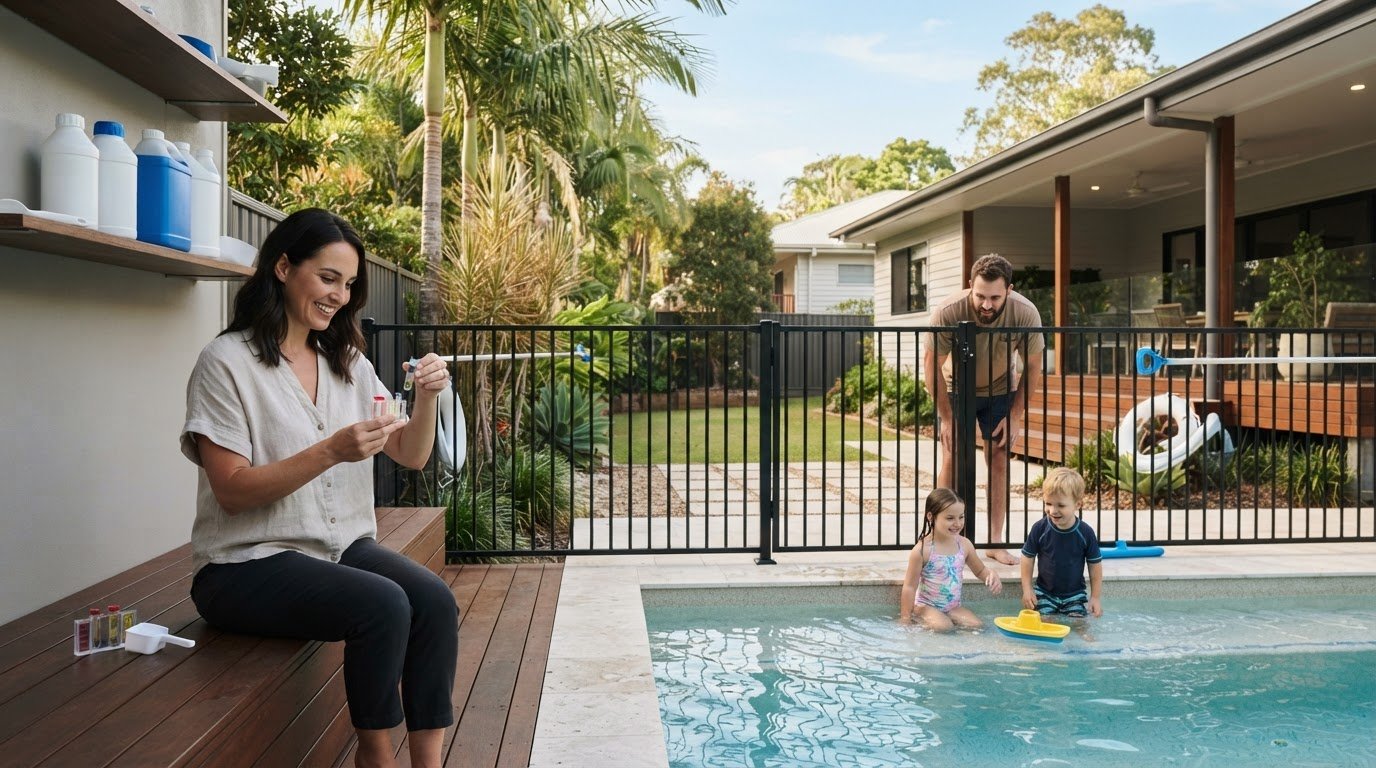
What if clear-looking pool water isn’t enough to tell you whether it’s comfortable for your children to swim in? For Brisbane families, child safe pool chemical balancing means looking beyond appearance and understanding what key water readings can, and can’t, tell you.
It’s sensible to feel cautious about testing and adding chemicals when children are at home. Balanced water can help reduce the risk of irritation and support effective sanitising, but it can’t guarantee a risk-free swim, prevent drowning or replace active supervision and appropriate pool barriers.
This guide explains which readings matter, how to approach testing, chemical handling and storage, and what to consider before letting children swim. You’ll also learn why Brisbane’s heat, UV and rainfall can affect pool chemistry, and when professional water balancing may help if results are confusing or keep shifting. Pool Blitz provides regular and casual pool servicing and expert water balancing to help Brisbane families make sense of pool-care readings.
Key Takeaways
- Child safe pool chemical balancing supports water quality and swimmer comfort, but balanced readings can’t replace active supervision or pool barriers.
- Check the relevant water readings and what they can indicate, rather than relying on clear-looking water alone.
- Use a steady test, record and retest routine, following your test-kit instructions and chemical labels rather than generic online figures.
- Keep children away while testing or adding chemicals, and store products securely in their original containers as labelled.
- Brisbane’s heat, strong sun and rainfall can affect pool chemistry. Regular care or expert water balancing can help reduce guesswork.
What child-safe pool chemical balancing can, and cannot, do
Balanced pool water is managed chemistry, not a guarantee that every swim is safe. The aim is to support effective sanitising, make the water more comfortable for swimmers and help protect pool surfaces and equipment. For families, child safe pool chemical balancing starts with understanding what water readings can tell you and where their limits lie.
Water can look sparkling and still have readings that need attention. Clarity is useful to observe, but it doesn’t reveal whether sanitiser is at a suitable level or whether pH is affecting how that sanitiser works. Cloudy water is a reason to pause and investigate, but clear water alone doesn’t prove conditions are suitable for swimming.
What does balanced pool water mean?
Balance depends on several readings working together, not just chlorine. Sanitiser helps control germs in pool water. pH describes how acidic or alkaline the water is and can influence sanitising performance and swimmer comfort. Other measures, including total alkalinity, help keep pH steadier, while calcium levels can matter for protecting pool surfaces and equipment.
Each pool’s needs and product instructions matter, so don’t treat a single generic figure as universal. For a plain-language overview of how disinfectants and other measures fit into pool hygiene, see Swimming Pool Sanitation Guidelines. Use your test-kit instructions and chemical labels to understand what readings mean for your pool.
Why water balance is not a substitute for supervision
Chemical readings describe water quality. They don’t show whether a child is being watched, whether pool access is controlled or whether safety equipment is in place. A correctly managed pool can still present a drowning risk. Children need active adult supervision around water, alongside appropriate physical safety measures such as compliant barriers.
Balanced water can support sanitation and comfort, but it can’t prevent drowning or establish that a pool is safe in every other respect.
Keep these responsibilities separate in your routine:
- Water care: Test the water, interpret the readings and follow product directions before adjusting the chemistry.
- Supervision: Stay attentive and close enough to respond while children are in or near the pool. Don’t rely on chemical readings as a safeguard.
- Physical safety: Maintain suitable barriers and other safety measures, and refer to current Queensland Government pool-safety guidance for information about applicable requirements.
This distinction helps families make informed swim-readiness decisions. Water testing tells you about the condition of the pool, while supervision and barriers address separate, essential risks. If readings are confusing or repeatedly unstable, professional water balancing can help clarify the water-care side without replacing those safeguards.
Which pool chemical readings matter for children’s swimming?
For child safe pool chemical balancing, read a set of results together rather than focusing on one number in isolation. Which measures matter, and what counts as an appropriate range, can depend on your pool’s sanitising system, surface and products. Follow your test-kit and chemical-label instructions, and use current, authoritative guidance for your setup.
Sanitiser and pH: the first readings to understand
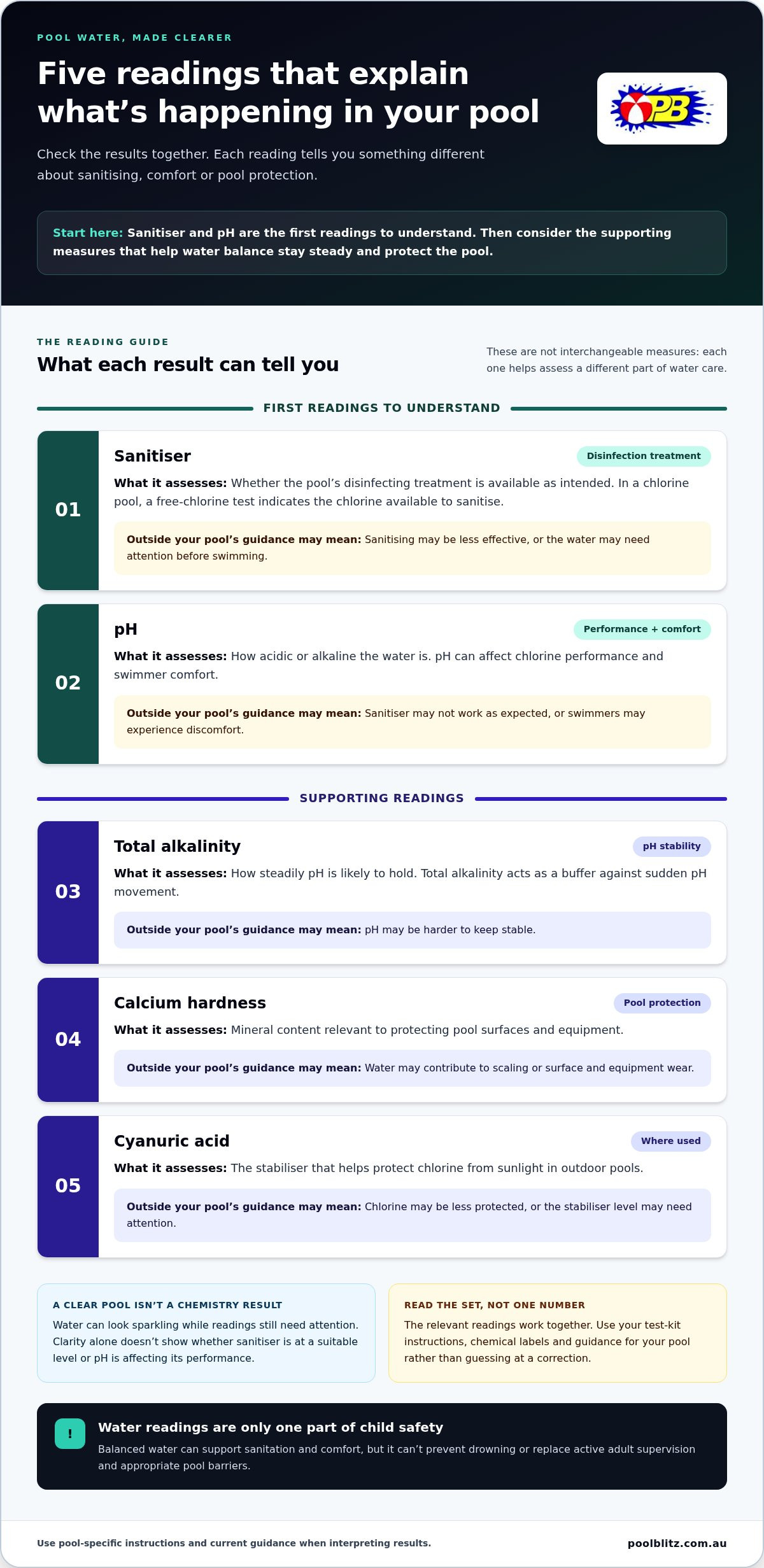
Sanitiser helps control contaminants in pool water. In a chlorine pool, a free-chlorine test indicates the chlorine available to sanitise; other systems may need different tests. pH affects how effectively chlorine works and can influence swimmer comfort. If a result falls outside the guidance for your pool, investigate rather than guessing at a correction or assuming one reading settles the question.
| Reading | What it helps you assess | What an out-of-range result may indicate |
|---|---|---|
| Sanitiser, such as free chlorine | Whether the pool’s disinfecting treatment is available as intended. | Sanitising may be less effective, or the water may need attention before swimming. |
| pH | Water acidity or alkalinity, which can affect chlorine performance and comfort. | The sanitiser may not work as expected, or swimmers may experience discomfort. |
| Total alkalinity | How steadily pH is likely to hold. | pH may be harder to keep stable. |
| Calcium hardness | Mineral content relevant to pool surfaces and equipment. | Water may contribute to scaling or surface and equipment wear. |
| Cyanuric acid, where used | Stabiliser that helps protect chlorine in outdoor pools from sunlight. | Chlorine may be less protected, or the stabiliser level may need attention. |
One test result is only part of the picture. Overall water balance depends on how the relevant readings work together. The WHO Guidelines for Safe Recreational Water Environments provide broader context on microbial and chemical risks in recreational water. For pool adjustments, follow your product directions and applicable current guidance.
Supporting readings that help stabilise pool water
Total alkalinity acts like a buffer, helping resist sudden pH movement. Calcium hardness matters for protecting pool finishes and equipment, while stabiliser is relevant to outdoor chlorine pools. These readings serve different purposes, so don’t try to correct one by changing another without checking instructions. For related context on how circulation and filtration complement water treatment, see the Brisbane pool filtration and health guide.
If several results are hard to interpret or keep shifting, Pool Blitz provides expert water balancing to help make sense of them. Learn about Pool Blitz water-balancing support.
How to test pool water and decide what to do next
A consistent routine makes pool readings easier to interpret and helps prevent rushed corrections. For child safe pool chemical balancing, keep children away from the pool, test equipment and chemical products while you collect a sample, treat the water and wait for any label-directed retesting period to pass.
Testing and interpreting results without guesswork
Test strips can be convenient, while other kits may measure different readings or use a different process. Neither method is automatically right for every pool. Follow the instructions for your chosen kit, including how to collect the sample, how much to use and how to read the result.
Where practical, test at a consistent time and use the same method. Keep a dated record. If a result looks unexpected, check the kit’s expiry and instructions, then repeat the test with a fresh sample before adjusting the water. This can help distinguish a genuine change from a sampling or reading error.
Use this sequence to turn a test into a considered next step:
- Test: Collect and test the sample exactly as your kit instructs, away from chemical containers.
- Record: Note the date, results, test method and recent events that may affect the water, such as heavy rain or increased swimming.
- Compare: Check the result against guidance for your pool system and the instructions for the products you use. Don’t treat a general online range as a substitute for those directions.
- Decide: If a result is surprising or conflicts with other readings, test again before making a correction. If it remains unclear, don’t guess at a dose.
- Retest: After any adjustment, follow the product’s directions for circulation and retesting before making another change or deciding whether swimming can resume.
Making cautious adjustments and checking the result
Product labels guide dosage, dilution, application and any required circulation or waiting period. Read the full directions before opening a container, and use the pool-volume information the product requires to calculate treatment. Don’t estimate a dose or mix different chemicals together. If the pool volume or instructions are uncertain, pause and seek experienced help.
Change one thing at a time. Adding multiple products before checking their effect can make it harder to understand what changed and may create new problems. Keep children away throughout treatment and for the period specified on the label. Don’t rely on clear water or a single follow-up result as permission to swim. Use the test results and product instructions together.
If readings remain inconsistent, several values need correction, or you’re unsure how your pool’s system affects the results, professional water balancing can provide a clearer path forward. Pool Blitz’s qualified team helps Brisbane pool owners make sense of difficult or persistently unstable readings, so decisions are based on the water results rather than guesswork.
Child-aware routines for handling chemicals and deciding when to swim
A child-aware pool routine begins before you open a chemical container. Keep children out of the testing and treatment area, and plan the task so you can focus without interruption. This is a practical part of child safe pool chemical balancing: accurate readings matter, but safe handling and clear boundaries at home matter too.
Keeping pool chemicals out of children’s reach
Store products in their original, labelled containers, closed and secured where children can’t access them. Follow each label’s storage directions, including advice about temperature, moisture or separation from other products. Keep chemicals away from food and drink, and never transfer them into a bottle or container that could be mistaken for something consumable.
During testing and treatment, keep children away from containers, measuring equipment and the pool until the work is finished and everything is put away. Children shouldn’t handle chemicals, even as helpers. Use any protective equipment specified on the label, and don’t mix different chemicals together. A closed container is not a reason to leave it unattended within reach.
- Before you start: Set out only the products and equipment you need, and keep the label available to follow.
- While treating the water: Keep children and pets away from the work area, and avoid distractions.
- Once finished: Close containers as directed, return them to secure storage and clear away testing materials.
A consistent servicing routine can make pool care easier to organise for busy households. Pool Blitz offers regular and casual servicing options. Read about the Pool Blitz pool servicing options and how planned support can fit into a household routine.
Checking swim-readiness after pool treatment
Don’t decide the pool is ready based on clear water or a lack of chemical smell. After treatment, follow the product directions for circulation and the required time before swimming. Then use fresh test results and guidance relevant to your pool and treatment to assess the water. If readings are unclear or remain unsuitable, keep swimmers out and seek experienced advice rather than guessing.
- Finish the treatment: Follow label directions for application, circulation and any stated waiting period.
- Keep access restricted: Make sure children know the pool is out of bounds until you’ve completed the checks.
- Test again: Use your kit as instructed and compare the results with the relevant product guidance.
- Pause if uncertain: If results don’t make sense or the water still needs attention, don’t swim until you’ve resolved the uncertainty.
Swim-readiness depends on current readings and treatment instructions, not appearance alone. If results remain confusing or persistent, Pool Blitz’s expert water-balancing support can help you decide on a considered next step.
Brisbane pool water balancing: when professional help brings confidence
Brisbane pool water can shift with the conditions around it. Heat and strong sun can affect sanitiser, while heavy rainfall may change water balance. A busy spell of swimming can also increase the pool’s treatment demands. Readings that were steady may need attention after a change in weather or several active pool days.
Keep a simple record of weather, pool use and water readings to help spot patterns. If the same issue keeps returning or results are difficult to interpret, professional support offers a measured way to understand what may be affecting the water. It can also make ongoing care more manageable for families who’d rather spend less time second-guessing each adjustment.
When to bring in a pool-care professional
Consider experienced help if readings repeatedly move outside the guidance for your pool, water problems recur despite following product directions, or you’re unsure which corrective step is appropriate. Avoid repeatedly adding chemicals in response to unclear results. Professional water balancing can help make sense of persistent patterns and reduce trial and error.
Some households prefer regular servicing, while others need casual support at particular times. Pool Blitz provides both options. This Brisbane pool service comparison guide explains the difference in approach. Choose a routine that helps you keep track of pool care without adding uncertainty.
What Brisbane families can expect from Pool Blitz
Pool Blitz is an independent Brisbane pool-care business with more than three decades of local experience. Its qualified team provides pool servicing and expert water balancing, with regular and casual servicing options for different household needs. When readings are confusing or persistently unstable, the team can help clarify the water-care picture and guide the next steps, without suggesting that chemistry alone makes a pool safe.
For families, that clarity is practical: you can better understand what readings indicate and what needs attention, while keeping chemical handling, supervision and physical pool safety as separate parts of your routine. Professional balancing supports water care; it doesn’t replace product directions or adult supervision around water.
Pool Blitz provides servicing and expert water balancing to help Brisbane families take a steadier approach to child safe pool chemical balancing. Explore Pool Blitz pool servicing.
Build a pool-care routine that fits family life
Choose a routine you can maintain, even when Brisbane weather or family plans change. Set a regular time to review your pool readings and record any adjustments. This makes it easier to spot patterns over time instead of making decisions in a rush before a swim. Keep product directions accessible and allow time to follow any treatment and retesting instructions.
A steady routine can make child safe pool chemical balancing more manageable, while keeping water care in its proper place alongside the other measures that protect children around pools. If readings remain difficult to interpret, you don’t have to guess at the next adjustment. Pool Blitz’s expert water balancing can help clarify the results.
Arrange expert pool water balancing with Pool Blitz for a clearer plan to care for your family’s pool.
Frequently Asked Questions
Does a saltwater pool still need chemical balancing?
Yes. A saltwater pool still needs chemical balancing because its system produces chlorine to sanitise the water; salt doesn’t make the pool chemical-free. Test the readings required for your chlorination system and follow its manufacturer’s instructions, as testing and care routines vary. Saltwater also isn’t automatically child-safe. Keep water treatment separate from adult supervision and physical pool safeguards, and use current product guidance when deciding what action to take.
Is a strong chlorine smell a reliable sign that pool water is unsafe?
No. Smell alone can’t reliably tell you the water’s quality or sanitiser level, and odour may be affected by different water conditions. Rather than adding more chemicals based on the smell, test the water with a suitable kit and follow current product guidance. If a swimmer develops irritation, or you can’t interpret the readings confidently, keep swimmers out of the pool and seek qualified advice.
Can sunscreen affect pool water balance?
Sunscreen, other body products and the number of swimmers can add material to pool water, but a single application doesn’t tell you that a particular chemical reading has changed. Keep up with your usual testing and filtration routine, and pay particular attention after a busy swim session. Sun protection remains important. Monitor water quality and follow your pool-system and product instructions rather than blaming families for using sunscreen.
What should I do if pool chemicals get in my child’s eyes?
Follow the product label’s first-aid directions immediately, then seek urgent medical or Australian Poisons Information Centre advice. Don’t try to neutralise the chemical or delay getting help while looking for a home remedy. Keep the container or label available so you can tell the medical professional exactly which product was involved. For a severe reaction or immediate danger, contact emergency services.
What should I do if my child swallows pool water?
Seek prompt advice from an Australian Poisons Information Centre or health professional, as the right response depends on how much water was swallowed and how your child is feeling. Don’t diagnose the situation or try a home remedy without professional guidance. If your child has severe symptoms or is in immediate danger, contact emergency services. Keep calm and be ready to describe what happened and when.
Can pool water look clear but still need chemical adjustment?
Yes. Clear water shows how the pool looks, not whether every reading is suitable. For example, after heavy use or a downpour, the water may still appear inviting even though a test shows a measure needs attention. As part of child safe pool chemical balancing, check with a suitable kit and compare results with current product guidance. Don’t use appearance alone to decide children can swim.
No responses yet