
What if the very equipment designed to keep your swimming spot clean is actually the biggest drain on your weekend and your wallet? It’s a frustrating reality for many locals who find themselves constantly backwashing hundreds of litres into the sewer or scrubbing cartridges that never seem to stay clean. You’ve likely heard conflicting advice about which pool filters are best for the Brisbane heat, leaving you stuck with cloudy water and a mounting chemical bill. We understand that you’d rather be enjoying a refreshing dip than playing amateur chemist or wasting water during a dry spell.
We’ve spent over 30 years helping the community achieve that perfect, sapphire-blue clarity without the headache of high-maintenance machinery. This guide compares the leading 2026 filtration technologies to help you choose a system that balances superior water quality with long-term reliability. We’ll examine the efficiency of glass media, the low-impact benefits of modern cartridges, and how to match your pump perfectly to ensure your equipment lasts for a decade or more. By the end, you’ll have a clear path to a low-maintenance backyard oasis that stays pristine through every Queensland summer.
Key Takeaways
- Learn how high-performance pool filters act as the heart of your sanitation system, significantly reducing your annual chemical consumption and costs.
- Compare the distinct advantages of sand, glass, and cartridge systems to identify which filtration method best suits your lifestyle and maintenance preferences.
- Understand the local Brisbane regulations regarding backwashing and how to manage your water usage effectively during periods of low rainfall.
- Discover the critical importance of matching equipment flow rates to ensure your filtration system remains reliable and efficient for 10 years or more.
- Gain insights into preparing your pool for the Brisbane storm season by choosing a filter with the capacity to handle heavy debris and sudden environmental changes.
Understanding Pool Filtration: Why Your Filter is the Heart of Your Pool
A swimming pool is a living ecosystem that requires constant care to remain healthy and inviting. While the pump provides the muscle and the chlorinator provides the protection, pool filters act as the vital organs of the entire system. In Brisbane, our backyards face unique challenges from heavy leaf litter and fine dust carried on the afternoon breeze. Without a robust filter to trap these physical contaminants, your water quickly loses its sparkle and becomes a breeding ground for bacteria.
This mechanical process is part of a broader cycle of swimming pool sanitation methods that keep your family safe while swimming. There is a distinct difference between mechanical filtration, which removes physical debris, and water balancing, which manages the chemical health of the water. When a filter struggles to remove organic matter, it creates a high “chlorine demand.” This means your chlorinator has to work twice as hard to sanitise the water, leading to expensive chemical bills and a shorter lifespan for your equipment.
How a Pool Filter Actually Works
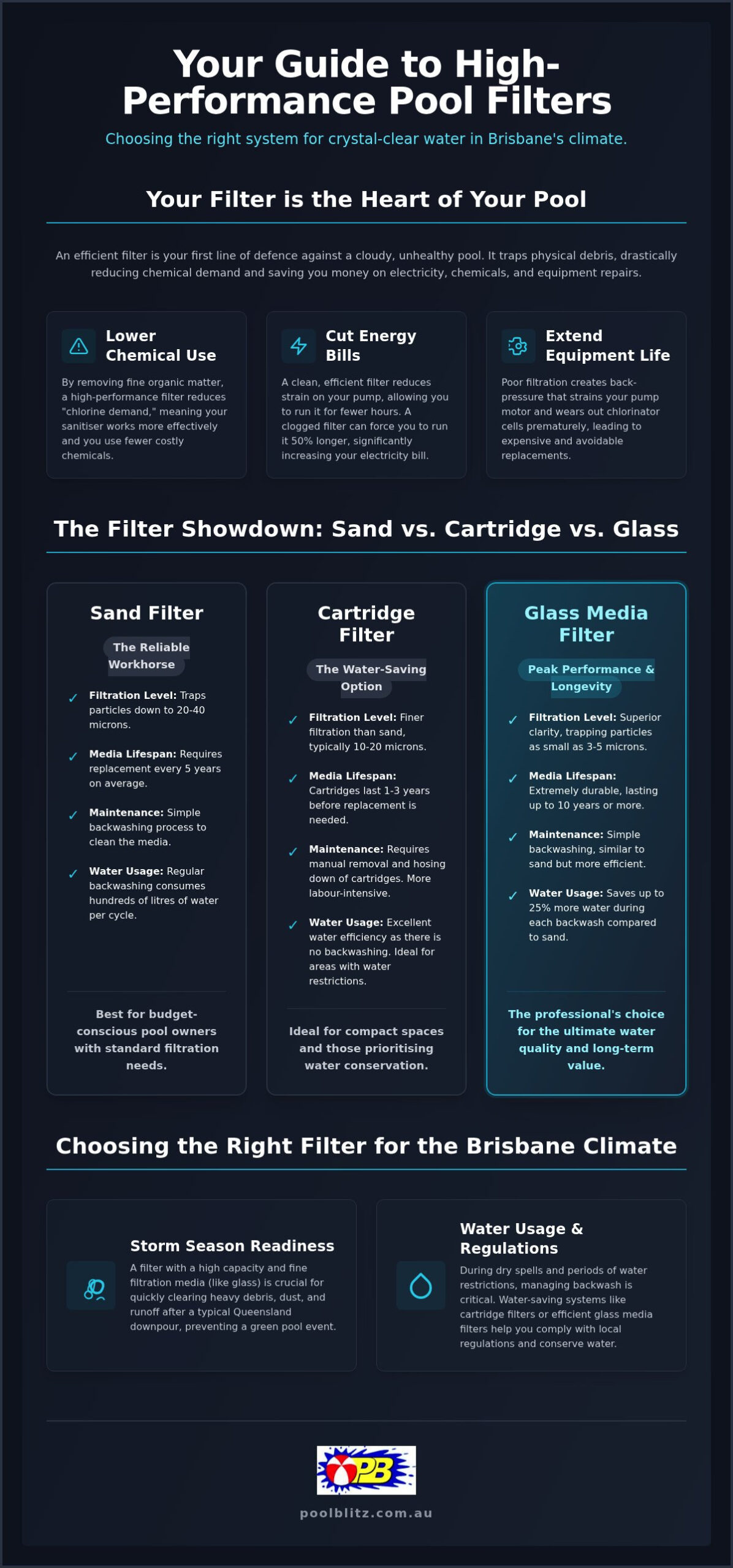
Every filter operates on the principle of “micron ratings,” which measures the size of particles the media can catch. For instance, traditional sand filters typically trap particles down to 20 or 40 microns, while advanced glass media can catch debris as small as 5 microns. The water travels from your skimmer box, through the pump, and is forced through the filter media before returning to the pool. It’s a common misconception that a larger tank always equals better cleaning. In reality, the flow rate must be perfectly matched to your pump to ensure the water isn’t pushed through the media too quickly to be cleaned effectively.
The Cost of Poor Filtration
Neglecting your filter often leads to a cascade of hidden expenses that impact your household budget. If the water remains cloudy, you might find yourself running the pump for 12 hours instead of 8, which noticeably increases your quarterly electricity bill. Poor filtration is also the primary driver behind “green pool” events. Recovering a swampy pool requires heavy doses of shock treatment and professional labour that far exceeds the cost of regular maintenance. Additionally, a clogged filter creates back-pressure that strains your pump motor and wears out your salt water chlorinator cells prematurely, resulting in avoidable replacement costs.
The Three Main Contenders: Sand, Cartridge, and Glass Media
Choosing between the various pool filters available today requires an understanding of your property’s specific needs and your own maintenance preferences. While Diatomaceous Earth (DE) was once considered the gold standard for ultra-fine filtration, it has become less common across Australia. The requirement for handling messy powder and the environmental impact of its disposal often outweighs its performance benefits for the average homeowner. Most modern Brisbane residents now focus on three primary technologies that offer a better balance of convenience and clarity.
Sand remains a popular, budget-friendly workhorse for many, while cartridge systems offer exceptional clarity for compact spaces. However, glass media has emerged as the modern professional’s choice for those seeking the ultimate balance of longevity and efficiency in maintaining water quality. Each system has its place depending on whether you value low upfront costs or minimal ongoing effort.
Sand vs. Glass Media: The Performance Showdown
The performance gap between traditional sand and modern glass is significant. While sand is reliable, it typically only captures particles down to 20 or 30 microns. In contrast, glass media filters down to a precise 3 microns. This finer filtration results in noticeably more brilliant water that requires fewer chemicals to stay clear, as it removes the microscopic organic matter that usually consumes your chlorine.
Longevity is another area where glass excels. You will generally need to replace sand every five years as the grains become rounded and lose their “grab.” Glass media is far more durable, often providing peak performance for up to 10 years before needing attention. From a sustainability perspective, glass is also the superior choice; its smoother surface allows for more efficient cleaning, which can save up to 25% more water during every backwash cycle.
The Pros and Cons of Cartridge Filtration
Cartridge filters are the go-to solution for the increasingly popular Brisbane plunge pool. Because they don’t require a multi-port valve or backwash plumbing, they take up significantly less space in tight equipment housing. They are also highly effective at trapping fine dust and body oils, providing a level of clarity that rivals high-end glass media systems.
The maintenance profile is where cartridges differ most from media tanks. There is no backwashing involved, which is a major advantage for water-conscious owners or those in areas with strict discharge rules. However, you must be prepared to manually remove and hose down the pleated elements every few weeks to prevent clogging. If you’re unsure which system fits your lifestyle, our team at Pool Blitz can help you weigh these practical realities against your backyard’s specific layout.
Maintenance Realities: Backwashing vs. Manual Cleaning
Understanding the upkeep requirements of different pool filters is essential for long-term satisfaction and water clarity. Media filters, including sand and glass systems, rely on a “backwash” process to stay effective. This involves reversing the water flow through the tank to flush out trapped contaminants into the waste line. In Brisbane, Urban Utilities requires residents to manage this discharge responsibly, and a typical backwash cycle should last approximately five minutes to ensure the media is thoroughly rinsed. It’s also a local requirement to avoid discharging to the sewer within six hours of a significant rain event.
Cartridge systems offer a different maintenance profile that appeals to many water-conscious homeowners. Instead of backwashing, you must physically remove the pleated elements and hose them down to clear away fine dust and body oils. To extend the life of these cartridges, we recommend using a specialised degreasing solution every few months to break down stubborn oils that a standard garden hose cannot reach. Keeping these filtration and recirculation systems in peak condition is the best way to avoid the sudden onset of cloudy water during a humid Queensland summer.
The Relationship with Robotic Pool Cleaners
Investing in the best robotic pool cleaner Brisbane has to offer can significantly reduce the physical load on your main filter. These independent units act as a secondary filtration stage, capturing leaves and large grit before they ever reach the skimmer box. By “over-filtering” the water with a robot, you prevent your sand or glass media from clogging prematurely. This synergy leads to fewer backwash cycles and less wear on your primary equipment. It’s a proactive approach that keeps your water pristine while protecting your long-term investment.
Troubleshooting Common Filter Issues
Even the most reliable systems can occasionally encounter technical hurdles. If you happen to find pool filter sand in pool, it’s often a sign of a cracked lateral or a failing multi-port valve gasket. Monitoring your pressure gauge is your first line of defence; a reading that remains 50kPa above your “clean” baseline indicates that a deep clean is overdue. You should also watch for “short-cycling,” where the filter requires cleaning every few days. This usually suggests the media is saturated with oils or calcium, meaning it’s time to call in a professional to assess if a media replacement or a chemical soak is required.
Choosing the Right Filter for the Brisbane Climate
Brisbane’s sub-tropical climate demands more from pool filters than almost any other Australian capital. Between the relentless summer UV levels and the sudden arrival of afternoon storm cells, your equipment must be resilient enough to handle rapid environmental changes. Managing high evaporation rates is another local priority. During periods of drought or strict water restrictions, a cartridge filter becomes an attractive option as it requires no backwashing. Conversely, if you prefer a media tank, switching to glass media can reduce your backwash water consumption from nearly 1,900 litres with traditional sand to just 180 litres per cycle.
It is vital to match your filter’s capacity to the power of your pump to ensure long-term reliability. If your pump is too powerful for a small filter, the water moves too fast to be cleaned properly, which leads to a perpetual cycle of cloudy water despite your best efforts. A perfectly sized system ensures that the flow rate allows the media or cartridge to trap even the finest dust particles carried on the Brisbane breeze.
The ‘Leaf Litter’ Challenge
Brisbane backyards often feature sculptural palms or majestic gum trees that shed significant organic matter. In these environments, sand or glass media filters are frequently the superior choice because they can be easily backwashed to remove large volumes of debris without the need for manual scrubbing. To protect your main system, we often recommend installing secondary leaf canisters or pre-filters. These act as a first line of defence, preventing organic staining on your pool’s surface by trapping tannins and large grit before they can break down in the main tank.
Energy Efficiency and the ‘Climate Care’ Movement
The “Climate Care” movement has highlighted the benefits of installing a larger-than-necessary filter tank. By choosing a high-capacity system, you allow your pump to run at lower, more efficient speeds while still achieving total water turnover. This approach provides substantial financial benefits in the 2026 energy market, as lower RPMs consume significantly less electricity over time. Professional installation ensures that every pipe and valve is positioned for optimal flow, which is the key to unlocking these long-term savings and ensuring your equipment lasts for a decade or more.
If you’re ready to upgrade your equipment for the upcoming season, explore our range of high-performance pool filtration systems designed specifically for Queensland conditions.
The Pool Blitz Approach: Expert Installation and Repair
While it might be tempting to attempt a weekend DIY swap, installing modern pool filters requires a precise understanding of hydraulic pressure and chemical compatibility. A minor misalignment in the plumbing can lead to persistent leaks that damage your pump motor or cause a significant drop in filtration efficiency. At Pool Blitz, we ensure that every installation is handled by a qualified technician who understands the specific flow requirements of your backyard setup. We pride ourselves on stocking only the most reliable hardware from industry leaders like Astral and Zodiac, ensuring your investment is backed by world-class engineering.
Our service doesn’t end with a sale. We seamlessly integrate pool equipment repairs Brisbane into our comprehensive long-term care plans. This proactive approach means we identify potential issues, such as a failing multi-port valve or a worn-out lateral, before they lead to a green pool or a costly emergency. When combined with our expert water balancing, you gain the peace of mind that comes from knowing your swimming environment is both crystal clear and safe for your family.
Why Local Expertise Matters
Since 1994, our team has been a fixture in the Brisbane community, particularly around the Kenmore area. This 30-year history has given us a deep understanding of the local water chemistry challenges and the specific council regulations that govern backwash discharge. Choosing a local partner means you aren’t just getting a piece of equipment; you’re gaining a steward for your property. We understand how the local storm season affects your filter capacity and can advise on the best ways to keep your system running smoothly through the humid months.
Ready to Upgrade Your Filtration?
Booking a professional equipment audit is the first step toward a more efficient backyard. During this process, we evaluate your current pump’s flow rate, your pool’s volume, and the surrounding environment to recommend the perfect filtration solution. A professional installation involves more than just swapping tanks; we optimise your pipework and test the entire system under pressure to ensure peak performance. Our focus remains on providing reliable, high-performance hardware that stands up to the rigours of the Queensland sun, allowing you to spend more time swimming and less time troubleshooting.
Securing Pristine Clarity for Your Brisbane Backyard
Achieving a crystal-clear swimming environment begins with choosing a system that matches your lifestyle and the specific demands of the Queensland sun. We have explored how modern glass media offers superior micron filtration while cartridge systems provide a water-conscious alternative for tighter spaces. Selecting the most effective pool filters ensures that your water remains sapphire-blue throughout the heavy storm season without requiring hours of manual labour every weekend.
As an independent local business founded in 1994, we have spent over 30 years perfecting the art of water clarity for families across the region. We are experts in both robotic cleaner and filter repairs, providing the technical precision needed to keep your equipment running efficiently for a decade or more. Our Kenmore-based team is proud to serve the wider Brisbane area, acting as a dependable partner for all your equipment needs. Upgrade your pool filtration with Brisbane’s seasoned experts; Contact Pool Blitz today. Your perfect summer dip is just a well-balanced system away.
Frequently Asked Questions
Which is better for a Brisbane pool: sand or cartridge filters?
The ideal choice depends on your backyard’s vegetation and your available space. Sand or glass media filters are generally superior for pools surrounded by gum trees because they handle large volumes of debris through a simple backwash. Cartridge filters are the preferred option for compact plunge pools or areas with strict water discharge rules, as they provide exceptional clarity without the need for backwash plumbing or high water consumption.
How often should I change the sand or glass media in my filter?
Traditional sand media typically needs replacing every five years as the grains become rounded and lose their ability to trap fine particles. If you have upgraded to glass media, you can expect a much longer lifespan of approximately 10 years. You will know it’s time for a change when your backwash cycles become more frequent or if you notice fine grit returning to the pool floor through the return jets.
Is it worth upgrading from a sand filter to glass media?
Upgrading to glass media is highly recommended for homeowners seeking the best possible water clarity and reduced maintenance. Glass filters down to a precise 3 microns, which is significantly more effective than the 20 to 30 microns achieved by traditional sand. This transition also leads to more efficient backwashing, potentially saving you up to 25% in water usage every time you clean the tank to meet local Brisbane regulations.
Can I replace my pool filter myself, or do I need a professional?
We strongly recommend professional installation to ensure your new equipment is perfectly matched to your existing pump and plumbing. A DIY replacement often leads to persistent leaks at the barrel unions or poor filtration because the flow rate wasn’t correctly calculated. Our experienced team ensures the system is pressure-tested and that the multi-port valve is correctly configured, giving you long-term peace of mind and protecting your manufacturer’s warranty.
How do I know if my pool filter is too small for my pool?
You will know your pool filters are too small if the pressure gauge rises rapidly within a few days of cleaning or if the water never truly sparkles despite balanced chemicals. An undersized system forces the pump to work harder, which increases your electricity costs and shortens the lifespan of your equipment. Correctly sizing your filtration to your pool’s volume is essential for maintaining a healthy swimming environment during the humid summer months.
Why is my pool filter pressure always high even after cleaning?
Persistent high pressure after a thorough clean usually indicates that the media has become calcified or heavily saturated with body oils and sunscreen. In media filters, this often requires a professional chemical soak to break down the buildup within the tank. For cartridge systems, it may mean the fabric has lost its porosity, suggesting that a replacement element is needed to restore the correct flow rate and filtration efficiency.
Will a new filter help me save money on pool chemicals?
Installing a high-efficiency filter directly reduces your chemical costs by removing the microscopic organic matter that would otherwise consume your chlorine. When your filter traps fine debris effectively, your salt water chlorinator doesn’t have to work as hard to maintain a safe sanitiser level. This results in fewer expensive shock treatments and a more stable pH, making your pool much easier and more affordable to manage year-round.
Does my robotic pool cleaner replace the need for a good filter?
While a robotic cleaner is a fantastic addition for capturing leaves and grit, it is not a substitute for a high-quality pool filters system. The main filter’s job is to remove the microscopic contaminants and bacteria that the robot’s mesh bag cannot catch. Think of the robot as a secondary stage that protects your main filter from clogging, allowing the two systems to work together to produce the clearest possible water.
No responses yet